
Key Takeaways
- Gemini 4 Carbon is not a confirmed public product. It is reportedly an internal Google checkpoint being evaluated by employees.
- The “Opus 5.5-like” claim is subjective. It refers to one employee’s impression of agentic coding, not a public benchmark result.
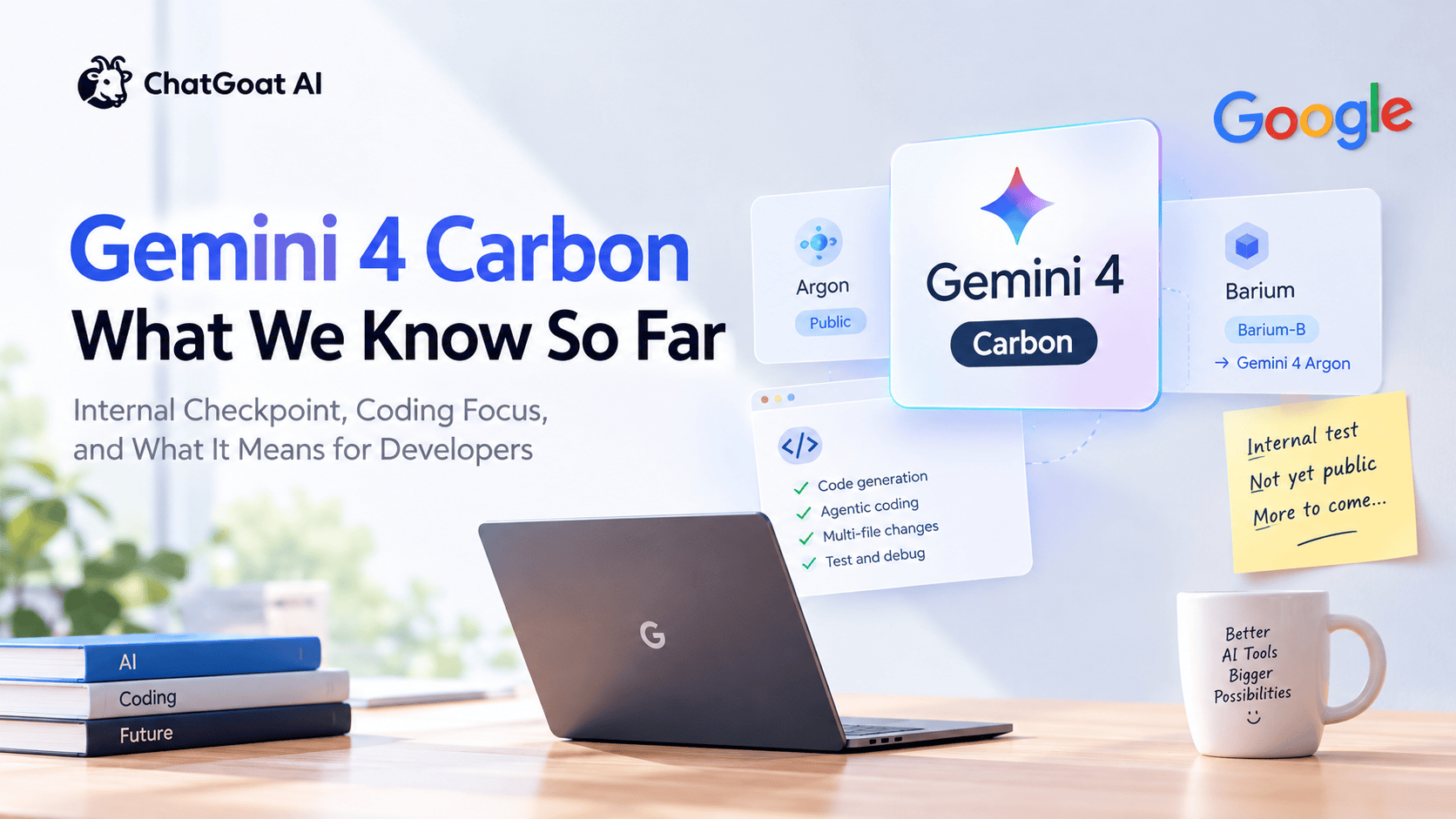
- Carbon may be related to Argon, but the relationship is unconfirmed. Google has reportedly used internal codenames including Argon, Barium, and Carbon.
- Reddit users are split between excitement and skepticism. Many want broader access, while others caution against treating internal checkpoints as finished products.
- The best preparation is model portability. Teams should be able to swap models without rewriting their entire application, prompt library, or agent workflow.
- ChatGOAT AI supports multiple language models, including Google models today and Gemini 4 Carbon when it becomes publicly available.

What Is Gemini 4 Carbon?
Gemini 4 Carbon appears to be an internal development checkpoint rather than a consumer-facing model. According to Business Insider’s reporting, Google employees recently gained access to Carbon through Jetski, Google’s internal coding platform, where they tested it for software-engineering and agent-style work.
That distinction matters. A checkpoint is a version of a model produced during training and evaluation. It may become a public release, be folded into another model, receive a different commercial name, or never ship at all. Google has not officially announced Carbon, so claims about its capabilities should be treated as early signals rather than confirmed specifications.
What Is Reportedly Known
| Item | Current status |
|---|---|
| Internal testing | Reported: Google employees have tested Carbon through Jetski. |
| Coding focus | Reported: Early feedback centers on long-running, agentic coding tasks. |
| “Feels like Claude Opus 5.5” | Reported as one employee’s subjective impression, with that person noting more testing was needed. |
| Public release date | Unconfirmed. |
| Public API | Unconfirmed. |
| Pricing | Unconfirmed. |
| Public benchmarks | Unconfirmed. |
| Final public name | Unconfirmed. |
Carbon, Argon, and Barium: How the Names Fit Together
Google reportedly uses element-themed codenames for Gemini 4 development paths, including Argon, Barium, and Carbon. The public Gemini 4 Argon model has been linked to the internal Barium-B checkpoint, which shows why an internal codename should not be assumed to become the public product name.
A useful way to think about it:
textGoogle internal Gemini 4 development
├── Argon
├── Barium
│   └── Barium-B ──> Public Gemini 4 Argon
└── Carbon ──> Internal testing reported; public fate unknown
Carbon may eventually become an Argon upgrade, a separate Gemini 4 tier, or an internal-only checkpoint. Until Google says otherwise, any stronger claim is speculation.
What “Feels Like Claude Opus 5.5” Actually Means
The most viral claim around Carbon is that an employee said it felt like Claude Opus 5.5 for coding. That is meaningful context, but it is not proof that Carbon outperforms Claude. The reported comment concerned long-duration agentic coding, and the employee reportedly said the model still needed further evaluation.
For engineering teams, “feels like Opus 5.5” should trigger a testing plan, not a migration decision. A credible evaluation should measure:
- Multi-file change accuracy
- Test-generation and test-repair quality
- Ability to follow repository conventions
- Tool-use reliability across terminals, Git, CI systems, and documentation
- Recovery after partial failures in long agent runs
- Latency, token cost, and human-review time
- Safety behavior around destructive commands and sensitive data
A single anecdote can indicate promise. It cannot replace controlled evaluation on your own codebase.
What Reddit Is Saying About Gemini 4 Carbon
Reddit discussion adds useful context because it captures the concerns of developers and AI enthusiasts who are watching the rollout closely.
In r/GeminiAI, users discussing the Carbon leak focused on whether it is an upgraded Argon checkpoint or a separate model tier, and emphasized that the reported feedback is mainly about programming and agent-driven coding rather than general chat.
Other threads show a more skeptical mood. In r/singularity, one discussion about excitement for Carbon included concerns that Argon had produced too many hallucinations for some users, alongside frustration that advanced internal models may arrive long before ordinary users can access them.
A separate r/GeminiAI thread questioned why Google is reportedly testing Carbon while Pro users are still waiting for broader access to Argon. Commenters also noted that internal testing does not necessarily mean imminent public availability.
Another discussion made a more technical point: later checkpoints often improve because they receive additional training and evaluation, but they cannot be released publicly until they pass the necessary testing and assessment. That is a reasonable explanation for why internal models can appear ahead of public releases without indicating an immediate launch.
The Balanced Reddit Takeaway
Reddit’s overall mood is neither pure hype nor dismissal:
- Optimists see Carbon as evidence that Google is aggressively closing the coding-agent gap.
- Skeptics warn that internal access, vague comparisons, and unnamed checkpoints do not equal a shipping product.
- Practitioners want something more useful than rumors: stable APIs, transparent benchmarks, predictable pricing, and reliable agent behavior.
That last group is the audience ChatGOAT AI serves best.
Gemini 4 Carbon vs Gemini 4 Argon
Argon is the model with public information; Carbon is still mostly an internal-development story. Treat the following as a snapshot of confirmed versus unconfirmed details, not a performance verdict.
| Dimension | Gemini 4 Argon | Gemini 4 Carbon |
|---|---|---|
| Availability | Publicly announced | Reported internal testing only |
| API access | Available through Google’s published model offerings | Not confirmed |
| Pricing | Public pricing information exists for Argon | Not confirmed |
| Benchmarks | Public benchmark information has been discussed for Argon | No verified public Carbon benchmarks |
| Internal codename link | Associated with Barium-B in reporting | Relationship to Argon not confirmed |
| Coding reputation | Established public model | Early employee feedback suggests strong agentic-coding potential |
| Best current decision | Evaluate against your real workloads | Monitor; prepare an evaluation plan |
Do not assume Carbon will inherit Argon’s price, context window, latency profile, or benchmark results. Those attributes must be confirmed independently if Carbon ships.
Why Agentic Coding Is the Real Battleground
The Carbon story is less about a single chat answer and more about whether a model can complete engineering work over many steps. Modern coding agents must plan, inspect a repository, edit files, run tests, diagnose failures, use tools, and know when to ask a human for help.
That is why the reported Jetski testing matters. Jetski is described as an internal coding platform, and the reported feedback specifically concerns extended agentic coding rather than simple autocomplete.
The practical implication is that teams should stop judging models only by isolated code-generation prompts. A model that writes a neat function may still fail at a real task involving legacy code, hidden dependencies, flaky tests, deployment constraints, and ambiguous requirements.
How ChatGOAT AI Prepares You for Carbon
ChatGOAT AI is built for a multi-model world. Instead of locking your product or workflow to one provider, ChatGOAT lets you use different language models such as GPT 6 Astra, GPT 6.1 Sol, and so on for different jobs - and it is prepared to support Gemini 4 Carbon once Google releases it publicly.
That matters because no single model will win every task:
- Complex planning and architecture: Use the strongest reasoning or agentic coding model available.
- Fast iteration: Use a lower-latency model for drafts, summaries, classification, and lightweight refactors.
- Cost-sensitive workloads: Route bulk tasks to efficient models.
- High-stakes code changes: Use a premium model with stronger review, testing, and tool-use behavior.
- Vendor resilience: Keep the ability to switch providers if pricing, availability, or quality changes.
With ChatGOAT, your prompts, workflows, evaluation data, and agent logic remain portable. When Carbon becomes available, you can add it to the same evaluation pipeline rather than rebuilding your stack around a rumor.

A Practical Rollout Plan
- Define real tasks. Select 20-50 recurring engineering tasks from your own repositories.
- Create measurable success criteria. Include passing tests, review quality, task completion, cost, and latency.
- Run models side by side. Compare current Gemini, Claude, OpenAI, and other supported models under identical conditions.
- Add Carbon when available. Insert it into the same benchmark without changing the task set.
- Route by task type. Use the best model for complex work and efficient models for routine work.
- Keep a fallback model. Preserve continuity if a model is rate-limited, deprecated, or unavailable.
Should You Wait for Gemini 4 Carbon?
For most teams, no. Carbon is interesting, but it has no confirmed public release date, API, price, benchmark suite, or final name. Waiting for an unannounced checkpoint would delay product work without a clear payoff.
Instead, build the infrastructure that lets you adopt Carbon quickly if it proves valuable:
- Keep prompts and agent workflows model-agnostic.
- Store evaluation results by model, task, and version.
- Separate model routing from business logic.
- Track cost, latency, quality, and failure modes.
- Test new models on private, representative workloads before production rollout.
The teams that benefit most from new frontier models are not necessarily the first to hear about them. They are the teams that can evaluate and deploy them safely within days.
Conclusion
Gemini 4 Carbon is one of the more interesting recent Gemini developments because the reported testing focuses on agentic coding—the area where AI assistance can create the most engineering value. Still, the public evidence remains limited: Carbon is reportedly an internal checkpoint, its relationship to Argon is unconfirmed, and Google has not announced a release, API, price, or benchmark result.
Reddit reflects a healthy mix of anticipation and skepticism: people want better coding agents, but they also want transparency, access, and proof beyond internal impressions.
ChatGOAT AI’s position is simple: prepare for Carbon, but do not depend on it. Use a multi-model platform that can evaluate Gemini, Claude, OpenAI, and other leading models today - and add Gemini 4 Carbon to the same workflow the moment it becomes publicly available.
FAQ
Is Gemini 4 Carbon officially released?
No. Carbon is reportedly an internal Google checkpoint tested by employees on Jetski. Google has not announced a public release, API, pricing, or final product name.
Is Gemini 4 Carbon better than Claude Opus 5.5?
That has not been proven. One Google employee reportedly said Carbon felt like Claude Opus 5.5 for long agentic coding tasks, but this is a subjective impression rather than a public benchmark result.
Is Carbon an upgrade to Gemini 4 Argon?
Possibly, but it is unconfirmed. Reporting suggests Carbon may be a newer internal checkpoint, while Argon has been linked to the internal Barium-B checkpoint. Google has not confirmed Carbon’s final relationship to Argon.
When will Gemini 4 Carbon be released?
There is no confirmed release date. Any specific launch date currently circulating online is speculation.
Will Gemini 4 Carbon have an API?
No API, pricing, rate limits, or model documentation have been confirmed. Developers should wait for an official Google announcement before planning production integration.
What are Reddit users saying about Carbon?
Reddit discussions range from excitement about Google improving agentic coding to frustration over limited access and skepticism about internal checkpoints. Many users also caution that an internal model may never reach the public in its current form.
How can developers prepare for Carbon?
Build a model-agnostic evaluation and routing workflow now. Test models on your own repositories, measure quality and cost, and retain the ability to swap providers. ChatGOAT AI supports multiple models and can incorporate Carbon once it is publicly available.
Can ChatGOAT AI use Gemini 4 Carbon?
Yes - once Google makes Carbon publicly available through an official API or supported interface, ChatGOAT AI can add it as one of the selectable language models in your workflow. Until then, ChatGOAT supports multiple current models so teams can avoid vendor lock-in.

