
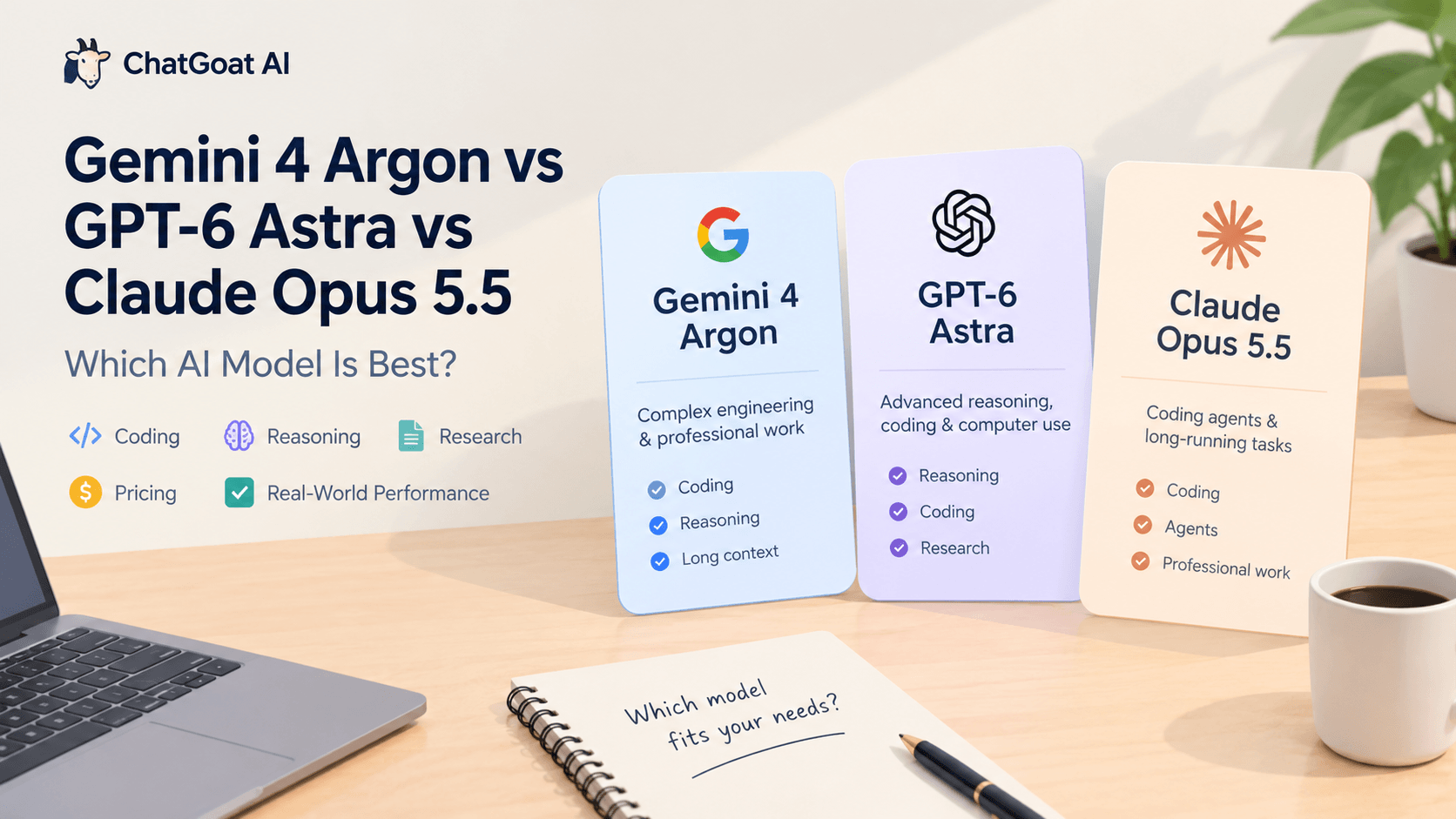
The competition between Gemini 4 Argon, GPT-6 Astra, and Claude Opus 5.5 highlights an important shift in artificial intelligence. Today's leading models are no longer judged only by how well they answer questions. Developers, researchers, and everyday users also want AI that can solve complex problems, understand large projects, write reliable code, analyze documents, and complete multi-step tasks with less supervision.
Each model has a different set of strengths. Google positions Gemini 4 Argon around complex engineering, professional knowledge work, and cybersecurity defense. OpenAI presents GPT-6 Astra as a model for demanding reasoning, coding, research, and computer-use tasks. Anthropic emphasizes Claude Opus 5.5's capabilities in software engineering, long-running agents, and professional work.
But which model should you choose? Is Gemini 4 Argon actually better at coding? Does GPT-6 Astra justify its higher API price? Can Claude Opus 5.5 complete complicated projects with fewer instructions?
This comparison examines official benchmark results, pricing, availability, practical use cases, and discussions from Reddit. It also explains how to evaluate these models for real work and explore AI-powered workflows through ChatGOAT AI.

Quick Verdict: Gemini 4 Argon vs GPT-6 Astra vs Claude Opus 5.5
There is no single winner for every task. The best choice depends on the work you need to complete, your budget, and whether you can access the model through your preferred platform.
| Comparison | Gemini 4 Argon | GPT-6 Astra | Claude Opus 5.5 |
|---|---|---|---|
| Primary positioning | Complex engineering and professional workflows | Advanced reasoning, coding, research, and computer use | Coding agents and long-running professional tasks |
| Coding | Strong results on selected software engineering benchmarks | Strong across reasoning-intensive coding and technical tasks | Designed for complex coding and agent workflows |
| Reasoning | Designed for complex, multi-step problem solving | Built for demanding reasoning and professional work | Strong at complex instructions and sustained work |
| Long-context work | Up to 1 million output tokens announced | 1.05 million-token context window | Long-running agent workflows and large projects |
| Standard API input price | $2 per million tokens | $10 per million tokens | $4 per million tokens |
| Standard API output price | $10 per million tokens | $50 per million tokens | $20 per million tokens |
| Availability | Initially restricted to trusted cyber defenders | Available through OpenAI's supported products and API | Available through supported Claude and developer platforms |
These models should not be ranked using price or one benchmark alone. A model that costs less per token may need more retries to finish a task, while a model with an impressive benchmark score may not be accessible to the average user.
The practical takeaway: Compare the quality of the final result, the time required, the number of corrections, and the actual cost of completing your task.
Gemini 4 Argon: Built for Complex Engineering and Knowledge Work
Google announced Gemini 4 Argon on September 30, 2026, positioning it as a frontier model for real-world software engineering, enterprise knowledge work, and cybersecurity defense.
Unlike a model designed primarily for everyday conversations, Argon is presented as a system capable of handling long, interconnected tasks. These may involve examining extensive technical information, identifying problems, planning a sequence of actions, and producing a final result.
Key strengths
Complex software engineering
Argon has shown strong results on selected software engineering benchmarks. Google's announcement emphasizes long-horizon engineering tasks, where an AI system must maintain context while working through a complicated problem.
Potential applications include reviewing a large codebase, identifying the source of a bug, planning a migration, and evaluating whether proposed changes solve the original problem.
Professional research and document analysis
Google also highlights legal, financial, and other enterprise knowledge work. This makes document-heavy tasks an important area to evaluate, particularly when the model must connect information across several files.
For example, a business analyst could use an AI workflow to summarize reports, extract financial figures, compare assumptions, and prepare a structured briefing for human review.
Long-form output
Google announced a maximum output limit of up to one million tokens for Argon. This is an output allowance, not the same thing as a context window. The distinction matters when comparing models because the amount of information a model can receive and the amount it can generate are different capabilities.
What are the limitations?
The biggest practical limitation is access. At announcement, Google was rolling Argon out to trusted cybersecurity defenders through its Fairwind Program, with wider availability planned for a later stage.
That means the published results should not automatically be treated as independently reproducible by ordinary users.
A high benchmark score also does not establish that Argon will outperform other models on every programming language, research task, or real-world project.
GPT-6 Astra: Advanced Reasoning, Coding, and Computer Use
OpenAI describes GPT-6 Astra as its model for demanding professional tasks, including complex reasoning, software development, research, document creation, and computer use.
Its value is not limited to producing a good answer in a single exchange. For suitable workflows, the goal is to reason through a problem, use available tools, and work toward a clearly defined result.
Key strengths
Advanced reasoning
GPT-6 Astra is intended for problems that require more than retrieving a fact or generating a short response. It can be evaluated on mathematical reasoning, planning, complex technical questions, and tasks involving multiple constraints.
For example, a product manager could ask it to compare competing product strategies, identify risks, build a decision framework, and produce an implementation plan.
Software development and debugging
Astra can help developers generate code, inspect existing implementations, diagnose errors, and work through more complicated engineering tasks.
Useful tests include debugging an unfamiliar project, modifying multiple files, generating unit tests, and verifying whether the final implementation satisfies the requirements.
Computer-use and agent workflows
OpenAI also documents capabilities related to computer use. However, actual automation depends on the tools, permissions, and safeguards provided by the environment in which the model runs.
A model's ability to plan a task does not mean every chat interface automatically allows it to browse websites, operate applications, or execute code.
What are the limitations?
GPT-6 Astra has a higher standard API token price than the other two models in this comparison. Its published rates are $10 per million input tokens and $50 per million output tokens, before applicable caching, tool, and other charges.
For users running many long conversations or large automated workflows, costs can add up quickly.
The model should therefore be evaluated on the quality of completed work, not just its raw intelligence. If a less expensive alternative produces equally reliable results for a routine task, paying for the more expensive model may not be necessary.
Claude Opus 5.5: Coding Agents and Long-Running Tasks
Claude Opus 5.5 is positioned around demanding software engineering, long-running agent workflows, and professional work. Its appeal to many developers is the possibility of delegating a complicated task while maintaining the original requirements throughout the process.
This is particularly important when a project involves several files, multiple dependencies, or a long sequence of decisions.
Key strengths
Codebase understanding
A useful coding model must understand how different parts of a project interact. It should be able to identify the cause of a bug, determine which files need changes, and avoid introducing regressions elsewhere.
Claude Opus 5.5 is a strong candidate to evaluate for these workflows, especially when the task requires sustained attention to a project's structure and requirements.
Complex instructions and writing
Many professional tasks involve detailed instructions that cannot be reduced to a single question. A user may specify an audience, tone, technical constraints, formatting rules, and a list of required deliverables.
Claude can be evaluated on how well it follows those constraints, maintains consistency, and produces work that needs minimal editing.
Long-running agent workflows
For development teams, an AI agent may need to inspect a project, make changes, run tests, interpret errors, and revise its implementation.
The number of steps completed successfully is often more meaningful than the quality of the first response.
What are the limitations?
A capable model can still overcomplicate a task, make incorrect assumptions, or consume substantial usage allowances during a long session.
Access limits and subscription rules also matter. Community discussions frequently mention usage limits, even when users are satisfied with the model's quality.
Claude Opus 5.5's published standard API rates are $4 per million input tokens and $20 per million output tokens. These are lower than Astra's standard rates, although actual cost depends on usage patterns, caching, and additional services.
What Do the Benchmarks Actually Tell Us?
Benchmark scores are useful for understanding model capabilities, but they do not tell the whole story.
Different tests measure different skills. A model that performs well on a long software engineering benchmark may not be the best choice for factual research, writing, or visual analysis.
Google's Argon announcement and the published GPT-6 Astra evaluation results provide several useful points of comparison.
Selected coding benchmark results
| Benchmark | Gemini 4 Argon | GPT-6 Astra | Claude Opus 5.5 |
|---|---|---|---|
| DeepSWE v1.1 | Approximately 78% | 74.1% | Approximately 74% |
| FrontierSWE v2 | See Google's published evaluation | Reported advantage in available comparisons | See Google's published evaluation |
| Terminal-Bench 4.0 | See Google's published evaluation | 57.9% in OpenAI's published results | Different evaluation results may apply |
Important: These figures should be treated as reported results, not as a fully controlled independent comparison. Results can differ by model version, testing harness, tool access, reasoning settings, and evaluation date. Where the original sources do not establish a directly comparable figure, the table deliberately avoids inventing one.
The available results also illustrate why a universal ranking is misleading. Argon has been reported to lead on DeepSWE v1.1, while Astra and Opus can perform differently on other software engineering evaluations.
A better approach is to ask which benchmark resembles your actual workload.
- For code maintenance, prioritize real repository tasks and test pass rates.
- For research, measure factual accuracy and whether citations support the claims.
- For agent workflows, measure end-to-end completion and recovery from errors.
- For business writing, evaluate accuracy, instruction following, and editing time.
The benchmark is a starting point. Your own task is the final test.
What Are Reddit Users Saying About These Models?
Reddit provides a different perspective from official announcements. Users discuss the parts of model performance they notice during everyday work, including code quality, creativity, speed, usage limits, and the amount of guidance a model needs.
These discussions are useful evidence of user priorities, but they are anecdotal. A post does not establish that one model is objectively better for every user.
Gemini 4 Argon: Impressive scores, but access remains a concern
In the r/singularity discussion of Gemini 4 Argon benchmarks, users discussed Google's reported results across coding, cybersecurity, and professional tasks.
One recurring question was whether the model's performance would translate into practical benefits and when broader access would become available.
This creates a useful distinction for a comparison article: benchmark leadership is not the same as everyday usefulness. Users need a way to test the model on their own tasks before deciding whether it is worth adopting.
GPT-6 Astra vs Claude Opus 5.5: Quality, speed, and usage limits
The r/ClaudeAI discussion comparing Opus 5.5 with GPT-6 Astra illustrates how quickly community preferences can change between model releases.
Participants described different experiences with the models. Some preferred Astra, while others praised Opus 5.5's capabilities but criticized the amount of guidance they sometimes needed to provide.
The broader lesson is that model quality depends partly on the task and the user's workflow. A model that performs well for one developer may be less suitable for another project's requirements.
Usage limits are another concern. In a Reddit discussion about choosing between Opus 5.5 and Astra, a user raised questions about running out of usage and whether switching subscriptions would offer better value.
For frequent users, the cost of sustained work can matter as much as the quality of individual responses.
A simple creative task can produce different results
In a Reddit comparison of Opus 5.5, GPT-6 Astra, and other models, users discussed giving several models the same prompt to create a short paper-airplane animation.
The responses reflected different preferences: some users favored the animation quality, while others preferred the interpretation or creative direction of a different model.
This is a useful reminder that model comparisons are not limited to coding and reasoning. For creative work, output quality can be subjective, and the most appropriate model depends on the result the user wants.
What can we learn from the discussions?
Across these threads, four themes stand out:
- Real-world performance matters more than a headline score. Users want models that solve their specific problems.
- Instruction following affects productivity. A strong model is more useful when it understands constraints without repeated clarification.
- Usage limits affect the overall experience. High-quality results are less valuable if users cannot sustain their workflow.
- Different tasks reward different strengths. Creative output, coding, research, and automation should not be evaluated using the same criteria.
These observations should inform the tests in this article, rather than replace them.
How to Compare the Three Models in Real-World Tasks
The most useful comparison would give all three models the same task, the same input materials, and the same evaluation criteria.
If all three models are available to you, the following tests can help determine which one fits your workflow.
Test 1: Coding and debugging
Give each model the same small codebase containing a reproducible bug. Ask it to identify the problem, implement a fix, write tests, and explain the changes.
Measure:
- Whether the original bug is fixed
- Whether existing tests still pass
- Whether new bugs are introduced
- How many follow-up prompts are needed
- Total time and token usage
A model that produces a plausible explanation but fails the tests should not be considered the winner.
Test 2: Research and document analysis
Provide the same set of reports, tables, and source documents. Ask each model to summarize the evidence, extract important figures, identify contradictions, and prepare a short report with references.
Measure factual accuracy, citation quality, coverage of important information, and the amount of manual correction required.
This test is especially useful for analysts, students, consultants, and content teams.
Test 3: Multi-step project execution
Give each model a task that requires several deliverables, such as analyzing a product idea, developing a project plan, creating a task table, and preparing a final report.
Evaluate whether it follows the required sequence, maintains consistency between deliverables, and checks the final result.
If the environment provides tools, record whether the model uses them correctly. Keep model intelligence separate from the capabilities of the platform that runs it.
Test 4: Writing and instruction following
Provide a detailed writing brief with a target audience, tone, required points, length, and restrictions.
Compare the results for factual accuracy, readability, structure, originality, and compliance with the brief.
For marketing teams, this can reveal which model produces usable first drafts and which requires more editing.
Use a consistent scoring framework
A simple 100-point evaluation can make results easier to compare.
| Criterion | Suggested weight |
|---|---|
| Accuracy and correctness | 30 |
| Task completion | 25 |
| Instruction following | 15 |
| Output quality | 15 |
| Speed and efficiency | 10 |
| Cost | 5 |
| Total | 100 |
The weights should change according to the task. For example, coding tests should place more emphasis on working code and passing tests, while research tests should prioritize factual accuracy and source quality.
Do not publish a score as an independent test unless you have actually run the experiment. If access to Argon is restricted, use a clearly labeled comparison of published results and reserve the independent test section for models you can genuinely evaluate.
Pricing Comparison: Which Model Offers Better Value?
The standard API rates published for these models provide a useful starting point.
| Model | Input per 1M tokens | Output per 1M tokens |
|---|---|---|
| Gemini 4 Argon | $2 | $10 |
| GPT-6 Astra | $10 | $50 |
| Claude Opus 5.5 | $4 | $20 |
At these published standard rates, Argon has the lowest listed token price, followed by Opus 5.5 and Astra. However, this does not automatically make Argon the cheapest practical option for every user, especially while access remains restricted.
Example: A task using 100,000 input tokens and 20,000 output tokens
Assuming the published rates apply, with no caching discounts, tool fees, or other charges:
- Gemini 4 Argon: $0.20 input + $0.20 output = $0.40
- GPT-6 Astra: $1.00 input + $1.00 output = $2.00
- Claude Opus 5.5: $0.40 input + $0.40 output = $0.80
This is a token-cost example, not a claim that the models use the same number of tokens to finish the same task.
For a fairer comparison, calculate the cost of producing one successful result. If one model needs five retries and another completes the task in one attempt, their effective costs may differ significantly from the standard token-price ratio.
Subscription plans also have their own pricing, limits, and usage rules. Do not compare API prices directly with subscription fees as though they were equivalent.
Which AI Model Is Best for Your Needs?
The right model depends on what you do, how often you use AI, and what a successful result looks like.
For software developers
Consider testing GPT-6 Astra and Claude Opus 5.5 on your actual codebase. Both are positioned for demanding engineering work, but their relative performance will depend on your language, tools, and project complexity.
Gemini 4 Argon is also worth watching for its reported software engineering results, subject to access and independent verification.
For researchers and analysts
Prioritize accurate information extraction, reliable citations, long-document handling, and the ability to distinguish facts from assumptions.
For work involving large collections of files, test whether the model can find relevant details without overlooking contradictory evidence.
For content creators and marketers
Compare how well each model follows a content brief, maintains a consistent tone, organizes information, and produces drafts that need minimal editing.
A practical workflow might include keyword research, outlining, drafting, fact-checking, and adapting content for different audiences. Human review remains essential, especially for factual claims and SEO content.
For business users
Focus on task completion, document analysis, spreadsheet workflows, reporting, and the reliability of outputs.
For recurring tasks, even a small reduction in manual review time can matter more than a modest improvement in benchmark scores.
For budget-conscious users
Compare the actual cost of completing your common tasks rather than selecting a model based on its advertised intelligence alone.
If a less expensive model consistently meets your requirements, it may be the better everyday option. Reserve more expensive models for work where their additional capabilities make a measurable difference.
How to Explore AI Models and Complete Tasks on ChatGOAT AI
Comparing models is useful, but the real benefit of AI comes from applying it to your own work.
ChatGOAT AI provides an AI workspace for supported models and tools, helping users explore AI-assisted writing, research, analysis, and creative workflows without treating every task as a separate experiment.
Where Gemini 4 Argon, GPT-6 Astra, and Claude Opus 5.5 are enabled in the current ChatGOAT model selector, users can explore their responses within the platform and evaluate which approach works best for their needs. Availability can vary by model and integration, so check the live model list before starting.
What can you do with AI on ChatGOAT AI?
Use AI to brainstorm article ideas, build outlines, draft blog posts, rewrite paragraphs, summarize long materials, or adapt content for different audiences.
For example, an SEO specialist can develop a blog outline, draft a comparison article, prepare FAQ answers, and revise the content for clarity and search intent.
Analyze information and documents
AI can help extract key points from provided materials, compare reports, organize research findings, and turn unstructured notes into a clearer summary.
For example, a business user can turn meeting notes into an action plan, create a comparison table, and prepare a concise executive summary.
Create structured tables and project plans
Use AI to organize product comparisons, prepare task lists, build research matrices, and create structured project plans.
A marketing team could use this workflow to compare competitor features, map keywords to landing pages, and organize a content calendar.
Support coding and problem-solving
For supported coding workflows, AI can explain unfamiliar code, suggest debugging steps, draft functions, and help organize technical documentation.
Always test generated code and review changes before using them in production.
ChatGOAT AI also provides AI image-generation capabilities through its supported image tools and models. These can help users create illustrations, visual concepts, social media graphics, and other creative assets.
Image generation is a separate capability from text-model reasoning. Do not assume that every model in this comparison can generate images directly just because the workspace includes image tools.
Build a more efficient workflow
Instead of treating every task as an isolated prompt, users can break a project into steps: research, planning, drafting, checking, and final delivery.
The most useful workflow is the one that produces accurate results with less repetitive work, not necessarily the one that uses the most advanced model for every step.
Explore ChatGOAT AI to see the currently supported models and AI tools available for your workflow.
FAQ
Is Gemini 4 Argon better than GPT-6 Astra?
Not in every situation. Google has reported strong results for Argon on selected engineering and professional-work benchmarks, while OpenAI publishes strong results for Astra on several demanding evaluations. Access restrictions and differences in testing methods make a universal ranking premature.
Is Claude Opus 5.5 better than GPT-6 Astra for coding?
Both are designed for demanding software engineering tasks. The better option depends on the codebase, programming language, available tools, and the quality of the final implementation. Compare test pass rates, regression risks, iteration counts, and total cost on the same task.
Which model is best for complex reasoning?
GPT-6 Astra and Gemini 4 Argon are both positioned for complex reasoning and multi-step work, while Claude Opus 5.5 is designed for demanding professional and agent workflows. Use task-specific tests to determine which model performs best for your needs.
Which model is the cheapest?
Based on the standard published API rates listed above, Gemini 4 Argon has the lowest token price, followed by Claude Opus 5.5 and GPT-6 Astra. However, Argon's restricted availability affects whether most users can actually use that pricing. Total task cost also depends on token usage, retries, caching, and tools.
Can I use Gemini 4 Argon right now?
Google initially announced Argon for trusted cybersecurity defenders through the Fairwind Program, with broader access planned. Check Google's latest official announcement for changes to availability before relying on it for a project.
Can I compare these models on ChatGOAT AI?
You can explore models and tools supported by the current ChatGOAT AI workspace. To compare all three directly, verify that Gemini 4 Argon, GPT-6 Astra, and Claude Opus 5.5 are each available in the current model selector. If one is unavailable, compare its published documentation with hands-on results from accessible models instead.
Which model is best for everyday work?
There is no universal answer. Consider the tasks you perform most often, how accurate the results need to be, the amount of editing required, your budget, and the usage limits of your preferred platform. Testing a few representative tasks is more useful than choosing solely by reputation.
Final Verdict: Choose the Model that Completes Your Work Best
Gemini 4 Argon, GPT-6 Astra, and Claude Opus 5.5 represent different approaches to advanced AI assistance. Argon has reported strengths in selected engineering and professional-work evaluations, Astra targets demanding reasoning and computer-use tasks, and Opus 5.5 focuses on coding agents and long-running professional workflows.
The best model is not necessarily the one with the highest score or the most expensive API. It is the one that reliably completes your tasks, follows your instructions, fits your budget, and requires the least unnecessary intervention.
Use official benchmarks to narrow your options, Reddit discussions to understand the questions real users are asking, and consistent hands-on tests to make the final decision.
With ChatGOAT AI, you can explore supported AI models and tools for writing, research, analysis, and creative work in one workspace. Start with a task you actually need to complete, compare the quality of the results, and choose the workflow that makes your work easier.

