
Key Takeaways
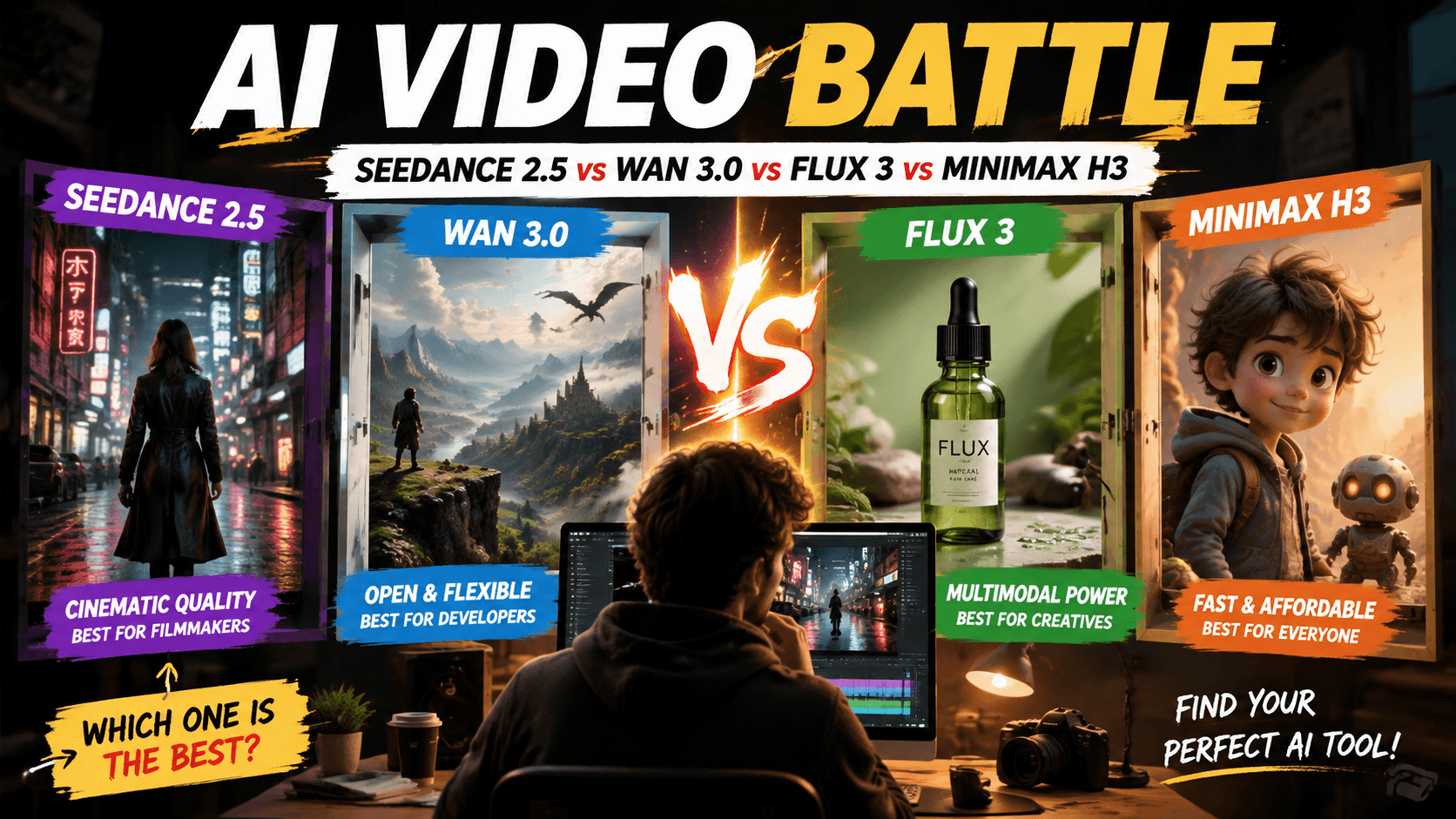
- Wan 3.0 is the most flexible and customizable option, making it the top pick for developers and technical creators.
- Seedance 2.5 leads in cinematic quality, camera movement, and long-shot consistency - best for filmmakers and ad creators.
- MiniMax H3 is the fastest and most budget-friendly, ideal for high-volume social media content.
- FLUX 3 blends image and video generation into one workflow, which is why design agencies gravitate toward it.
- No single model wins every category - the "best" AI video generator depends entirely on what you're making and who it's for.
- Character consistency across frames is still the biggest gap between these tools, and it's where the real differences show up.
- Pricing should be judged by output-per-dollar, not sticker price alone.
AI video generation has gone through a genuine leap over the last year. What used to be three-second clips with warped hands and flickering backgrounds has turned into scenes with believable camera pans, consistent characters, and lighting that actually matches the mood of a shot. Creators now have real choices, not just one or two usable tools.
That's also what makes picking a model harder. Seedance 2.5, WAN 3.0, FLUX 3, and MiniMax H3 all claim to be the best AI video generator on the market, and technically, each of them is the best - at something specific. This comparison looks at video quality, motion realism, character consistency, prompt accuracy, pricing, and real production use cases, so you can match the model to the job instead of guessing.
Quick Winner Summary
| Category | Winner | Why |
|---|---|---|
| Best Overall Video Quality | Seedance 2.5 | Strongest cinematic detail and lighting realism |
| Best Cinematic Generation | Seedance 2.5 | Camera movement and shot composition feel director-made |
| Best Open Model | WAN 3.0 | Deepest customization and developer control |
| Best Multimodal Workflow | FLUX 3 | Seamless image-to-video pipeline for design teams |
| Best Budget Choice | MiniMax H3 | Lowest cost per generation with solid output |
| Best for Social Media | MiniMax H3 | Fast turnaround built for short-form content |
| Best for Professional Content | Seedance 2.5 | Consistent quality across longer, branded videos |
AI Video Model Comparison Table
| Feature | Seedance 2.5 | WAN 3.0 | FLUX 3 | MiniMax H3 |
|---|---|---|---|---|
| Main purpose | Cinematic video creation | Flexible, developer-driven generation | Multimodal image + video design | Fast, affordable content generation |
| Video quality | Excellent | Very good | Good to very good | Good |
| Motion realism | Excellent | Good | Moderate | Moderate |
| Character consistency | Strong across shots | Moderate, needs tuning | Strong within a scene | Moderate |
| Image-to-video | Strong | Strong | Excellent | Good |
| Text-to-video | Strong | Strong | Good | Strong |
| Camera control | Advanced | Advanced (manual) | Basic to moderate | Basic |
| Audio capability | Built-in sync options | Limited, plugin-based | Limited | Basic |
| Speed | Moderate | Moderate to slow | Moderate | Fast |
| Pricing/value | Mid-to-premium | Free/open, technical cost | Mid-range | Budget-friendly |
| Best users | Filmmakers, brands | Developers, technical creators | Designers, agencies | Marketers, social creators |
WAN 3.0 Review
WAN 3.0 is built for people who want to get under the hood. It's the most open and customizable of the four, which is exactly why developers and technically-minded creators favor it. You can fine-tune parameters, adjust generation pipelines, and integrate it into custom workflows in ways the more polished, closed tools don't allow.
That flexibility comes with a learning curve. Out of the box, WAN 3.0's results are good but not always as clean as Seedance 2.5's — character consistency in particular needs manual tuning to get right. But for a developer building a product on top of AI video, or a studio that wants full control over the pipeline, that trade is worth it.
Who should use WAN 3.0:
- Developers building AI video into an app or product
- Technical creators who want to fine-tune output
- Teams that need an open ecosystem rather than a closed tool
Advantages: deep customization, active open community, strong text-to-video baseline.
Limitations: steeper setup, less "plug and play" polish, inconsistent results without tuning.
Seedance 2.5 Review
Seedance 2.5 is the model people reach for when the video actually needs to look like a video - not a slideshow of AI frames stitched together. Its biggest strength is camera movement. Pans, dolly-ins, and tracking shots hold together instead of warping halfway through, which is where a lot of older tools fall apart.
What stands out most is long-shot consistency. A character's face, outfit, and even lighting stay stable for several seconds at a time, which matters enormously for storytelling. Motion also reads as physically real - walking, turning, and hand gestures don't have that rubbery AI look.
Best use cases:
- Short films and narrative scenes
- Advertisements and branded video
- Product showcase videos
- Cinematic trailers and mood pieces
The trade-off is speed and cost. Seedance 2.5 isn't the fastest or cheapest option, and it's overkill if you just need a quick 10-second social clip.
MiniMax H3 Review
MiniMax H3 is built around one idea: speed without breaking the budget. It generates clips faster than the other three models and costs less per output, which makes it the obvious choice for creators who need volume - think daily social posts, ad variations, or quick marketing clips.
The quality is solid, not flashy. It won't match Seedance 2.5's cinematic polish, but for short-form platforms where attention spans are measured in seconds, that level of polish often isn't necessary anyway.
Strengths: fast generation, low cost per clip, good fit for high-volume content calendars.
Limitations: less camera control, weaker long-shot consistency, not built for cinematic or long-form work.
FLUX 3 Review
FLUX 3 isn't just a video tool - it's a multimodal creative workflow. It started as an image generation model and carried that strength into video, which is why its image-to-video results are so strong. Designers can generate a still, refine the exact visual style they want, then animate it, all inside the same system.
This matters most for agencies and design-led teams that care about a consistent visual identity across a campaign. Instead of jumping between an image tool and a separate video tool, FLUX 3 keeps the look and feel locked in from the first still frame to the final clip.
Where it's weaker is camera control and long-form motion - FLUX 3 is happiest generating shorter, stylistically tight clips rather than complex multi-shot scenes.
Why designers and agencies prefer it: one workflow for both image and video assets, strong style consistency, easier to keep a brand's visual language intact across formats.
Real AI Video Test: Same Prompt Comparison
To see how these models actually behave under identical conditions, we ran the same prompt across all four:
"A cinematic shot of a woman walking through Tokyo streets at night, neon lights reflecting on wet roads, realistic camera movement, movie lighting."
Human realism
Seedance 2.5 produced the most natural face and expression, with believable eye movement and skin texture under neon lighting. WAN 3.0 came close but showed minor inconsistency in facial detail between frames. FLUX 3's still-frame quality was excellent, but motion introduced slight softness around the face. MiniMax H3 handled the overall scene well but simplified facial detail, which is typical for a speed-optimized model.
Motion quality
This is where Seedance 2.5 separated itself. The walking motion, arm swing, and weight shift looked physically grounded, and the camera tracked alongside her smoothly. WAN 3.0's motion was good but occasionally sped up unnaturally for a frame or two. FLUX 3 handled the animation adequately but with less fluid camera movement. MiniMax H3 prioritized a clean, watchable result over precise physics, which works fine for short clips but shows under close inspection.
Scene consistency
Seedance 2.5 again led here - the wet road reflections and neon signage stayed consistent across the shot instead of flickering or shifting. WAN 3.0 held up reasonably well once tuned. FLUX 3 kept the visual style consistent but with more background drift. MiniMax H3 kept the core scene stable but simplified background detail to maintain speed.
Cinematic feeling
Lighting, composition, and mood are where the differences are most visible to the eye. Seedance 2.5's output looked closest to an actual movie still in motion. WAN 3.0 produced a strong result with the right settings. FLUX 3's frame composition was visually striking, closer to a fashion-film aesthetic. MiniMax H3's output was clean and usable, but read more like a stock video clip than a directed shot.
Takeaway: if cinematic realism is the priority, Seedance 2.5 wins clearly. If you need the clip fast and the bar for realism is lower, MiniMax H3 gets the job done for a fraction of the effort and cost.
Seedance 2.5 vs WAN 3.0 vs FLUX 3 vs MiniMax H3: Which One Should You Choose?
For filmmakers: Seedance 2.5. Camera control and long-shot consistency matter most for narrative work, and this is where it clearly leads.
For marketers: MiniMax H3 for volume and speed, or Seedance 2.5 when a single hero video needs to look premium. Most marketing teams end up using both.
For developers: WAN 3.0. The open, customizable pipeline is built for integration, not just one-off generations.
For social media creators: MiniMax H3. Fast turnaround and low cost per clip matter more than cinematic polish when you're posting daily.
For beginners: MiniMax H3 or FLUX 3. Both have simpler workflows than WAN 3.0's technical setup, and forgive imperfect prompts more easily than Seedance 2.5's more demanding cinematic style.
Pricing and Value Comparison
Price alone doesn't tell you much - what matters is cost per usable output. A cheap tool that requires five regenerations to get one usable clip isn't actually cheaper than a premium tool that gets it right the first time.
Seedance 2.5 sits at a mid-to-premium price point, but its first-attempt success rate on complex shots is high, which reduces wasted generations. WAN 3.0 is free or low-cost to run but carries a technical cost - time spent tuning and setting things up. FLUX 3 is mid-range and delivers strong value specifically when you need both image and video assets from one workflow, since you're not paying for two separate tools. MiniMax H3 is the cheapest per generation and the best fit when you're producing high volumes of shorter content where perfect realism isn't the goal.
The real question to ask isn't "which is cheapest" but "which gets me a finished, usable video in the fewest attempts for what I'm making."
How ChatGOAT AI Helps Creators Experiment With AI Models
Most creators don't settle on one AI video model forever - the right tool changes depending on the project. A filmmaker might want Seedance 2.5's cinematic quality for a brand film, then need something faster like MiniMax H3 for the social cutdowns that promote it. A developer might rely on AI agents to automate parts of a workflow while still needing a polished AI video generator for the final output.
This is where a platform like ChatGoat AI fits in. Instead of subscribing to four different tools and relearning four different interfaces, ChatGoat AI brings multiple AI capabilities together - including an AI image generator for concept stills, an AI writing assistant for scripts and captions, and video generation tools - in one place. For creators who are still figuring out which model fits their style, being able to test different approaches without juggling separate accounts makes the whole process faster. You can explore more of what's available on the ChatGoat AI homepage.
FAQ
Is Seedance 2.5 better than WAN 3.0?
It depends on the goal. Seedance 2.5 produces more cinematic, polished results out of the box, while WAN 3.0 offers more flexibility and control for technical users willing to fine-tune their setup.
Which AI video generator has the best quality?
For raw cinematic quality and motion realism, Seedance 2.5 currently leads the comparison, particularly for longer, more complex shots.
Is WAN 3.0 free?
WAN 3.0 is largely open and low-cost to access, though getting the best results often requires technical setup and tuning, which carries its own time cost.
Is FLUX 3 better than Seedance 2.5?
Not for pure video quality, but FLUX 3 wins for teams that need a combined image-and-video workflow with strong visual style consistency.
Which AI video model is best for commercial videos?
Seedance 2.5 for high-production brand videos and ads; MiniMax H3 for high-volume commercial content like social ads and promos.
What is the best AI video generator in 2026?
There isn't one universal answer. Seedance 2.5 leads on cinematic quality, WAN 3.0 leads on flexibility, FLUX 3 leads on multimodal design workflows, and MiniMax H3 leads on speed and affordability. The best choice depends on what you're creating and who it's for.

