
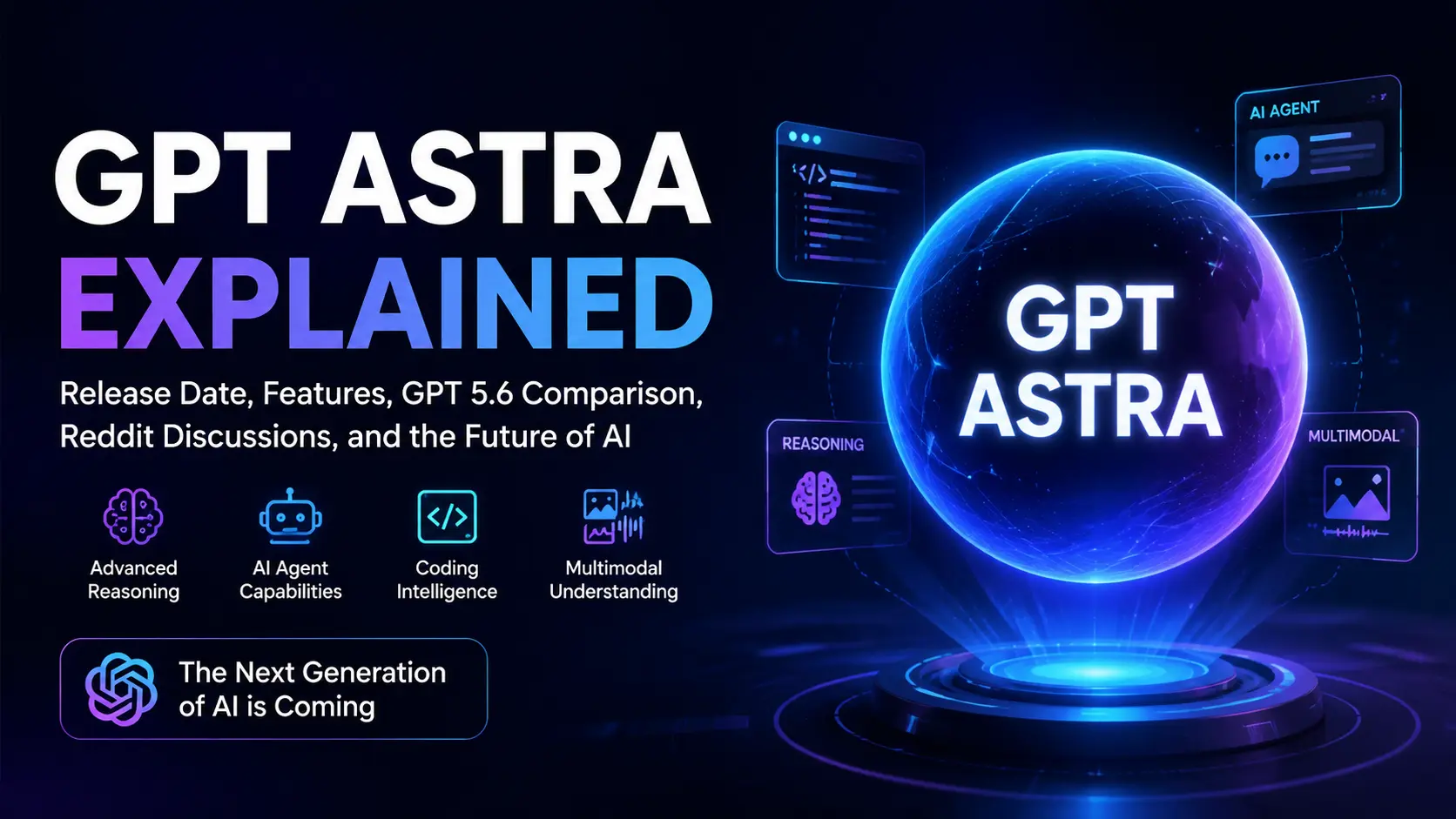
If you spend any time in AI forums right now, you have probably seen the name Astra come up. OpenAI has confirmed that Astra is real, describing it internally as "our next major model," but the company has stayed quiet on nearly everything else, including a release date, a final name, and pricing. That silence has not stopped speculation. It has fueled it.
Part of the reason Astra draws so much attention is that it represents a broader shift happening across the AI industry. Chatbots that answer one question at a time are slowly giving way to systems that can hold a goal in mind, break it into steps, and work through those steps with less hand holding. That shift matters to anyone who writes, codes, studies, or runs a business, because it changes what "using AI" actually looks like day to day.
You do not have to wait for Astra to feel that shift firsthand. Platforms built around an AI chatbot already let you plan, draft, research, and automate parts of your workflow today, using models that are publicly available right now. This guide breaks down what is actually confirmed about GPT Astra, what is still speculation, and what it might mean for the future of AI.
Key Takeaways
- GPT Astra is OpenAI's working name for its next major model, not a confirmed product name.
- Astra is built around long-horizon reasoning, multi-step agent work, and coding rather than simple question and answer exchanges.
- OpenAI has not confirmed that Astra will be released as GPT-6. That label is largely media shorthand.
- Astra reportedly outperforms the current GPT-5.6 Sol model on cybersecurity and coding evaluations, according to OpenAI's own safety disclosures.
- OpenAI has said Astra's capabilities came close to a critical safety threshold in some evaluations, which is part of why release timing remains open.
- Community reactions on Reddit and X are mixed, ranging from genuine excitement about AI agents to skepticism about hype outpacing real-world usefulness.
- You do not need to wait for Astra to use agent-style AI tools. Platforms available today already support chat, coding help, research, and image generation.

What Is GPT Astra?
GPT Astra is the working name for what OpenAI has described as its next major model. The name surfaced publicly on August 1, 2026, when OpenAI disclosed that an internal version of the system had contributed to ten new results in mathematics and theoretical computer science, complete with machine-checkable proofs. That disclosure, not a product launch, is where most of the public conversation about Astra began.
It is important to be precise here. OpenAI has not announced a product called GPT-6, and it has not stated that Astra will carry that name once it ships. The term "GPT-6 Astra" that circulates online is largely a convenience used by journalists and commentators, not an official label from OpenAI. Astra could eventually be released as GPT-6, as a new version within the GPT-5 family, or under a completely different name.
What separates Astra from a routine model update is the way OpenAI has described its purpose. Rather than being framed as a slightly better chat model, Astra is being positioned as a system designed for extended, complex work: research tasks, coding projects, and multi-step assignments that can run for a long time rather than resolve in a single reply. According to current discussions among AI researchers and journalists tracking OpenAI's roadmap, this direction fits a pattern the company has been building toward with agent features, memory improvements, and tool use in its existing products.
Until OpenAI publishes a system card or an official launch announcement, everything about Astra's architecture, training approach, and exact capabilities should be treated as expected or reported rather than confirmed.
Why GPT Astra Matters for the Future of AI
To understand why Astra has generated so much interest, it helps to look at the shift happening underneath it. Most people's mental model of a chatbot still looks like this:
Traditional chatbot: User asks, AI answers.
Future AI: User gives a goal, AI plans, AI executes.
That second model is what the industry usually means when it talks about AI agents.
From Chatbots to AI Agents
An AI agent is a system that can take a broad instruction, break it into smaller steps, use tools or software along the way, and keep working with less back and forth from the user. Instead of answering a single question, it manages something closer to a small project. This requires a few things a basic chatbot does not need: the ability to plan across many steps, the ability to use external tools such as code execution or file access, and enough persistence to keep track of progress over a long session.
Reports on Astra describe exactly this kind of behavior, including the ability to continue working on a task for extended periods, correct its own mistakes along the way, and coordinate different parts of a project rather than answering everything in one shot.
Here is what that could look like in practice across different fields:
- Marketing - Instead of asking for one blog outline at a time, a marketer could describe a full content plan and have a system draft, structure, and organize multiple pieces while tracking what has already been covered.
- Coding - A developer could describe a feature at a high level and let the system write, test, and revise code across several files, rather than pasting snippets back and forth.
- Research - A student or analyst could hand off a broad research question and receive a structured summary built from multiple steps of searching, reading, and synthesis.
- Business automation - A small business could describe a repetitive workflow, such as sorting customer inquiries, and have an agent handle the routine parts while flagging anything unusual for a human.
If you want to explore how AI agents are already being used in real workflows, current platforms offer a practical starting point while the next generation of frontier models continues to develop.
GPT Astra Release Date: When Will GPT Astra Launch?
This is the question most people actually want answered, and the honest answer is that nobody outside OpenAI knows for certain. As of now, OpenAI has not announced a release date, pricing, an API, or public availability for Astra.
Is GPT Astra available now?
No. Astra exists in internal testing and has been referenced in research disclosures and safety documentation, but it has not been released to the public in any form, including a limited beta.
When can users try GPT Astra?
There is no confirmed timeline. Some reporting suggests OpenAI has been expanding internal testing and working through additional checkpoints, which is often a sign that a model is getting closer to release, but "closer" is not the same as "soon." OpenAI's own public statements have avoided committing to a date.
Part of the delay likely comes down to safety evaluation. OpenAI has stated that Astra's cybersecurity capabilities are significantly stronger than those of the current GPT-5.6 Sol model, including improvements in vulnerability identification and exploit development. In some evaluations, those capabilities reportedly approached a threshold OpenAI classifies as critical risk. When a model's capabilities cross into that territory, companies typically slow down, add safeguards, and run controlled deployment tests before any public release. There are also reports that Astra's rollout could involve additional government review given the sensitivity of its cybersecurity capabilities, which adds another layer of uncertainty to any timeline.
Will GPT Astra be free?
Unknown. OpenAI has not disclosed pricing, and given the reported cost of running Astra internally, which has been described as expensive compared to current models, it seems unlikely that early access would be free for most users. This is speculation, not a confirmed detail.
GPT Astra Features and Capabilities
OpenAI has shared some specifics about what Astra can reportedly do, mostly through research disclosures and safety documentation rather than a full product announcement. Here is what is currently known or expected, organized by category.
Advanced Reasoning
Astra is described as capable of sustained, long-horizon reasoning rather than quick single-pass answers. In its math and computer science disclosure, OpenAI said an internal version of the system contributed to ten new results, with reasoning that could run for extended periods on a single hard problem. This points to a model built for research-style thinking: forming hypotheses, testing them, and revising its approach based on intermediate results, rather than producing an answer in one attempt.
AI Agent Capabilities
Beyond reasoning, Astra is reportedly built to plan and execute multi-step tasks with less supervision. Early accounts describe a system that can work on a task for hours or potentially longer, keep track of what it has already tried, and coordinate different parts of a larger project. For example, instead of only writing a piece of code when asked, it could plan a small application, build it in stages, test it, and adjust based on what does not work, all within a single extended task.
Coding Ability
Coding is one of the areas where the reported jump is most noticeable. Surfaced examples attributed to Astra include producing playable games, functional websites, and 3D or voxel environments from a single detailed prompt, with more attention to small implementation details than earlier models typically show. For developers, the practical value would be less time spent debugging boilerplate and more time reviewing higher-level decisions the model made along the way.
Multimodal Intelligence
While most of the public disclosures about Astra have focused on reasoning, agents, and coding, OpenAI's broader model lineup already spans text, image, voice, and video, and it is reasonable to expect Astra to build on that multimodal foundation rather than step back from it. If you want to see what multimodal AI tools look like in practice today, an AI image generator is a good example of how text and visual generation already work together in current products.
GPT Astra vs GPT 5.6: What Has Changed?
GPT-5.6 is OpenAI's current flagship model family, released publicly on July 9, 2026, and organized into three tiers: GPT 5.6 Sol as the flagship, along with Terra and Luna at different capability and cost levels. Astra is being described as the generation after that.
| Category | GPT-5.6 Sol | GPT Astra (expected) |
|---|---|---|
| Reasoning | Strong, but optimized for shorter sessions | Long-horizon reasoning across extended sessions |
| Coding | Capable, general-purpose coding assistant | Reported gains in complex, multi-file projects |
| AI agents | Limited agent features, mostly single-task | Designed around multi-step, self-directed work |
| Multimodal ability | Text, image, and voice support | Expected to extend existing multimodal features |
| Availability | Publicly available now | Not released, in internal testing |
| User experience | Fast, conversational, widely accessible | Reportedly slower per task, built for depth over speed |
The clearest documented difference so far is in cybersecurity capability. OpenAI has stated directly that Astra shows a significant increase in cybersecurity capability compared to GPT-5.6 Sol, describing it as more token efficient and more capable at both identifying vulnerabilities and developing exploits. That is a meaningful technical claim, but it also explains why OpenAI is moving carefully rather than rushing Astra to market. A model that is unusually good at finding security flaws needs correspondingly strong safeguards before it reaches the public.
If you want a closer look at what GPT-5.6 offers today, a dedicated GPT 5.6 review is a useful place to start before comparing it against a model that has not shipped yet.
GPT Astra vs Claude and Gemini
It is tempting to rank AI models on a single scale, but in practice each major lab tends to optimize for a slightly different experience. Since Astra has not been released, any comparison here is necessarily about direction and philosophy rather than head-to-head benchmarks.
GPT Astra is being positioned around long-horizon reasoning and agentic execution, meaning tasks that unfold over an extended period with multiple steps and tool use. Its early emphasis appears to be research-heavy work and complex coding projects.
Claude, from Anthropic, has built a reputation around careful, well-reasoned writing, strong coding assistance, and a cautious approach to safety and alignment. Anthropic has also invested heavily in tool use and longer working sessions through its own agent-oriented features, so the philosophical overlap with what Astra is attempting is real, even if the specific implementations differ.
Gemini, from Google, leans on deep integration with Google's ecosystem and strong multimodal performance, particularly around search, documents, and everyday productivity tasks.
For most people, the practical takeaway is less about which lab wins and more about matching the tool to the task. Someone doing heavy coding work might lean toward whichever model handles their specific stack best. Someone who values careful, well-structured writing might prefer Claude's style. Someone deep in Google's tools might get more value from Gemini's integrations. If you want a direct breakdown of writing style, reasoning, and everyday usability, a Claude vs GPT comparison covers those differences in more detail.
What Are Reddit and X Users Saying About GPT Astra?
Online discussion about Astra has grown steadily since OpenAI's August disclosure, and the reaction is more mixed than a single headline would suggest. It is worth being upfront that these are general themes drawn from public conversation, not official statements or verified benchmarks, and individual opinions vary widely.
Users Are Excited About AI Agents
A significant part of the conversation centers on genuine enthusiasm for what long-running AI agents could mean day to day. People discussing Astra online frequently bring up the idea of a personal assistant that can handle multi-step chores, from research to scheduling to routine writing, without needing constant prompting. The appeal is less about novelty and more about time saved on repetitive work.
Developers Expect Better Coding Ability
Among developers specifically, expectations tend to focus on debugging and larger codebases rather than one-off snippets. The examples that have surfaced, including generated games and functioning websites from single prompts, have fueled discussion about whether a model like Astra could meaningfully reduce the time spent on early-stage prototyping and repetitive debugging in larger software projects.
Some Users Think Astra May Be Overhyped
At the same time, a fair amount of skepticism runs through the same communities. Some commenters point out that OpenAI's own safety disclosures, including the mention of capabilities approaching a critical risk threshold, suggest Astra is not close to a smooth public rollout. Others note that early demos and cherry-picked examples have a track record of looking more impressive than the shipped product ends up being. Concerns about safety, cost, and whether "AI agent" claims will hold up outside of controlled demos come up regularly.
Taken together, the community reaction reflects a familiar pattern in AI discourse: real interest in the underlying capability, paired with reasonable caution about the gap between a research disclosure and a finished, publicly available product.
GPT Astra Safety Concerns
Safety is not a side note in Astra's story. It appears to be one of the main reasons the model has not shipped yet.
OpenAI has stated that Astra shows a substantial jump in cybersecurity-related capability compared to GPT-5.6 Sol, including stronger performance at identifying software vulnerabilities and developing exploits. In some internal evaluations, this reportedly pushed close to what OpenAI classifies as a critical capability threshold, a category the company reserves for risks serious enough to require additional safeguards before deployment.
To manage this, OpenAI has described deploying misalignment monitoring for Astra-class models, involving classifiers that check the model's reasoning and actions for unauthorized behavior and can automatically halt suspicious activity. This is similar to the kind of monitoring OpenAI has used for internal deployments of powerful systems, extended here specifically because of Astra's capability profile.
It is worth being balanced here rather than alarmist. Stronger cybersecurity capability in a model is a double-edged development. The same skills that could be misused for building exploits are also valuable for legitimate security research and defensive work. Responsible deployment, careful evaluation, and controlled rollout are standard practice for any frontier model that clears a new capability level, and OpenAI's public disclosures on this topic suggest that process is actively underway rather than skipped.
Real World Use Cases of GPT Astra
Assuming Astra eventually ships with the capabilities currently being reported, here is how it could apply across different groups.
Students
Long-horizon reasoning could help with structured research projects, working through multi-step problems in math or science, and drafting longer papers that require the model to keep track of an argument across many sections rather than losing the thread.
Developers
Extended agentic coding could reduce the friction of setting up new projects, testing code, and iterating on bugs without pasting error messages back and forth manually. Larger, multi-file projects stand to benefit the most from a model that can hold more context and work for longer stretches.
Businesses
Workflow automation and customer support are natural fits for agent-style AI. A system that can follow a defined process, handle routine customer questions, and escalate anything unusual could reduce the manual load on small teams without replacing human judgment on complex cases.
Creators
Content creation, from written drafts to images and video, benefits from models that can plan a larger project rather than generate one isolated piece at a time. A creator working on a campaign or series could describe the overall goal and let the system handle more of the structural planning.
How to Experience Advanced AI Before GPT Astra
GPT Astra is not available yet, and there is no confirmed date for when that will change. That does not mean advanced AI workflows are out of reach right now. Current platforms already give users a practical way to work with capable models for writing, coding, research, and image generation, without waiting on an unreleased system.
An AI chatbot built around today's leading models can already handle a lot of what people are hoping Astra will eventually do, including drafting content, answering research questions, and helping plan multi-step projects. For visual work, an AI image generator covers a different part of the same workflow, letting you move from an idea to a finished visual without switching tools.
If you are currently using ChatGPT and want to see how other options compare, a roundup of ChatGPT alternatives is a useful next step. The broader point is simple. You do not need to wait for the next major model release to start using AI in a more agent-like, project-oriented way. The tools for that already exist, and they continue to improve while Astra remains in testing.

GPT Astra FAQ
What is GPT Astra?
GPT Astra is the working name OpenAI has given to its next major model, first publicly acknowledged on August 1, 2026. It is built around long-horizon reasoning, agentic task execution, and advanced coding, but it has not been officially released.
Is GPT Astra GPT 6?
Not confirmed. "GPT-6 Astra" is largely media shorthand. OpenAI has not announced a product called GPT-6 and has not confirmed what Astra's eventual public name will be.
When will GPT Astra release?
There is no official release date. OpenAI has been expanding internal testing, but safety evaluations, including cybersecurity capability concerns, appear to be a major factor in the delay.
What are GPT Astra features?
Reported features include long-horizon reasoning, multi-step agent behavior, strong coding performance including complex project generation, and significant gains in cybersecurity-related capability compared to GPT-5.6.
GPT Astra vs GPT 5.6, which is better?
Astra has not been released, so a direct comparison is not yet possible. Based on OpenAI's disclosures, Astra is expected to outperform GPT-5.6 on reasoning depth, coding complexity, and agentic tasks, while GPT-5.6 remains the current, publicly available option.
Can I use GPT Astra now?
No. Astra is still in internal testing and has not been released to the public in any form.
Will GPT Astra replace ChatGPT?
Astra is expected to become part of OpenAI's product lineup, likely powering a future version of ChatGPT rather than existing as a separate, unrelated product. The exact rollout plan has not been announced.

