
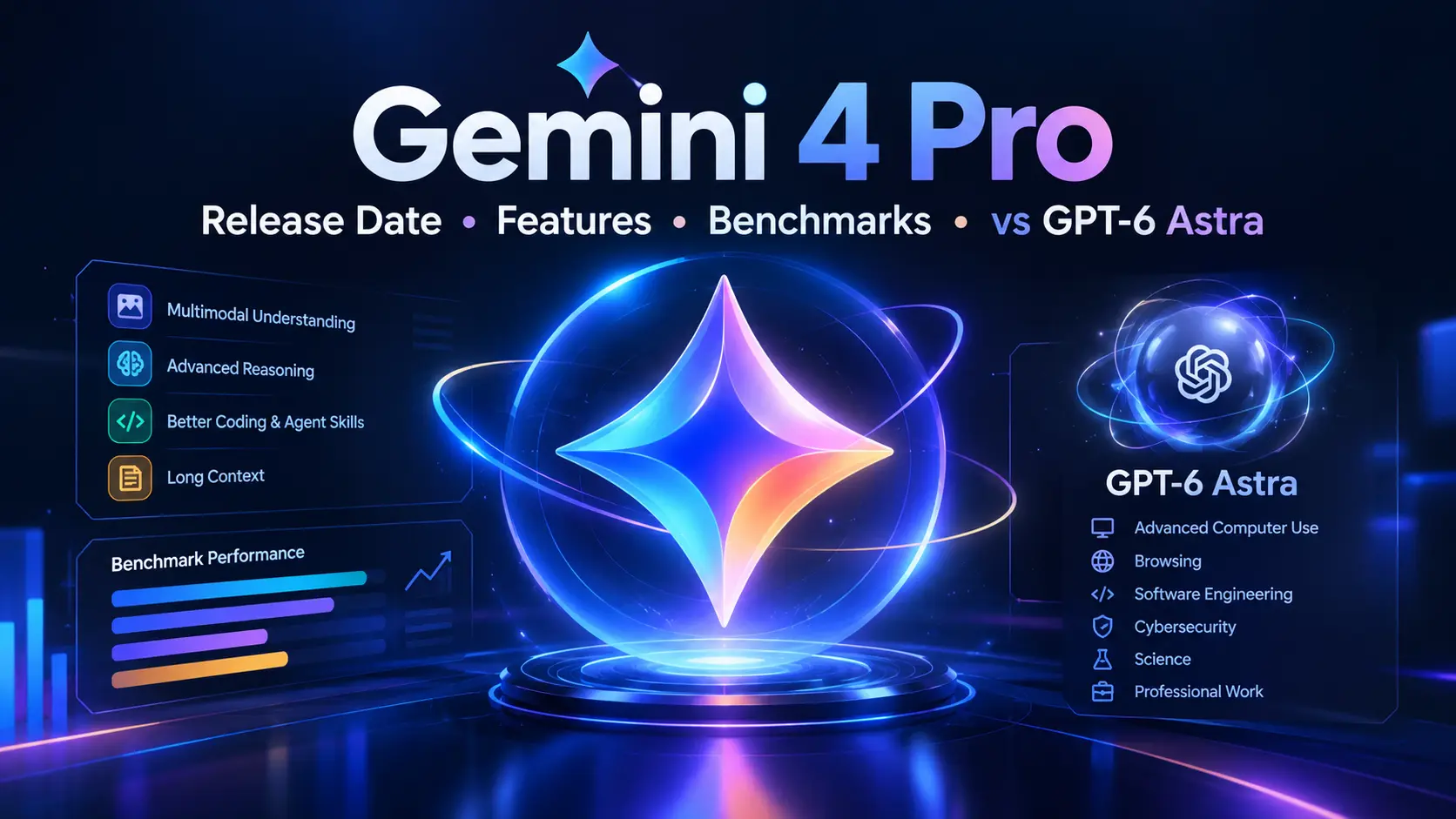
Key Takeaways
- Gemini 4 Pro is expected to be Google's next major flagship model.
- Google has not publicly confirmed every detail surrounding Gemini 4 Pro.
- The biggest expected improvements are likely to involve reasoning, coding, multimodal understanding, and agentic workflows.
- Reddit discussions show that users increasingly care about real world performance rather than benchmark scores alone.
- Long context remains an important area to watch because a large context window does not automatically mean strong long context performance.
- Gemini's integration with Google's ecosystem could become one of its biggest advantages.
- Gemini 4 Pro will likely face strong competition from OpenAI and Anthropic's latest models.
- Users interested in comparing different AI models can also explore platforms such as ChatGoat AI instead of switching between multiple AI services.

What Is Gemini 4 Pro?
Gemini 4 Pro is Google's next flagship large language model, the planned successor to the Gemini 3 generation (Gemini 3.1 Pro, Gemini 3 Deep Think, and the Gemini 3.6/3.7/3.8 Flash line). Google confirmed the project publicly for the first time on its Q2 2026 earnings call, when CEO Sundar Pichai stated that Gemini 4 was already in training and described it as a significantly larger effort than any prior Gemini generation, with coding and agentic capability as the priority areas for improvement.
Gemini sits at the center of Google's AI strategy in a way that goes beyond a standalone chatbot. The model family already powers Search, Android, Workspace, Cloud, and a growing set of developer tools, so a stronger Gemini 4 Pro has implications for AI search, coding assistants, document analysis, multimodal reasoning, and autonomous agents across the entire Google ecosystem.
Gemini 4 Pro Release Date: The Latest Timeline
Gemini 4 Pro does not have a confirmed public release date, but the picture is clearer than it was even a few weeks ago.
- Original target: An early-to-mid September 2026 launch was widely rumored, based on Google's shift toward a faster, near-monthly release cadence.
- First delay: Google DeepMind pushed the flagship to October 2026, citing additional pre-training work needed to hit the benchmark bar set by earlier Gemini releases.
- First checkpoint confirmed: Google has since deployed an internal checkpoint for Gemini 4 Pro, and industry reporting now points to a full public rollout in October 2026.
- Bridge releases: Rather than rushing the flagship, Google has kept shipping faster Flash-tier updates - Gemini 3.6 Flash, Gemini 3.7 Flash, and Gemini 3.8 Flash - along with a Gemini 4 Flash-Lite release and an updated Nano Banana 2 Lite image model to hold the line until Gemini 4 Pro is ready.
As always with unreleased models, treat this timeline in three tiers:
| Tier | What it means | Example |
|---|---|---|
| Confirmed | Stated directly by Google | Gemini 4 is in training; coding and agentic ability are priority areas |
| Reported | Credible reporting, not yet a Google announcement | October 2026 public launch window |
| Rumored | Social media, leaks, anonymous sources | Specific benchmark scores beating GPT-6 Astra or Claude Fable 5.1 |
Why the Delay Happened
Google has cited pre-training hurdles as the core reason for pushing Gemini 4 Pro from September into October. Reporting has also suggested Google scrapped a planned bridge release, sometimes referred to as Gemini 3.5 Pro, after internal testing found it fell short of the step-change needed for multi-file codebase refactoring and autonomous agent execution. Rather than ship an incremental model, Google appears to be holding the flagship until it clears a higher bar - a pattern consistent with how Gemini 3.1 Pro and Gemini 3 Deep Think were staged earlier in 2026.
What Reddit Users Are Saying about Gemini
One of the best ways to understand expectations around Gemini is to look beyond official announcements.
Reddit discussions reveal a much more complicated picture.
In one recent r/singularity discussion, users debated whether Google's current Gemini models were falling behind competitors. Some commenters argued that Google had focused too heavily on product integration and speed, while others pointed out that integrating AI throughout Google's massive product ecosystem could be strategically more important than winning every benchmark.
That debate is important for understanding Gemini 4 Pro.
There are essentially two different definitions of winning AI:
Google has the potential to compete strongly on both fronts.
Another Reddit discussion in September focused on the difference between benchmark performance and real world agentic performance. Users debated whether Gemini's strengths in question answering necessarily translate into stronger performance on longer running agent tasks.
This is likely to become one of the biggest tests for Gemini 4 Pro.
Gemini 4 Pro Expected Features
Google has not published a full specification sheet, so the items below are areas to watch rather than confirmed features.
1. Stronger Reasoning
Users expect improvements on complex mathematics, scientific reasoning, multi-step planning, and difficult coding problems. The more meaningful test will not be benchmark scores alone but whether Gemini 4 Pro holds up across long, multi-step real-world workflows rather than degrading partway through.
2. Better, More Autonomous Coding
Google has been building toward agentic coding through its Flash releases, and Gemini 4 Pro is expected to extend that further into repository-level understanding, long-running autonomous coding sessions, refactoring, and tool use. The relevant question is not whether Gemini 4 Pro can write code - nearly every frontier model can - but whether it can complete an entire software task reliably with minimal supervision.
3. Multimodal Understanding
Multimodality remains one of Gemini's core differentiators. A next-generation Gemini model is expected to combine text, images, audio, video, documents, and code more fluidly, letting users analyze a PDF, inspect an image, review a video, and produce a structured output in a single workflow.
4. Longer and More Reliable Context
A large context window is not the same as strong long-context reasoning. Independent testing of Gemini 3.1 Pro found meaningful accuracy drop-off at very large context lengths, which is why the real benchmark for Gemini 4 Pro will be retrieval and reasoning accuracy across a large context, not the raw token count Google advertises.
5. More Capable AI Agents
Agentic AI is expected to be one of Gemini 4 Pro's defining features: understanding a goal, breaking it into tasks, using external tools, executing actions, checking results, and continuing until the task is complete. Google's advantage here is structural - the company controls many of the services (Search, Gmail, Drive, Calendar, Cloud) that an agent would eventually need to interact with.
GPT-6 Astra Is Already out: What that Means for Gemini 4 Pro
This is the biggest shift since earlier drafts of this guide: OpenAI has now released GPT-6 Astra, its flagship "most capable model," rolling out to ChatGPT Plus, Pro, Business, and Enterprise users as well as through the OpenAI API, Microsoft Azure, and AWS Bedrock.
Confirmed specifications and results for GPT-6 Astra include:
- A roughly 1.05 million token context window with up to 128,000 output tokens
- Pricing around $10 per million input tokens and $50 per million output tokens on the API, with reduced cache read/write rates
- State-of-the-art claims across computer use, browser use, software engineering, cybersecurity, science, and professional document work
- Reported human-parity level performance on the ARC-AGI-3 benchmark, with OpenAI stating Astra surpassed its human action-efficiency baseline on the large majority of tested levels
- A significant jump in single-attempt and multi-attempt task completion rates compared with OpenAI's prior flagship, GPT-5.6 Sol
- OpenAI's own safety classification places Astra at the "Critical" cybersecurity capability threshold under its Preparedness Framework, meaning the model can identify and exploit previously unknown security flaws with the right access - which is also why OpenAI says it built stronger safeguards around cyber-related requests
This changes the framing for anyone comparing the two models. Gemini 4 Pro is still an unreleased, rumored model. GPT-6 Astra is a shipped, independently testable one. Any Gemini 4 Pro vs GPT-6 Astra comparison published before Gemini 4 Pro's public launch should be read with that asymmetry in mind - leaked internal benchmarks are not the same as third-party evaluation.
Gemini 4 Pro vs GPT-6 Astra
| Category | Gemini 4 Pro | GPT-6 Astra |
|---|---|---|
| Availability | Not yet released; October 2026 expected | Released; rolling out now to ChatGPT tiers, API, Azure, AWS Bedrock |
| Reasoning | Expected major improvement over Gemini 3.1 Pro | Near human-parity results reported on ARC-AGI-3 |
| Coding / software engineering | Expected priority area, per Google's own statements | OpenAI describes it as its strongest software engineering model to date |
| Computer / browser use | Expected agentic focus | Explicit state-of-the-art claim from OpenAI |
| Context window | Rumored multi-million-token window, unconfirmed | Confirmed ~1.05M tokens |
| Cybersecurity capability | Unknown | Classified by OpenAI as "Critical" risk tier — a meaningful jump in offensive/defensive cyber ability |
| Pricing | Not announced | ~$10/M input, ~$50/M output (API) |
| Ecosystem integration | Search, Android, Workspace, Cloud | ChatGPT, Azure, AWS Bedrock |
| Independent verification | Not yet possible | Possible now, since the model is live |
How to read this table: early leaks suggest Gemini 4 Pro may outperform GPT-6 Astra on multi-step reasoning and edge out Claude Fable 5.1 on complex coding benchmarks, but none of that is independently confirmed. Until Gemini 4 Pro is publicly available, the only responsible comparison is "confirmed, shipped model" versus "expected, unreleased model" - not a like-for-like benchmark contest.
Benchmark Expectations
Once Gemini 4 Pro launches, expect heavy coverage of GPQA, MMLU-style evaluations, SWE-bench, HumanEval, MMMU, ARC-AGI-style reasoning tests, long-context evaluations, and agent benchmarks - the same categories OpenAI highlighted for GPT-6 Astra. Benchmark leadership on any single test does not guarantee a better everyday experience; a growing share of users and independent reviewers now weight real-world, multi-step task completion more heavily than isolated benchmark scores.
How to Use Gemini 4 Pro
Once Gemini 4 Pro becomes publicly available, users will likely be able to access it through Google's consumer and developer products, depending on the final launch structure.
For casual users, the easiest option will probably be Google's Gemini interface.
Developers will likely care more about API access, model limits, pricing and integration options.
However, users who frequently work with multiple AI models may prefer an AI platform that puts different models into one workflow.
For example, ChatGoat AI can be useful for users who want to experiment with different AI models without constantly switching between separate AI websites.

This can be particularly useful when comparing models for writing, brainstorming, research, coding or creative work.
Instead of asking which AI model is universally the best, users can test different models against the same task and choose the one that produces the most useful result.
How Much Will Gemini 4 Pro Cost?
Google has not announced Gemini 4 Pro pricing. Based on how Gemini 3.1 Pro and the Flash tier are currently priced, a tiered structure is likely:
- Free tier: Basic access with usage limits, similar to the current Gemini app
- Paid consumer subscription: Higher limits and access to the most capable Gemini 4 Pro variant
- Developer API: Usage-based pricing, likely positioned against GPT-6 Astra's roughly $10/$50 per million token rates and Claude's frontier pricing
Treat any specific number circulating before launch as speculation.
Use Cases by Audience
Students: explaining difficult concepts, summarizing research, generating practice questions, and working across documents and images — building on Gemini's existing study tools, research notebooks, and flashcard features.
Developers: debugging, code generation and review, repository-level analysis, automated testing, and agentic coding sessions. The real test is whether accuracy holds up across a long coding session, not just on short snippets.
Creators: content planning, image and video analysis, script writing, and campaign research, often paired with dedicated AI image and video generation tools for a full production workflow.
Businesses: customer support, document analysis, internal knowledge search, data analysis, and workflow automation - an area where Google's ecosystem of email, documents, spreadsheets, and cloud tools gives Gemini a structural advantage once agentic features mature.
Should You Wait for Gemini 4 Pro?
Not necessarily. If a current model already solves your problem, pausing a workflow for an unreleased model has a real opportunity cost, especially now that GPT-6 Astra has already raised the bar on shipped capability. A more practical approach:
- Need deep Google integration today? Gemini 3.1 Pro or Gemini 3.8 Flash already covers most of that ground.
- Need the most capable model available right now? GPT-6 Astra is live and independently testable.
- Need to compare models before committing to one? A platform such as ChatGoat AI lets you run the same prompt across multiple AI models side by side, so you can judge writing, coding, or research quality directly instead of relying on benchmark claims from any single vendor.
FAQ
Is Gemini 4 Pro released yet?
No. As of September 2026, Gemini 4 Pro is unreleased. Google has confirmed an internal checkpoint, and reporting points to an October 2026 public launch.
Why was Gemini 4 Pro delayed?
Google cited additional pre-training work needed to meet the benchmark standard set by earlier Gemini releases, and reporting suggests an interim bridge model was scrapped for falling short on coding and agentic tasks.
Is GPT-6 Astra better than Gemini 4 Pro?
This can't be answered fairly yet - GPT-6 Astra is a released, independently testable model, while Gemini 4 Pro remains unreleased. Any comparison claiming a clear winner today is relying on unverified leaks rather than confirmed data.
What is Gemini 4 Pro's context window?
Not officially confirmed. Rumors point to a very large, possibly multi-million-token window, but Google has not published a figure.
How can I compare Gemini, GPT-6 Astra, and Claude today?
Since Gemini 4 Pro isn't public yet, the fairest comparison is between currently available models - Gemini 3.1 Pro, GPT-6 Astra, and Claude's latest models. A multi-model platform like ChatGoat AI makes it possible to test the same prompt across all of them and compare the actual output rather than marketing claims.
This article will be updated as Google releases more information about Gemini 4 Pro's official launch, specifications, and pricing.

