


Story Prompt Generator
Find a clear starting point without giving away the whole story. ChatGOAT AI turns a genre, character, setting, theme, or loose idea into a concise writing prompt with enough direction to begin and enough unanswered questions for you to decide what happens next.
What Is a Story Prompt Generator?
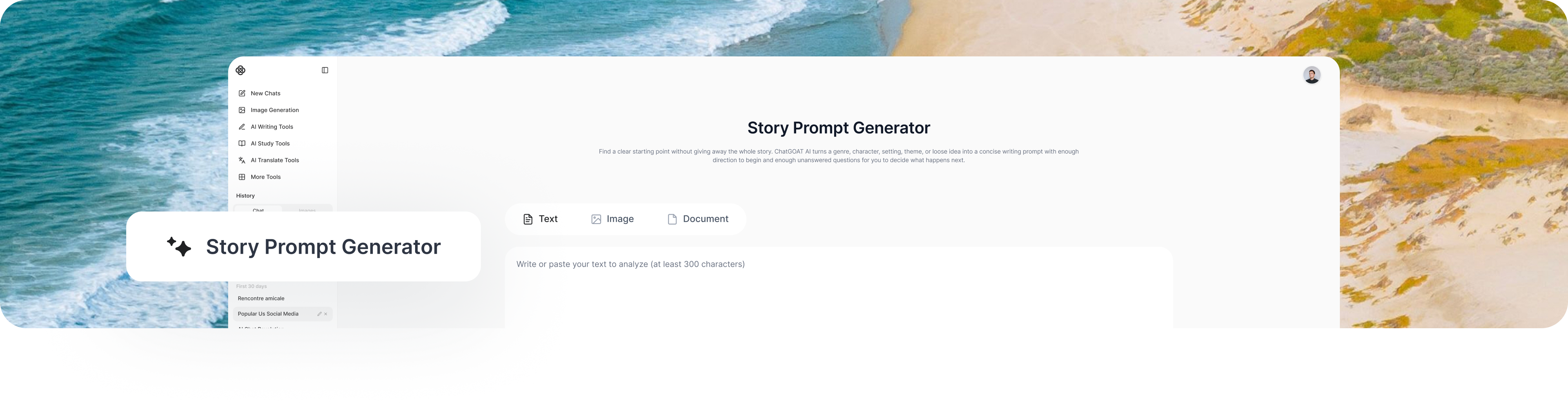
A story prompt generator is a writing tool that turns a genre, character, setting, or rough idea into a short premise you can start writing from. Writers use it to get past a blank page, try a genre they don’t usually write, compare possible directions for a novel, or set up a shared exercise for a class or writing group. Try ChatGOAT AI’s story prompt generator now for free.
How to Use ChatGOAT AI's Story Prompt Generator
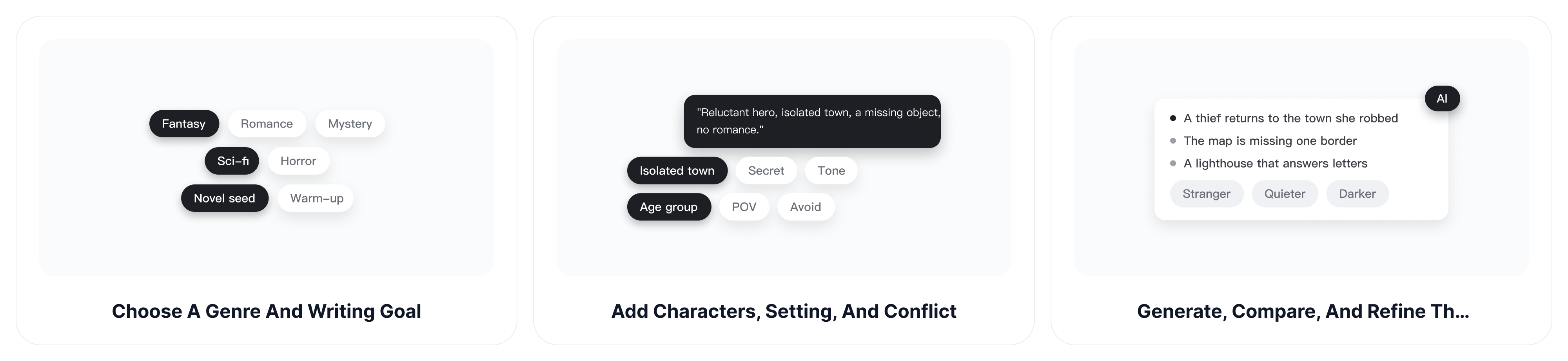
A useful request can be broad or specific. Start with the kind of story you want to explore, add the details that matter, and keep the result at prompt level instead of asking for finished prose.
Step 1: Choose a Genre and Writing Goal
Select fantasy, romance, mystery, science fiction, horror, literary fiction, or another genre. Then state whether you need a short-story premise, a novel seed, a classroom exercise, a roleplaying scenario, or a quick writing warm-up.
Step 2: Add Characters, Setting, Conflict, or Constraints
Provide any elements you want the prompt to use, such as a reluctant hero, an isolated town, a secret, a missing object, or a moral choice. You can also set the tone, age group, time period, point of view, or topics to avoid.
Step 3: Generate, Compare, and Refine the Prompts
Request one focused prompt or several contrasting options. Keep the most promising premise, then ask ChatGOAT AI to make it stranger, quieter, darker, more character-driven, or better suited to a specific length without writing the actual story for you.
Create Focused Ideas with a Writing Prompts Generator
A writing prompts generator is most useful when each result gives you something concrete to develop. The prompt should establish a starting situation and creative pressure while leaving the major decisions, discoveries, and ending in your hands.
Give the Writer a Character Who Must Act
A role, desire, fear, contradiction, or responsibility gives the prompt momentum. Instead of suggesting only 'a story about a detective,' identify what the detective wants and why taking action creates a personal cost.
Connect the Setting to the Central Problem
Use the location as more than decoration. A city where memories are taxed, a village that appears for one night, or a spaceship with no windows can create rules and limitations that shape the conflict.
Add a Conflict, Discovery, or Unanswered Question
End the prompt at the point where the writer must choose a direction. A warning, impossible request, hidden relationship, approaching deadline, or discovery can create urgency without deciding the resolution.
Use Random Details without Losing Coherence
Random story prompts become more useful when an unexpected element affects the conflict instead of appearing as a disconnected gimmick. The random object generator can supply an object that becomes a clue, obstacle, symbol, gift, or source of tension inside the final prompt.
Story Prompt Examples across Popular Genres
These examples show the intended level of detail: each one establishes a character, setting, and problem, but stops before the plot develops into finished scenes or a predetermined ending.
Fantasy Story Prompt
A young archivist learns that every erased name becomes a living creature in the library beneath her city. When her own name disappears from the records, she must decide which forbidden index to open before the creatures recognize her. For additional worldbuilding material, the AI species generator can help define one of the beings without deciding the story's outcome.
Romance Story Prompt
Two rival translators are hired to interpret the same collection of love letters, but each version reveals a different confession. They must determine whether the discrepancy comes from the original writer, their own assumptions, or someone changing the letters before publication.
Science Fiction Story Prompt
A maintenance worker on a generation ship receives a repair request from a deck that was sealed before she was born. The message uses her childhood nickname and warns her not to tell the captain what is growing behind the door.
Horror Story Prompt
Every mirror in a boarding school begins showing the same empty classroom at midnight. When a new student appears in the reflection and writes tomorrow's date on the board, three friends disagree about whether to enter the room or destroy every mirror first.
Use a Story Starter Generator for Different Writing Goals
A story starter generator can support more than one type of writing session. Change the scope, level of detail, and creative constraint according to what you plan to write next.
Find Manageable Ideas for Short Stories
Keep the cast small, limit the setting, and focus on one decision or change. An ideas for short stories generator should suggest a premise that can reach a meaningful turn within a shorter form instead of quietly demanding an entire novel.
Test Book Plots before Building an Outline
Use a book plots generator to compare central conflicts, character goals, and possible sources of escalation before committing to chapter planning. Keep the result at premise level until you know which question can sustain a longer project.
Create Prompts for Classes and Writing Groups
Set an age range, lesson objective, genre, length, and topics to avoid. A shared prompt can support timed writing, point-of-view practice, group discussion, or several stories that begin with the same situation but develop differently.
Break a Creative Routine with New Constraints
Ask for a familiar genre with one rule changed: a mystery with no crime, a romance told through objects, or a fantasy conflict that cannot be solved with magic. A story ideas generator can challenge default habits without forcing a complete plot onto the writer.
Why Choose ChatGOAT AI's Story Prompt Generator?
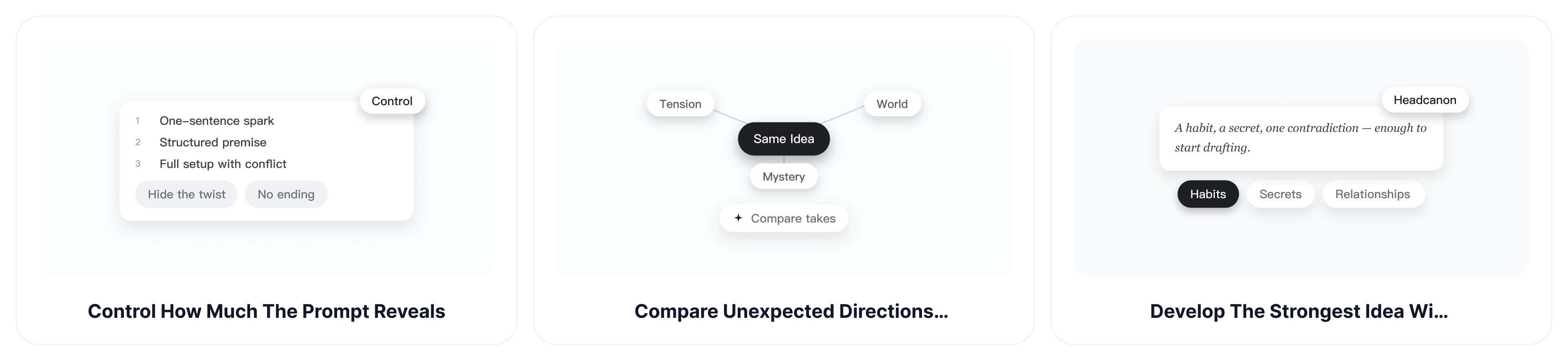
ChatGOAT AI combines flexible brainstorming with broader creative tools, helping you control how much the prompt reveals and continue developing only the idea you choose.
Control How Much the Prompt Reveals
Ask for a one-sentence spark, a structured premise, or several lines covering the character, setting, and conflict. You can also tell ChatGOAT AI to withhold the twist or ending so the output supports your writing rather than replacing it.
Compare Unexpected Directions across AI Models
Different AI models may prioritize character tension, worldbuilding, humor, mystery, or plot mechanics. ChatGOAT AI gives you access to multiple models in one platform, allowing you to compare alternative interpretations of the same starting idea.
Develop the Strongest Idea with Related Creative Tools
A prompt can reveal that the character needs more depth before drafting begins. The AI character headcanon generator can help explore habits, secrets, relationships, and contradictions while the original prompt remains the story's starting point.
Start Free When You Need a Quick Creative Spark
Free access and no sign-up make it practical to test one idea, request several random directions, or compare genres during a short writing session. Keep only the prompt that creates a question you genuinely want to answer.
Story Prompt Generator FAQs
Find answers about prompt length, genres, random ideas, short stories, book plots, and the difference between a writing prompt and finished story generation.
What should a story prompt include?
A useful prompt normally includes a character or role, a setting, a central conflict or discovery, and an unresolved question. It may also specify genre, tone, audience, or a creative constraint, but it should leave room for the writer to choose the development and ending.
Does the story prompt generator write the complete story?
No. This page is intended to produce a starting premise or writing task rather than finished story prose. If a result becomes too detailed, ask ChatGOAT AI to shorten it, remove the resolution, and keep only the character, setting, conflict, and hook.
Can I generate several prompts from the same idea?
Yes. Request contrasting versions that change the tone, genre, setting, stakes, or source of conflict while preserving the same core idea. Comparing options helps you identify which direction creates the strongest question for you to explore.
Can I use it as an ideas for short stories generator?
Yes. Ask for a limited cast, contained setting, focused conflict, and premise that can change meaningfully within a short form. You can also specify a target mood or approximate writing length without asking the tool to draft the story itself.
Can a book plots generator help with a novel?
Yes. It can suggest a central premise, protagonist goal, opposition, stakes, and possible sources of escalation. Choose the strongest premise before developing chapters, subplots, or a full outline.
How do I create random story prompts that still feel usable?
Combine one random element with a clear character goal and consequence. An unexpected object, place, profession, or rule becomes useful when it changes what the character can do or what they risk losing.
Can I choose fantasy, romance, mystery, or science fiction?
Yes. State the genre and add any preferred theme, tone, setting, character type, or restriction. You can also request hybrid prompts, such as a romantic mystery in a science-fiction setting.
Can I use ChatGOAT AI as a horror story prompt generator?
Yes. Specify the type of fear you want, such as psychological dread, isolation, supernatural horror, body horror, or a slow-building mystery. Ask the prompt to establish danger and uncertainty without revealing the final explanation.
What is the difference between a story starter and a story idea?
A story idea may be a broad concept, while a story starter usually gives the writer a more immediate point of entry, such as a situation, discovery, decision, or first problem. Either can remain open enough for several possible plots.