


Random Object Generator
Get one random object or a custom list for drawing, writing, games, lessons, and creative challenges. Tell ChatGOAT AI how many items you need and add a category, difficulty level, or theme when you want more control.
What Is a Random Object Generator?
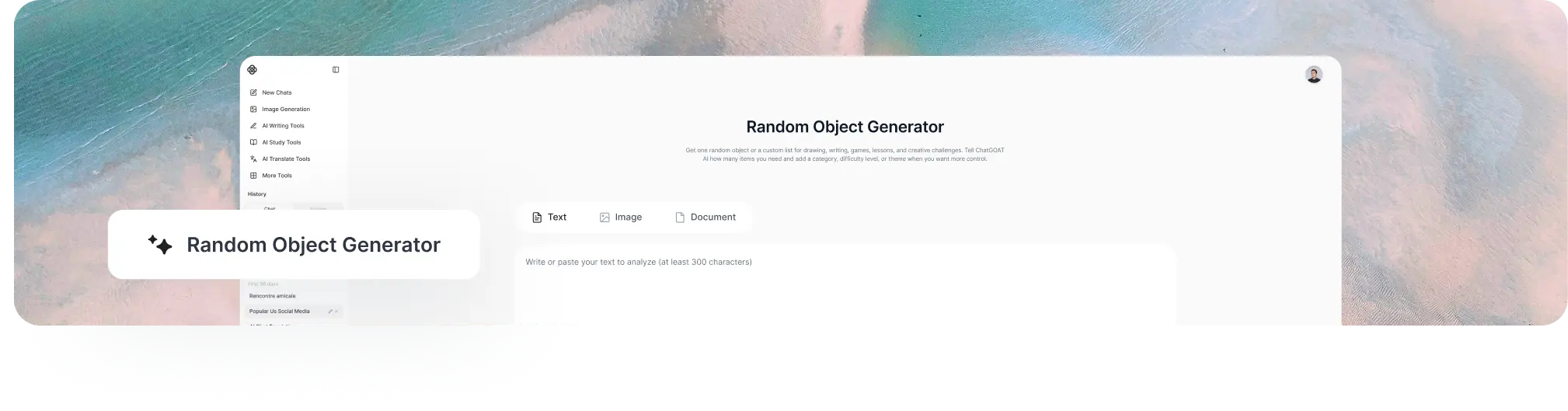
A random object generator is a tool that selects objects or everyday items without requiring you to choose them yourself. It can produce a single object, such as a lantern, compass, or coffee mug, or create a longer list for drawing exercises, stories, games, and classroom activities.
A basic generator normally selects nouns from a fixed database. An AI-powered random item generator can also follow instructions about categories, difficulty, setting, time period, appearance, or intended use. You might request five household items that are easy to draw, three unusual objects for a fantasy story, or ten items suitable for a children’s guessing game.
Random results are useful because they remove the pressure of deciding what to create. However, ChatGOAT AI is intended for creative idea generation rather than lotteries, gambling, security, scientific sampling, or other situations that require certified statistical randomness.
How to Use ChatGOAT AI’s Random Object Generator
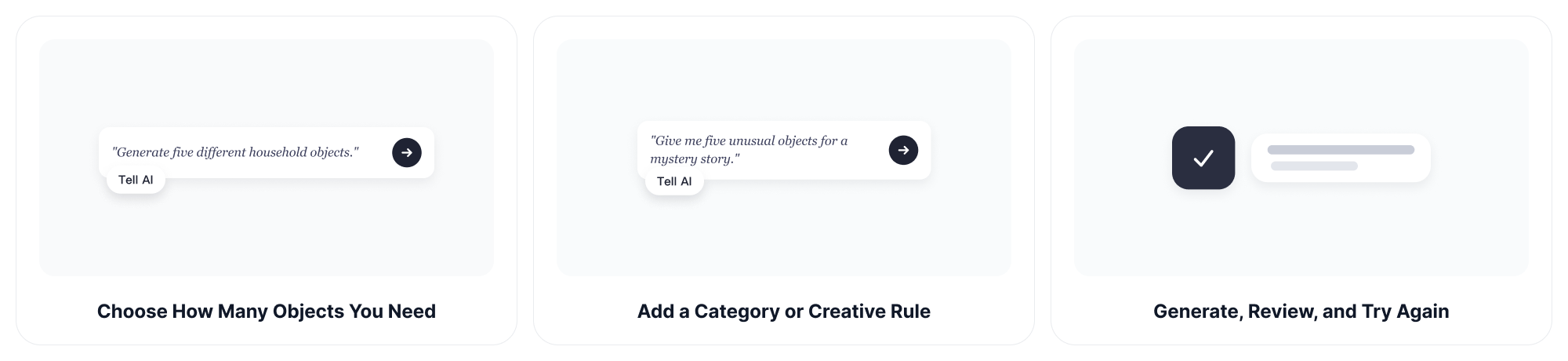
Step 1: Choose How Many Objects You Need
Tell ChatGOAT AI whether you want one object or a list. You can also request that every item be different.
Examples:
- "Give me one random object."
- "Generate five different household objects."
- "Create a list of ten random items with no duplicates."
- "Give me three objects that would fit inside a backpack."
Step 2: Add a Category or Creative Rule
Leave the request broad when you want a completely unexpected idea, or add instructions to make the results more useful.
You can specify:
- Household, kitchen, office, nature, technology, fashion, toys, tools, music, or sports
- Easy, medium, or difficult drawing subjects
- Modern, historical, fantasy, science-fiction, or magical objects
- Common or unusual items
- Objects of a particular color, material, size, or shape
- Items suitable for children, students, artists, writers, or game players
Example prompts:
- "Generate six random objects to draw, starting with easy subjects."
- "Give me five unusual objects for a mystery story."
- "Create ten random kitchen items for a vocabulary lesson."
- "Generate four fantasy items and describe what each one does."
- "Give me three unrelated objects and create a creative connection between them."
- "Generate eight objects for a Pictionary game without using brand names."
Step 3: Generate, Review, and Try Again
Review the results and keep the items that fit your activity. If a suggestion is too simple, difficult, similar to another item, or unsuitable for your audience, ask ChatGOAT AI to replace only that object.
You can also request another category, remove duplicates, add short descriptions, change the difficulty, or combine several objects into one creative prompt.
What Can a Random Item Generator Create?
Single Random Objects
Generate one object when you need a quick decision or a simple creative starting point.
Examples:
- Pocket watch
- Umbrella
- Telescope
- Paintbrush
- Rubber duck
- Antique key
A single object works well for a short sketch, vocabulary question, improv suggestion, or writing warm-up.
Lists of Different Objects
Request several objects at once when an activity needs more variety. Tell ChatGOAT AI not to repeat items and specify whether the list should stay within one category.
Example prompt:
"Generate ten different objects, including two kitchen items, two tools, two toys, two pieces of technology, and two completely unexpected objects."
Random Objects to Draw
Artists can use random objects to draw when they want to practise regularly but do not want to spend time choosing a subject. You can request objects based on skill level, shape, texture, material, or drawing time.
Easy drawing subjects may include:
- Apple
- Cup
- Book
- Candle
- Spoon
More detailed subjects may include:
- Vintage camera
- Sewing machine
- Mechanical clock
- Ornate lantern
- Open toolbox
You can also combine objects into a drawing challenge:
"Create a scene containing a bicycle, a cactus, and an old television."
After choosing a subject, the AI art generator can help turn the same object description into a visual reference or explore different artistic styles.
Creative Writing Objects
A random item can become a clue, obstacle, gift, weapon, symbol, piece of evidence, or object with emotional meaning.
Instead of generating only "a key," ask for more useful details:
"Generate a mysterious object with an unusual appearance, an unknown owner, and a hidden purpose."
Possible result:
"A brass key with no teeth, engraved with the date of an event that has not happened yet."
The object now provides a stronger starting point for a scene or plot.
Object Combinations
Combining unrelated items encourages lateral thinking and can produce less predictable ideas.
Examples:
- A compass and a broken phone
- A violin and a spacesuit
- A teacup and a treasure map
- A camera and a locked diary
- A snow globe and a train ticket
Ask ChatGOAT AI to explain how the objects could be connected, or use them without explanation as a more difficult creative challenge.
Game Items and Fantasy Loot
Generate objects for tabletop games, role-playing campaigns, fictional inventories, treasure chests, shops, quests, and puzzles.
Example prompts:
- "Generate five ordinary items found in an abandoned cabin."
- "Create three magical objects with useful effects and clear limitations."
- "Give me ten low-value items for a fantasy merchant."
- "Generate one object that could unlock a dungeon puzzle."
- "Create four science-fiction tools found on a damaged spacecraft."
For games, decide whether the items are purely descriptive or need attributes such as rarity, value, condition, effect, or location.
Pictionary and Charades Prompts
Create object lists for drawing and guessing games. You can set the difficulty according to the players’ ages and avoid words that are too abstract to draw or act out.
Example categories:
- Easy household objects
- School supplies
- Musical instruments
- Sports equipment
- Kitchen tools
- Travel items
- Objects from different historical periods
Ask for a balanced list so the game does not contain ten nearly identical objects.
Classroom Activities
Teachers can use random objects for vocabulary, spelling, description, observation, storytelling, and speaking exercises.
Activities may include:
- Name and spell the object
- Describe it using five adjectives
- Explain its purpose without saying its name
- Write a sentence containing the object
- Compare it with another item
- Draw it from memory
- Invent a different use for it
- Place it into a short story
Teachers should review the generated list to confirm that every object is age-appropriate and familiar enough for the lesson.
ESL Vocabulary Practice
Language learners can request everyday objects with definitions, example sentences, pronunciation guidance, or translations.
Example prompt:
"Generate eight common kitchen objects for an intermediate English learner. Give each word a short definition and one natural example sentence."
The list can also focus on a location such as a bedroom, classroom, supermarket, airport, or office.
Scavenger Hunts
Generate items that players must find around a home, classroom, office, park, or event space. Add practical restrictions so the generator does not suggest objects that are unavailable or unsafe.
Example prompt:
"Create a ten-item indoor scavenger hunt using common objects that children can pick up safely."
Observation and Memory Exercises
Generate several objects and study them for a limited time. Hide the list, then try to remember the objects in order or describe their imagined colors, shapes, textures, and locations.
You can also use the items in a memory-palace exercise by mentally placing each object in a familiar room.
Design and Brainstorming Prompts
Designers can combine random objects with an existing problem to explore unexpected features or forms.
Examples:
- Combine a backpack with a blanket
- Redesign a lamp for outdoor use
- Imagine a keyboard made for children
- Turn a lunch box into a travel organizer
- Create a phone case inspired by a seashell
These prompts are intended to encourage exploration, not to prove that an idea is technically or commercially viable.
Custom Object Descriptions
Unlike a fixed object list, ChatGOAT AI can add characteristics to each result.
You can request:
- Color and material
- Age and condition
- Size and shape
- Location
- Owner
- Emotional meaning
- Fictional power
- Possible story role
For example, "mirror" can become "a palm-sized silver mirror that reflects an unfamiliar room instead of the person holding it."
Why Choose ChatGOAT AI’s Random Object Generator?

Start without Creating an Account
ChatGOAT AI allows you to begin with free daily usage and no sign-up required. This is useful when you only need a quick drawing subject, classroom word, or game prompt.
Go Beyond a Fixed Object List
Many generators repeatedly select items from one predefined database. With ChatGOAT AI, you can describe the category, audience, complexity, setting, and intended activity instead of accepting a completely generic result.
Continue the Idea in the Same Platform
ChatGOAT AI includes writing, study, work, image, and creative tools in one platform. A generated object can become a story prompt, illustration concept, lesson activity, game item, or larger fictional world.
For fantasy projects, the AI spell generator can help develop magical names, effects, activation phrases, and limitations after you generate an unusual item.
Ask for Explanations and Replacements
You can keep the useful objects and replace only the unsuitable ones. Ask ChatGOAT AI why an item fits a category, request a simpler alternative, or add a description without rebuilding the entire list.
Try Different Advanced AI Models
ChatGOAT AI provides access to multiple AI models in one place. Different models may produce different associations, categories, descriptions, and creative connections, giving you more options when the first list feels predictable.
Who Can Use a Random Object Generator?
Artists and Drawing Beginners
Find subjects for daily sketches, warm-ups, drawing challenges, still-life practice, and portfolio exercises. Adjust the difficulty to match your current skill level.
Writers and Storytellers
Use unexpected objects to overcome writer’s block, introduce a plot device, reveal character history, or create conflict inside a scene.
If you already have a draft but do not know what should happen next, the AI story continuer can build on the existing characters, setting, tone, and unfinished plot.
Teachers and Students
Generate words for vocabulary lessons, creative writing, speaking practice, observation exercises, and classroom games. Teachers should check every result before presenting it to students.
Game Masters and Game Developers
Create loot, quest objects, merchant inventories, environmental details, collectibles, and puzzle components. Add rules for setting, rarity, value, or function to keep the results consistent with the game.
Families and Game-Night Hosts
Prepare object prompts for Pictionary, charades, guessing games, scavenger hunts, and storytelling activities without writing every word in advance.
Designers and Creative Teams
Introduce unexpected objects into brainstorming sessions to challenge familiar assumptions and explore unusual combinations.
Language Learners
Practise object names, spelling, definitions, descriptions, example sentences, and translations using words from familiar real-world categories.
Anyone Who Cannot Decide What to Create
Use the random item generator when choosing an idea is taking longer than the activity itself. A random result gives you a starting point that you can accept, reject, or develop further.
Random Object Generator FAQs
What Is a Random Object Generator?
A random object generator produces the name of an object or a list of items without requiring the user to select each one manually. It is commonly used for drawing, writing, games, lessons, and brainstorming.
Is a Random Item Generator the Same as a Random Object Generator?
Yes. The terms usually describe the same type of tool. "Random item generator" may also refer to fictional inventory, loot, prizes, or list entries, while "random object generator" more often suggests physical things.
Is the Random Object Generator Free?
ChatGOAT AI provides free daily usage. Certain models or additional usage may require an account or paid plan.
Do I Need to Sign Up?
No. You can start using ChatGOAT AI without signing up. Creating an account may provide access to additional features or usage.
Can I Generate More Than One Object?
Yes. State the number of objects you need and ask for no duplicates when every result should be different.
Can I Choose a Category?
Yes. Specify a category such as household, kitchen, technology, nature, fashion, music, toys, tools, office supplies, or sports.
Can It Generate Random Objects to Draw?
Yes. Ask for random objects to draw and include your preferred difficulty, art style, category, or available drawing time.
What Are Some Easy Random Objects to Draw?
Easy subjects include an apple, cup, candle, spoon, book, ball, envelope, key, bottle, and simple lamp. The difficulty depends on the level of detail and perspective you choose.
Can It Generate Unusual or Fictional Objects?
Yes. Ask for unusual, historical, fantasy, magical, or science-fiction items. You can also request a description, purpose, owner, condition, and limitation for each object.
Can I Use the Objects as Writing Prompts?
Yes. Make an object central to a scene, mystery, memory, conflict, or character decision. Combining two unrelated items can produce a less predictable prompt.
Can Teachers Use It in the Classroom?
Yes. It can support vocabulary, spelling, speaking, drawing, observation, science, and creative-writing activities. Teachers should review results for accuracy and age suitability.
Can I Use It for Pictionary or Charades?
Yes. Specify the game, player age, difficulty, number of rounds, and categories you want to include or avoid.
Can I Use It for Game Loot?
Yes. Ask for objects that match the setting and include attributes such as rarity, condition, value, effect, or location when needed.
Are the Results Truly Random?
ChatGOAT AI generates varied results from your prompt and conversation context. It is not a certified random-number service and should not be used for gambling, raffles, security, scientific sampling, or other tasks requiring verifiable randomness.
Can I Use Generated Object Ideas Commercially?
Common object names are general ideas, but the final project may involve other intellectual-property considerations. Review any generated descriptions, branded terms, recognizable fictional items, or artwork before commercial use.