


AI Detector
Check whether a passage contains writing patterns commonly associated with AI-generated text. Paste your content into ChatGOAT AI to receive an analysis you can review alongside the writing itself.
What Is an AI Detector?
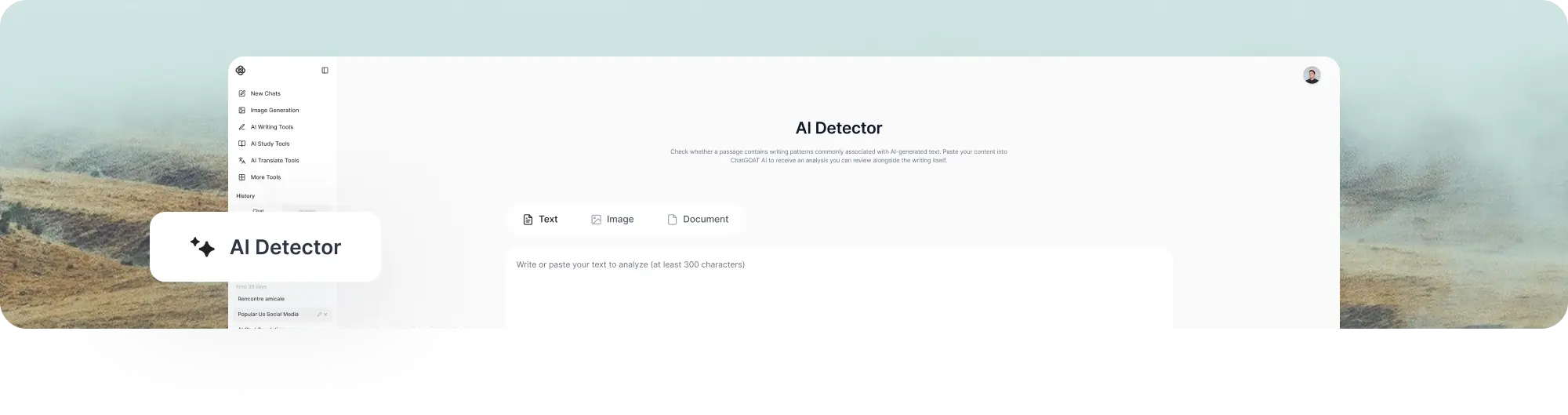
An AI detector is a tool that analyzes text and estimates whether its language patterns are more consistent with human writing or content produced by an AI model.
AI-generated writing often contains statistical patterns that differ from natural human writing. It may use highly predictable wording, similar sentence structures, repeated transitions, an unusually consistent tone, or general statements that follow a recognizable pattern.
An AI text detector evaluates these signals together rather than searching for one word or phrase that proves AI was used. The result should be treated as an estimate, not definitive evidence of authorship.
How AI Text Detection Works
AI detectors may examine factors such as:
- How predictable the next word or sentence appears
- Variation in sentence length and structure
- Repeated phrases, transitions, and grammatical patterns
- Consistency of vocabulary, tone, and rhythm
- Differences between human-written and machine-generated language
- Sections that appear more formulaic than the rest of the text
These signals can help identify possible AI-generated writing, but they cannot reconstruct exactly how a document was created.
General AI Detection and Watermark Detection
A general AI detector looks for broad language patterns associated with AI writing. Watermark detection is narrower and checks for a particular supported signal that may be associated with content from a specific model.
If you specifically need to check text for a supported Claude watermark signal, use the Claude watermark detector. A general AI detection result and a watermark result should not be treated as the same type of evidence.
AI Detection Is Not Plagiarism Detection
An AI detector and a plagiarism checker answer different questions.
An AI detector estimates whether text shows patterns associated with AI writing. A plagiarism checker compares the text with existing sources to identify copied or closely matching material.
A passage can be original but AI-generated. It can also be written entirely by a person and still contain copied material. One type of check cannot replace the other.
AI Detection Results Are Not Proof
No AI writing detector can determine authorship with complete certainty. Human writing can be flagged incorrectly, especially when it is highly structured, formulaic, heavily edited, written by a non-native speaker, or based on a fixed academic or professional template.
AI-generated text can also avoid detection after extensive rewriting or when it is mixed with human writing. Detection results should support a broader review rather than serve as the only evidence in an academic, hiring, publishing, or disciplinary decision.
How to Use ChatGOAT AI’s AI Detector
.png)
Step 1: Add the Text You Want to Check
Paste an essay, article, email, report, social media caption, product description, or another piece of writing into ChatGOAT AI.
Whenever possible, include a complete passage rather than one short sentence. Longer samples usually provide more linguistic patterns to analyze and can produce a more useful assessment.
Step 2: Ask for AI Detection
Tell ChatGOAT AI what you want to examine. You can request an overall assessment, ask it to identify possible AI-writing patterns, or focus on particular paragraphs.
Example prompts:
- "Check whether this text contains AI-generated writing patterns."
- "Analyze this article with an AI text detector."
- "Which paragraphs sound the most likely to be AI-written?"
- "Check whether this essay contains a mixture of human and AI writing."
- "Explain which language patterns make this passage sound AI-generated."
- "Review this draft as a ChatGPT detector."
Step 3: Review the Result in Context
Read the analysis together with the original text. Look at the sections identified as predictable, repetitive, overly uniform, or formulaic rather than relying only on one overall judgment.
Consider the text’s purpose, length, editing history, author, language background, and writing style. If the result could affect a student, employee, writer, or applicant, gather additional evidence and allow the person to explain their writing process.
What Can an AI Text Detector Analyze?
Essays and Academic Assignments
Review essays, research summaries, discussion posts, laboratory reports, and other assignments for writing patterns that may be associated with AI tools.
Educators can use the result to decide where closer review or a conversation may be useful. Students can check their own drafts before submission, especially when highly structured academic language may sound more formulaic than intended.
Articles and SEO Content
Analyze blog posts, landing pages, guest posts, and outsourced content before publication. An AI writing detector can help editors notice repetitive phrasing, generic explanations, abrupt changes in voice, and sections that may require closer human review.
Detection does not measure whether an article is helpful, accurate, original, or suitable for search engines. SEO professionals should still check facts, search intent, experience, readability, and overall content quality.
ChatGPT and Other AI-Generated Text
A ChatGPT detector examines patterns associated with text produced by ChatGPT and similar large language models. The same analysis can also be used when reviewing content created with other AI writing assistants.
Because models and editing methods continue to change, the tool should not claim which exact model created a passage unless there is separate evidence.
Mixed Human and AI Writing
Some documents combine original writing with generated sentences, AI-assisted revisions, or heavily edited AI drafts. Analyze the full document, then compare individual sections for noticeable differences in predictability, vocabulary, rhythm, and tone.
Mixed authorship is generally more difficult to assess than a passage created entirely by one source. A result may indicate that certain sections deserve attention without proving that the whole document was AI-generated.
Emails, Reports, and Workplace Documents
Review business emails, applications, proposals, reports, internal documentation, and client-facing content for possible AI-writing patterns.
The result can help teams understand how AI may have contributed to a document, but it should not be used alone to accuse an employee, applicant, freelancer, or partner of misrepresenting their work.
Creative Writing
Check stories, scripts, poems, character descriptions, and other creative drafts. Creative writing often contains deliberate repetition, unusual rhythms, or stylistic experimentation, so results need careful interpretation.
If you want feedback on the quality, structure, rhyme, or literary techniques of a poem rather than its likely origin, the AI poem checker provides a more relevant analysis.
Short and Long Text
The AI detector can review content of different lengths, but very short samples provide fewer language patterns to examine. A sentence, title, bullet list, or brief caption may not contain enough evidence for a meaningful conclusion.
For a more reliable review, submit several connected paragraphs when they are available. Avoid combining unrelated texts from different authors into one scan because the changes in style can distort the assessment.
Writing Patterns Behind the Result
Instead of treating AI detection as a simple yes-or-no test, ask ChatGOAT AI to explain the result. The analysis may discuss repetitive transitions, predictable sentence construction, similar paragraph openings, generic claims, limited stylistic variation, or an unusually consistent tone.
These indicators are not proof on their own. Their value comes from showing which parts of the text may need closer examination.
Why Choose ChatGOAT AI’s AI Detector?
.png)
Multiple Advanced AI Models in One Platform
ChatGOAT AI brings multiple advanced AI models together in one platform. You can use models such as GPT-5.6 Sol for writing, analysis, research, and other tasks without moving between separate AI services.
Text, Image, and Document Workflows
ChatGOAT AI supports more than typed prompts. Across the platform, you can work with text, readable images, and documents, making it easier to continue when the material you need is saved in a file or screenshot.
This does not mean the text detector determines whether an uploaded image was generated by AI. Image-generation detection is a separate task.
Interactive AI Assistance
ChatGOAT AI lets you continue the conversation after receiving a result. Ask follow-up questions, request a clearer explanation, add missing context, or explore a different interpretation without restarting the entire task.
Writing, Study, and Creative Tools Together
AI detection is often only one step in a larger workflow. ChatGOAT AI also brings writing, document analysis, study, image, and creative tools together, so you can continue working on different tasks in the same platform.
Free Access for Everyday Tasks
ChatGOAT AI provides free daily usage for writing, study, analysis, and creative tasks. Creating an account gives access to additional platform features according to the current product experience.
Who Can Use an AI Writing Detector?
Students
Check a draft before submission and identify sections that sound overly generic, repetitive, or different from the rest of the assignment. Students should still follow their institution’s rules regarding AI-assisted writing and disclose AI use when required.
Teachers and Educators
Use the AI detector as an initial review tool when an assignment contains sudden changes in style or unusually formulaic language. Detection results should lead to a fair conversation and an examination of drafts, sources, notes, or revision history, not an automatic accusation.
Writers and Editors
Screen submitted articles and drafts for possible AI-generated sections. Editors can use the analysis to decide where fact-checking, rewriting, source verification, or additional editorial review is needed.
SEO and Content Teams
Review blog posts, landing pages, product copy, and outsourced content before publication. The tool can help identify patterns that deserve attention, while human editors assess usefulness, accuracy, brand voice, and search intent.
Publishers and Media Teams
Examine articles, opinion pieces, contributor submissions, and other editorial material when authorship or disclosure matters. AI detection can support an editorial workflow but cannot independently verify originality or factual accuracy.
Recruiters and Employers
Review cover letters, writing tests, reports, and work samples when organizational policies limit AI assistance. Because false positives are possible, results should never be the sole basis for rejecting a candidate or taking action against an employee.
Researchers and Academic Editors
Analyze manuscripts, summaries, literature reviews, and research-related writing for possible AI involvement. Researchers should also verify citations, data, methods, and factual claims because AI detection does not check research integrity by itself.
Freelancers and Agencies
Check outsourced drafts before sending them to a client. Agencies can use the result as one quality-control signal while also reviewing originality, accuracy, tone, and compliance with the client’s AI policy.
AI Detector FAQs
What Is an AI Detector?
An AI detector is a tool that analyzes linguistic and statistical patterns to estimate whether text may have been generated by an AI writing model. It produces an assessment rather than definitive proof of authorship.
How Does an AI Text Detector Work?
An AI text detector examines characteristics such as word predictability, sentence variation, repetition, grammatical structure, tone, and rhythm. It compares these signals with patterns commonly found in human and AI-generated writing.
Can an AI Detector Identify ChatGPT Content?
A ChatGPT detector can identify patterns associated with text generated by ChatGPT and similar models. However, it cannot always determine which exact model created a passage, especially after the text has been edited or combined with human writing.
Can an AI Detector Be Wrong?
Yes. AI detectors can produce false positives and false negatives. Structured human writing may be flagged as AI-generated, while heavily edited AI text may appear human-written.
Is an AI Detector 100% Accurate?
No. Detection methods, language models, writing styles, and editing techniques continue to change. Results should be treated as probability-based signals and reviewed alongside other evidence.
Can Human Writing Be Detected as AI?
Yes. Formulaic academic language, professional templates, repetitive writing, simplified vocabulary, non-native English, and highly consistent sentence structures may sometimes resemble AI-generated patterns.
Can an AI Writing Detector Analyze Mixed Text?
It can look for changes between sections that may indicate a mixture of human and AI writing. Mixed documents are more difficult to classify, so individual paragraphs should be reviewed instead of relying only on one overall result.
Does Rewriting AI Text Make It Undetectable?
Not necessarily. Light edits may leave many of the original patterns in place, while substantial human rewriting can change the result. No detector can reliably reconstruct every stage of the writing process.
How Much Text Should I Check?
Use several connected paragraphs when possible. Very short samples provide fewer patterns and may produce less useful results. Longer, coherent passages usually allow a more informed analysis.
Can an AI Detector Check Images?
This AI detector is intended to analyze written content. An AI image detector is a different tool designed to assess whether an image may have been generated or manipulated by AI.
Is AI Detection the Same as Plagiarism Detection?
No. AI detection estimates whether text resembles AI-generated writing. Plagiarism detection checks whether material matches existing sources. A document may pass one check and fail the other.
Can an AI Detector Prove That a Student Cheated?
No. An AI detection result should not be treated as proof of misconduct. Educators should also consider drafts, citations, revision history, course policies, the student’s previous work, and the student’s explanation.
Can an AI Detector Check Content from Claude, Gemini, or Other Models?
AI detectors may recognize general patterns associated with writing produced by different large language models. However, performance can vary by model, language, text length, and the amount of human editing.
Does an AI Detector Measure Writing Quality?
No. A passage can be human-written and poorly researched, or AI-generated and grammatically polished. Detection does not replace fact-checking, editing, originality review, or an assessment of whether the content is useful.
Is ChatGOAT AI’s AI Detector Free?
ChatGOAT AI provides free daily usage. Creating an account gives access to additional features according to the current product experience.