


Claude Watermark Detector
Paste text into the ChatGOAT Claude watermark detector to check for a supported Claude watermark signal. You will get a simple result and a clear explanation of what it means - without confusing a watermark check with a generic AI-writing guess.
What Can ChatGOAT Claude Watermark Detector Do?
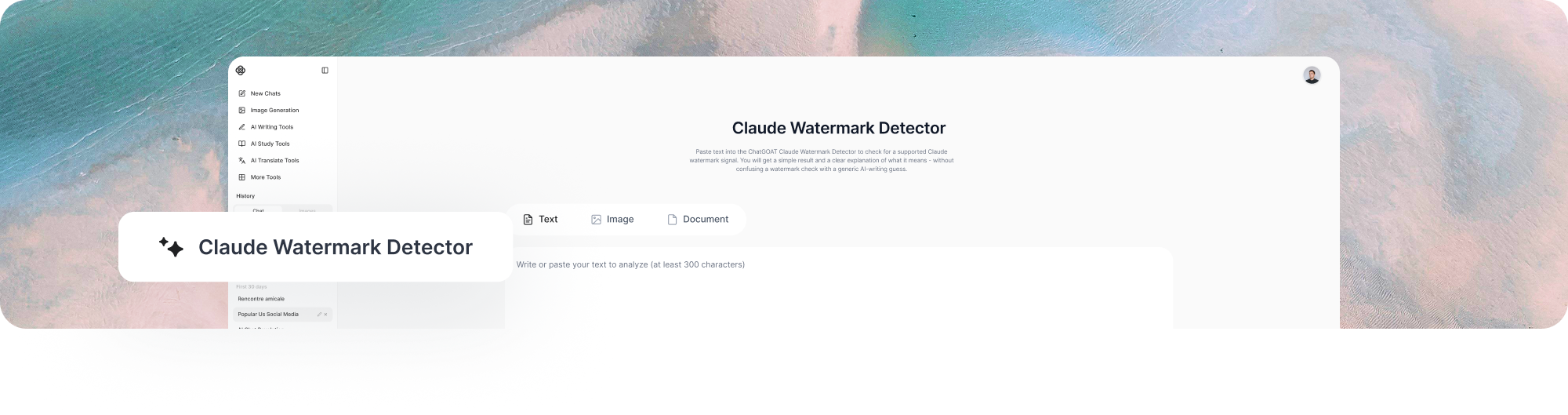
ChatGOAT AI helps you check text for a supported Claude watermark signal and understand the result in context. It is built for people who need a clearer answer than “this sounds like AI.” Use it when you review a draft, screen incoming content, or want to understand whether Claude may have been involved in a piece of writing.
| What you can do | Why it matters |
| Check pasted text | Review a passage before you publish, submit, or share it. |
| Get a readable result | See whether a supported signal was found, not found, or cannot be assessed with confidence. |
| Avoid guesswork | A watermark check and an AI-style detector answer different questions. |
| Understand the limits | Learn why a result cannot prove full authorship, ownership, or human-only writing. |
Understand What You Are Checking
Claude’s text watermark is a statistical pattern, not an extra string of invisible characters. When a model has several sensible word choices, watermarking can guide the random choice in a way that creates a pattern across a longer passage. A compatible check can estimate whether the pattern is present.
That is different from scanning for hidden Unicode spaces or judging sentence style. A hidden-character scan may find formatting characters. A generic AI detector may estimate whether prose looks AI-like. Neither one, by itself, verifies Claude’s published watermarking method.
Read Every Result the Right Way
| Result | What it can mean | What it does not mean |
| Signal found | Claude may have processed some of the text. | Claude wrote every word; the content belongs to Claude; or a specific person used Claude. |
| No supported signal found | The check did not find a supported signal in this sample. | The text is definitely human-written or was never touched by AI. |
| Inconclusive / more text needed | There may be too little usable text for a meaningful check. | The text is clean or suspicious. |
How to Detect a Claude Watermark with ChatGOAT AI
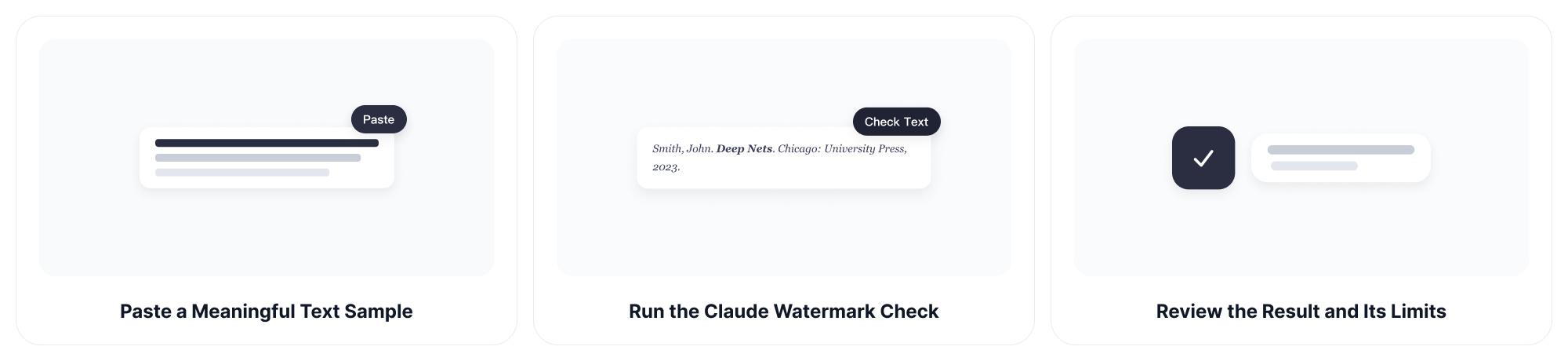
Step 1. Paste a Meaningful Text Sample
Add the text you want to review. Longer passages usually give a watermark check more evidence to work with. A very short sentence, a list of facts, or a few small grammar edits may not contain enough model-selected wording for a reliable signal.
Step 2. Run the Claude Watermark Check
Select Start now. ChatGOAT reviews the passage for the supported signal available to the detector. The check is designed to focus on watermark evidence rather than broad writing-style guesses.
Step 3. Review the Result and Its Limits
Read the result together with the explanation. A found signal is useful context, but it is not a final decision about authorship, integrity, or ownership. A missing signal also does not clear a text as human-written. Heavy edits, paraphrasing, mixed writing, short samples, older models, and unsupported contexts can affect whether a mark is detectable.
Why a Real Watermark Check Beats a Generic AI Detector
A generic AI detector looks for broad patterns in wording, rhythm, structure, or common phrases. It does not have access to a provider-specific watermark key. A supported watermark check is designed to look for a different kind of evidence: the presence of a known mark in the text itself.
| Question | Supported Claude watermark check | Generic AI detector |
| What does it examine? | A provider-specific supported watermark signal. | Surface-level language patterns and style. |
| What can a positive result suggest? | Claude may have processed the passage. | The passage may resemble AI-generated writing. |
| Can it prove who wrote the work? | No | No |
| Can it prove text is human-written? | No | No |
| Why can results differ? | It asks whether a specific signal is present. | It estimates likelihood from writing features. |
A watermark check is not automatically “better” for every question. If you want to know whether writing may sound AI-like, a generic detector addresses that different question. If you want to check for a supported Claude watermark signal, use a tool built for that purpose. In either case, avoid using one result as the only basis for a high-stakes decision.
Why Choose ChatGOAT Claude Watermark Detector?
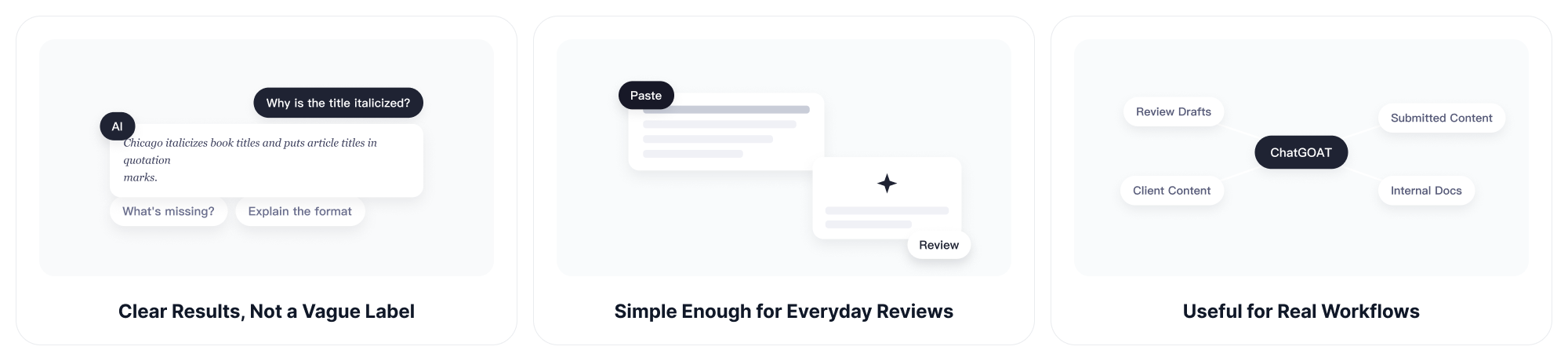
Clear Results, Not a Vague Label
ChatGOAT is designed to help you understand the difference between a signal found, no supported signal found, and an inconclusive sample. The aim is clarity - not a dramatic “AI or human” verdict.
Built for the Question You Actually Have
When you search for a Claude watermark detector, you want more than an AI-style score or a hidden-character cleanup. ChatGOAT focuses on the question at hand: whether the text contains a supported Claude watermark signal.
Simple Enough for Everyday Reviews
You do not need to understand token sampling or cryptography to start. Paste text, run the check, and read the plain-English explanation. The technical details are available below when you need them.
Honest About Boundaries
Good provenance tools should explain what they cannot establish. A detected mark does not reveal a user, organization, conversation, original author, or percentage of AI contribution. A clean result does not prove that a text is human-written.
Useful for Real Workflows
Use ChatGOAT as a review step for drafts, submissions, client content, internal documentation, or material that needs an extra provenance check. For high-stakes use, pair the result with your organization’s disclosure policy and a human review process.
FAQ
1. What is a Claude watermark detector?
A Claude watermark detector checks text for a supported Claude watermark signal. It is different from a general AI detector, which estimates whether writing looks AI-generated based on style. A watermark result can suggest that Claude processed text, but it cannot prove complete authorship.
2. Is a Claude watermark a hidden character or invisible code?
No. Anthropic says its text watermark does not add hidden characters or visible marks. It is a statistical pattern in model-selected word choices. This means a basic zero-width-character scan is not the same as a Claude watermark check.
3. How does Claude watermark text?
The watermark works across many low-stakes word choices. When several words could fit, the model’s selection process can create a pattern that a compatible verifier can test. The pattern is not visible to readers and is more useful over longer passages.
4. Does a detected watermark prove Claude wrote the whole text?
No. A signal may show that Claude was involved in processing the text, but it cannot distinguish a full Claude draft from a human draft that Claude translated, summarized, or edited. It also cannot identify the person, organization, or chat connected to the content.
5. Does “no watermark found” mean a human wrote the text?
No. A missing signal does not prove human authorship. The text may be from an unsupported or older model, heavily edited, paraphrased, translated, mixed with other writing, or too short for a meaningful check.
6. Can Claude watermark a human-written draft after proofreading?
Claude’s watermark applies to words Claude chooses. If Claude only makes a few grammar or punctuation corrections, there may be too little new text for a detectable signal. If it rewrites more of the draft, a signal may be more likely. A result still cannot say how much of the original work came from a person.
7. Does the watermark survive copy and paste or editing?
Copying and pasting text does not remove the text-based pattern. Light editing may leave enough of the pattern to be detectable, while substantial rewriting, paraphrasing, or mixing can weaken the signal. The exact result depends on the passage and the amount of changed text.
8. Why is my result inconclusive or why do I need more text?
Watermark checks need enough usable model-selected text to assess a pattern. Very short passages, exact factual statements, lists, code, and minor edits offer fewer flexible word choices. Add a longer relevant sample when possible.
9. Is Claude text watermarking the same as C2PA metadata in an image or file?
No. Claude’s text watermark is an embedded statistical pattern in text. C2PA is signed provenance metadata attached to certain supported files, such as PNG, JPG, and SVG. A file may lose metadata during conversion, re-saving, or a screenshot, while text watermarking has different limits.
10. Can a public tool verify Claude’s official text watermark today?
Check the tool’s current documentation carefully. Anthropic has said it is working to support detection and plans to share technical detection details. Do not assume that any tool that finds zero-width spaces, removes em dashes, or assigns an AI-writing score can verify Claude’s official statistical watermark.