


Chicago Style Bibliography Generator
Create and format Chicago style citations and bibliographies with ChatGOAT AI. Turn book, journal, website, and other source details into structured bibliography entries, check Chicago formatting, and refine your citations before adding them to your paper.
Create a Chicago Style Bibliography with ChatGOAT AI
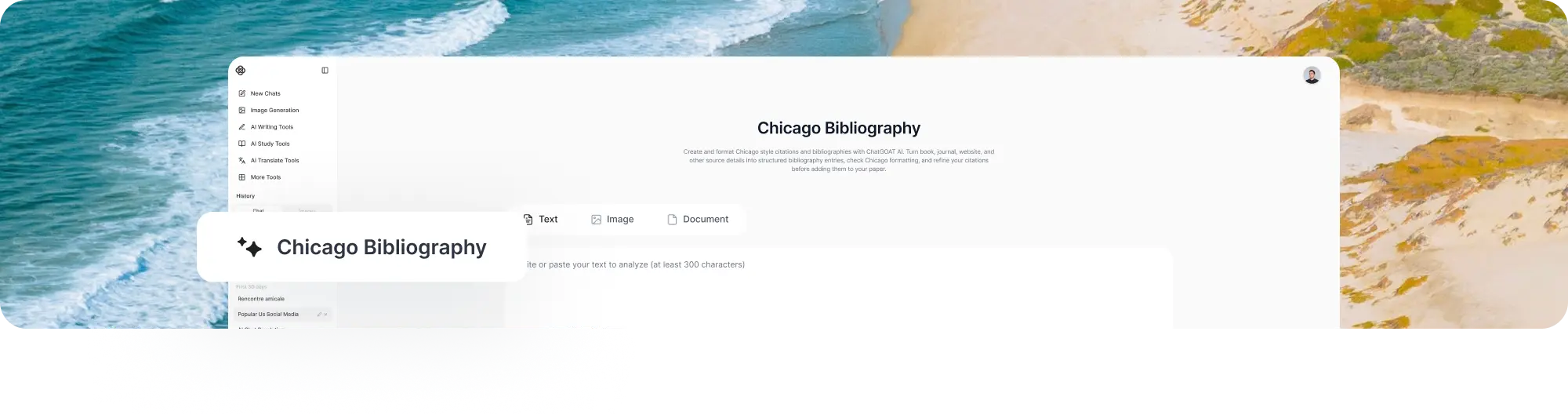
Creating a Chicago style bibliography involves more than listing your sources. Author names, titles, publication details, dates, and online information may need to be formatted differently depending on the source type and Chicago system you are using.
ChatGOAT AI can help organize the source information you provide into Chicago-style citations and bibliography entries. Give it a DOI, URL, title, author information, or other bibliographic details, then ask it to create or refine the entry.
You can also use ChatGOAT AI to review an existing bibliography, identify missing information, explain formatting choices, or convert citations from another style.
What Is a Chicago Style Bibliography?
A Chicago style bibliography is a list of sources that appears at the end of a paper or other academic work. In the Chicago Notes and Bibliography system, bibliography entries provide full information about the sources and are generally arranged alphabetically by author.
The Chicago Manual of Style also includes an Author-Date system, which normally uses a reference list rather than a Notes and Bibliography-style bibliography. The two systems organize and present source information differently, so it is important to confirm which one your assignment or publication requires.
Learning how to write a Chicago bibliography starts with understanding its basic structure. The first author's name is generally inverted, entries are arranged alphabetically, and sources that extend across multiple lines use a hanging indent. The details within each entry depend on the type of source you are citing.
How to Create a Chicago Style Bibliography with ChatGOAT AI
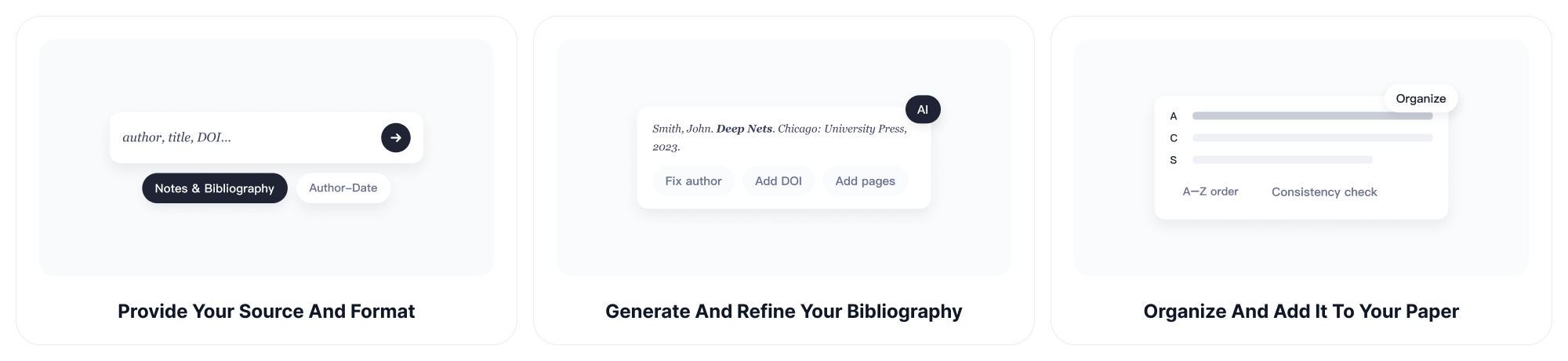
Step 1: Provide Your Source and Choose the Format
Give ChatGOAT AI the source details you have, such as the author, title, DOI, URL, publication information, or an existing citation. Specify whether you need a Notes and Bibliography entry or an Author-Date reference.
Step 2: Generate and Refine Your Bibliography
Ask ChatGOAT AI to format your source according to the appropriate Chicago system. Review the author name, title, publication details, date, page range, DOI, URL, and other source-specific information, then ask ChatGOAT AI to correct or add anything needed.
Step 3: Organize and Add It to Your Paper
For multiple sources, ask ChatGOAT AI to check consistency and arrange your bibliography alphabetically. Then add the finished bibliography to your paper according to your instructor's or publisher's requirements.
Chicago Style Bibliography Format
A Chicago bibliography normally appears at the end of the paper on a separate page. Entries are arranged alphabetically, and each source follows the formatting conventions appropriate to its type.
Alphabetical Order
Arrange entries alphabetically by the first author's last name. If there is no individual author, use the organization or other appropriate element for alphabetization.
Author Names
Invert the first author's name in a bibliography entry:
Smith, John.
For works with multiple authors, the first author's name is inverted while subsequent authors are generally written in their usual order.
Titles
Chicago bibliography entries distinguish between longer and shorter works. Books and other standalone works are generally italicized, while titles of articles, chapters, and other shorter works appear in quotation marks.
Hanging Indent
When an entry extends beyond one line, indent the subsequent lines so that each source is easy to identify.
Publication Details
The information included depends on the source. An entry may contain the publisher, publication year, journal volume and issue, page range, DOI, URL, access date, or other identifying details. For books, the 18th edition of The Chicago Manual of Style no longer requires the place of publication.
Because Chicago formatting varies by source type and can depend on the edition or specific publication requirements, check your instructor's or publisher's guidelines when they differ from general rules.
Need a citation in another style? Explore our more citation tools to find tools for other citation formats and source-related needs.
What Can ChatGOAT AI Create?
ChatGOAT AI can help you work with individual bibliography entries, Chicago style citations, multiple sources, or an existing bibliography. Instead of generating a single result and starting over when something needs to change, you can continue refining the same material through conversation.
Build Entries from Available Information
Give ChatGOAT AI the source details you have, even if some information is incomplete. It can organize the available information into a Chicago bibliography format and point out details that may need to be added or verified.
Keep Multiple Entries Consistent
Provide several sources and ask ChatGOAT AI to apply a consistent Chicago bibliography format across books, articles, websites, chapters, and other source types.
Organize a Complete Bibliography
Give ChatGOAT AI a collection of references and ask it to check consistency, identify potential issues, and help arrange entries alphabetically.
Understand the Formatting
Instead of simply receiving a formatted entry, ask why an author's name is inverted, why a title is italicized, or why a particular publication detail appears in the entry.
Refine Without Starting Over
If an entry is incomplete or needs to follow a specific requirement, continue the conversation to add information, correct details, or adjust the formatting without recreating the bibliography from scratch.
Generate Chicago Citations
Use ChatGOAT AI as a Chicago citation generator to create the citation format you need from your source information. Depending on your chosen Chicago system, you can work with bibliography entries, footnotes, endnotes, or author-date references.
Chicago Notes and Bibliography vs. Author-Date
Chicago style citation has two main systems: Notes and Bibliography and Author-Date. Chicago citation format depends on which system your assignment or publication requires.
Notes and Bibliography
The Notes and Bibliography system is commonly used in fields such as history, literature, and the arts. Sources are cited through footnotes or endnotes, while a bibliography can provide the full source information at the end of the paper.
A typical workflow is:
Main text → Footnote or endnote → Bibliography
The bibliography entry is formatted differently from the corresponding note, so a footnote should not simply be copied into the bibliography.
Author-Date
The Author-Date system uses parenthetical citations in the text, such as:
(Smith 2024, 25)
A reference list is generally used instead of a Notes and Bibliography-style bibliography. The publication year also appears much earlier in the entry, making it easier to connect the reference to the author-date citation.
If your assignment asks specifically for a Chicago style bibliography, confirm that it uses the Notes and Bibliography system rather than Author-Date.
Chicago Style Bibliography Examples
These Chicago bibliography examples show how the format changes across common source types. The exact details depend on the source and the Chicago documentation system being used.
Book
A basic book bibliography entry includes the author's name, book title, publisher, and publication year. An edition or other information can be added when relevant.
Johnson, Maria. Digital Worlds: Technology and Society. Beacon Press, 2024.
Journal Article
A journal article entry generally includes the author's name, article title, journal title, volume and issue, publication date or year, page range, and DOI when available.
Carter, Daniel. “Artificial Intelligence and Academic Research.” Journal of Digital Scholarship 12, no. 2 (2024): 115–32. https://doi.org/10.0000/example.2024.001.
Book Chapter
For a chapter in an edited book, identify the chapter author and title, followed by the larger work and its editor.
Lee, Hannah. “Language and Identity in Digital Communities.” In New Perspectives on Digital Culture, edited by Robert Miller, 85–104. Cambridge University Press, 2023.
Website
A website entry may include the organization or author, page title, website name, publication or update date, access date when appropriate, and URL. Chicago's current guidance notes that an access date can be used when a webpage does not provide a publication or revision date.
Digital Research Institute. “Research Data Management Guidelines.” Digital Research Institute. Accessed August 10, 2026. https://example.org/data-guidelines.
Newspaper or Magazine Article
For a newspaper or magazine article, include the author, article title, publication name, date, and URL when applicable.
Miller, James. “How Digital Archives Are Changing Historical Research.” The Daily Review, March 12, 2025. https://example.org/digital-archives.
Thesis or Dissertation
A thesis or dissertation bibliography entry identifies the author, title, type of work, institution, and year.
Chen, Emily. “Computational Models of Language Acquisition in Bilingual Children.” PhD diss., University of Michigan, 2024.
The required information can vary by source type. Review the original publication and the citation requirements for your assignment before finalizing a bibliography.
Why Use ChatGOAT AI for Chicago Style Bibliography?
Work with More Than One Source at a Time
Create or refine entries for books, journal articles, websites, chapters, newspapers, dissertations, and other sources without having to format every entry separately.
Keep Your Bibliography Consistent
Ask ChatGOAT AI to review multiple entries together and look for differences in author formatting, titles, punctuation, publication details, or other elements.
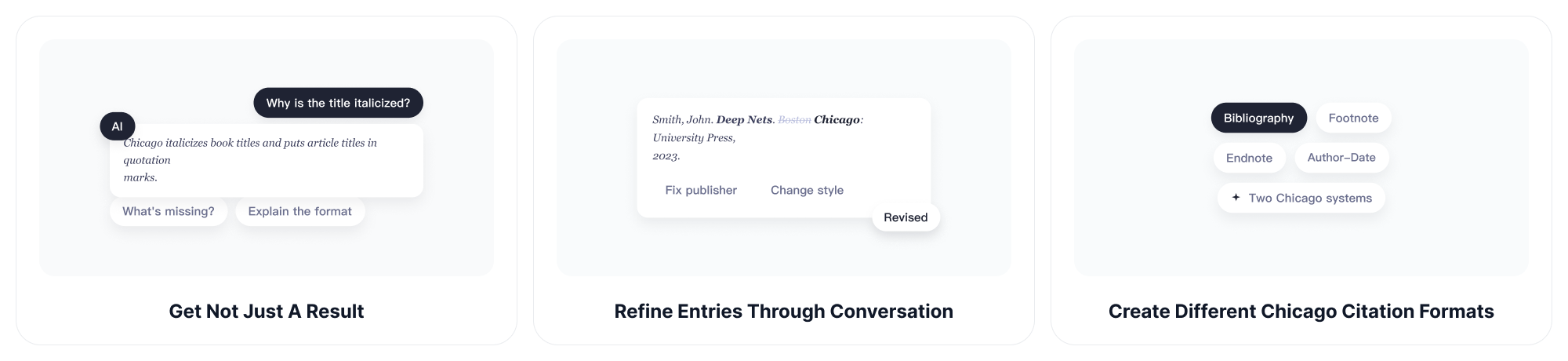
Get Not Just a Result
If you are unsure why a particular field is formatted a certain way, ask ChatGOAT AI to explain the Chicago bibliography format and identify information that may be missing.
Refine Entries Through Conversation
Add missing details, correct source information, change a formatting choice, or ask ChatGOAT AI to revise an entry based on your assignment requirements.
Create Different Chicago Citation Formats
Work with the Chicago Notes and Bibliography and Author-Date systems. Depending on your assignment, ChatGOAT AI can help you distinguish between bibliography entries, footnotes, endnotes, and author-date references.
Continue from Sources to Research Writing
Bibliography management is only one part of academic research. When you need to turn your research materials into a structured document, use the report generator to organize findings and develop a longer report.
Make Chicago Bibliography Formatting Easier
Managing a bibliography becomes more complicated as the number and variety of sources increase. A single paper may contain books, journal articles, websites, chapters, and other materials, each with different formatting requirements.
ChatGOAT AI can help you organize these sources into a consistent Chicago bibliography, explain individual formatting choices, and refine entries when information is missing or incorrect. For larger research projects, use the AI schedule maker to plan source collection, reading sessions, citation review, and writing deadlines from research to final submission.
FAQ
1. What is a Chicago style bibliography?
A Chicago style bibliography is an alphabetized list of sources that appears at the end of a paper or other academic work. In the Chicago Notes and Bibliography system, it provides full publication information for sources cited or consulted in the work.
2. What is the difference between a Chicago bibliography and a reference list?
A Chicago bibliography is associated with the Notes and Bibliography system, which uses footnotes or endnotes. The Chicago Author-Date system generally uses parenthetical author-date citations with a reference list. The two systems organize source information differently.
3. How do you format a Chicago style bibliography?
A Chicago bibliography is generally arranged alphabetically by the author's last name or the appropriate authoring organization. The first author's name is inverted, and entries that extend across multiple lines use a hanging indent. The exact format depends on the source type.
4. Does a Chicago bibliography go in alphabetical order?
Yes. Entries are normally arranged alphabetically by the author's last name or organization name. If no author is available, the entry is generally alphabetized according to the title or another appropriate element.
5. Do Chicago bibliography entries use a hanging indent?
Yes. A Chicago bibliography uses a hanging indent for entries that extend across multiple lines. The first line remains aligned with the left margin while subsequent lines are indented.
6. How do you format an author's name in a Chicago bibliography?
The first author's name is normally inverted, with the last name followed by the first name. For example:
Smith, John.
For works with multiple authors, the first author's name is inverted while subsequent authors are generally written in normal name order.
7. How do I cite different types of sources in a Chicago bibliography?
The format depends on the source. Books, journal articles, websites, book chapters, newspapers, dissertations, and other materials require different publication details. For example, a journal article may include the journal title, volume, issue, page range, and DOI, while a website may include the page title, site name, publication or revision date, access date, and URL.
8. How do I cite a book in a Chicago bibliography?
A basic book entry includes the author's name, book title, publisher, and publication year. Additional information may be needed for a specific edition, translation, editor, or other version. Under the current Chicago guidelines, the place of publication is no longer required for book citations.
9. How do I cite a journal article in a Chicago bibliography?
A journal article entry generally includes the author's name, article title, journal title, volume, issue, publication date or year, page range, and DOI or URL when applicable.
10. How do I cite a website in a Chicago bibliography?
A website entry may include the author or organization, page title, website name, publication or update date, access date when appropriate, and URL. If no publication or revision date is available, an access date may be appropriate under current Chicago guidance.
11. Does a Chicago bibliography need footnotes?
The bibliography itself does not contain footnotes. However, the Chicago Notes and Bibliography system uses footnotes or endnotes to cite sources within the main text, while the bibliography provides fuller source information at the end.
12. Can ChatGOAT AI create a Chicago bibliography from an existing citation?
Yes. You can provide an existing citation in APA, MLA, IEEE, or another style and ask ChatGOAT AI to convert it into a Chicago bibliography entry. Compare the result with the original source before using it.
13. Can ChatGOAT AI check an existing Chicago bibliography?
Yes. You can provide one or more entries and ask ChatGOAT AI to check formatting, author names, alphabetical order, missing source details, and consistency across the bibliography.
14. What is a Chicago annotated bibliography?
A Chicago annotated bibliography combines standard bibliography entries with annotations that summarize, evaluate, or explain each source. Annotation requirements can vary by assignment, so follow your instructor's guidelines.
15. Is ChatGOAT AI's Chicago bibliography generator free?
You can try ChatGOAT AI's AI tools for free to create and refine Chicago bibliography entries. Usage limits and additional features may vary depending on your account or plan.