


American Chemical Society Citation Generator
Create ACS in-text citations and reference entries without arranging authors, journal abbreviations, publication details, and DOIs manually. Add your source information and let ChatGOAT AI format it for your chemistry paper.
What Is an American Chemical Society Citation Generator?
An American Chemical Society citation generator formats sources according to ACS style, a citation system commonly used in chemistry papers, laboratory reports, dissertations, and scientific journal manuscripts.
ACS supports three common in-text citation methods: superscript numbers, italic numbers in parentheses, and author-date citations. The required method may depend on your instructor, institution, or target journal.
For example, a numbered paper may cite a source with superscript ¹ or an italicized (1). The corresponding reference contains the authors, title, abbreviated journal name, publication year, volume, page range, DOI, or other details required to identify the source.
The American Chemical Society citation machine reduces repetitive formatting, but every result should still be compared with the original source and the requirements of the relevant course or ACS journal.
How to Use ChatGOAT AI’s American Chemical Society Citation Generator
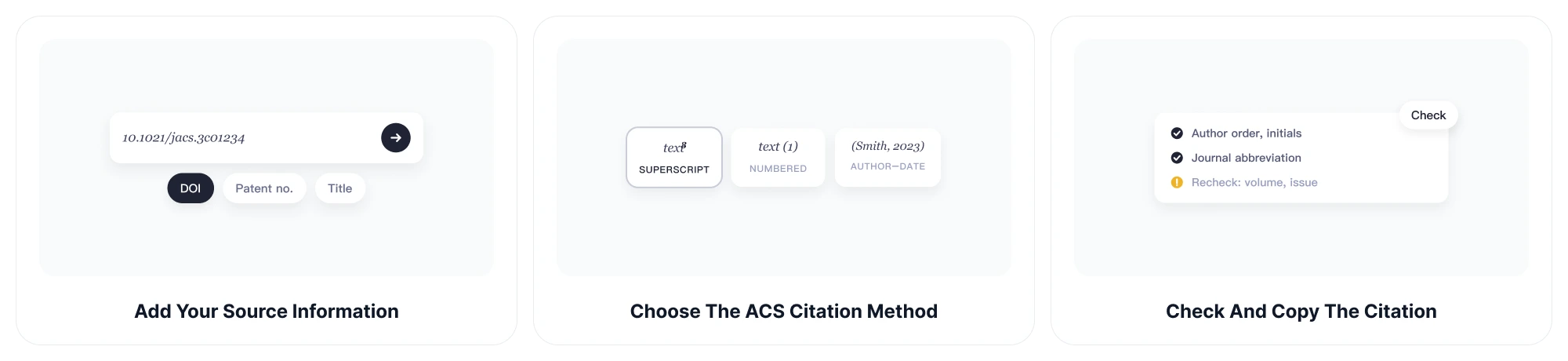
Step 1: Add Your Source Information
Enter a DOI, URL, ISBN, title, or the publication information you already have. Useful details may include the authors, article title, journal name, publication year, volume, issue, page range, publisher, patent number, access date, and DOI.
Step 2: Choose the ACS Citation Method
Tell ChatGOAT AI whether you need an in-text citation, a reference entry, or both. Specify whether your paper uses superscript numbers, parenthetical numbers, or author-date citations.
Example prompts:
- "Create an ACS reference for this journal article."
- "Format this DOI using ACS style."
- "Create a superscript citation and matching reference."
- "Convert these sources into an ACS bibliography."
- "Check this ACS reference for missing information."
Step 3: Check and Copy the Citation
Compare the result with the original publication. Verify the author order, initials, title, journal abbreviation, year, volume, issue, page range, URL, DOI, and citation method required by your instructor or journal.
What Can an American Chemical Society Citation Generator Create?
Superscript In-Text Citations
Many chemistry papers cite numbered sources using superscripts.
Example:
The catalyst produced a higher yield under acidic conditions.¹
Each source keeps the same number when it is cited again later in the paper.
Parenthetical Number Citations
Some ACS publications use italic reference numbers in parentheses.
Example:
The catalyst produced a higher yield under acidic conditions (1).
The number and parentheses should be italicized when this method is required. Use the same citation method throughout the document rather than switching between superscript and parenthetical numbers.
Author-Date Citations
ACS also supports author-date citations in some contexts.
Example:
The catalyst produced a higher yield under acidic conditions (Smith, 2024).
With the author-date method, references are generally arranged alphabetically by the first author’s surname instead of being numbered by their first appearance.
Journal Articles and DOIs
Format journal articles using the authors, article title, abbreviated journal title, year, volume, issue, page range or article number, and DOI.
General template:
Author, A. A.; Author, B. B. Article Title. Abbreviated Journal Title Year, Volume (Issue), Pages. DOI.
Journal titles may need to use the abbreviation required by ACS or the target publication. Article titles and DOI information should be copied from the original publication record.
Books and Book Chapters
Create references for complete books, edited books, and individual chapters.
General book template:
Author, A. A. Book Title; Publisher: Place of Publication, Year.
A chapter reference may also require the chapter title, editors, book title, edition, volume, publisher, year, and page range.
Websites and Online Sources
Format websites, chemistry databases, institutional pages, and other online resources using the available author or organization, page title, website name, URL, publication or update date, and access date.
General template:
Author or Organization. Page Title. Website Name. URL (accessed Month Day, Year).
Online information can change, so confirm that the page remains accessible and that the access date follows your instructor’s or journal’s requirements.
Patents, Theses, and Technical Reports
Create references for patents, dissertations, theses, government publications, conference materials, and technical reports.
Patents may require the inventor, assignee, patent number, and publication date. Theses and dissertations may require the author, title, degree type, institution, location, and year.
The AI spreadsheet generator can help organize source records, DOI information, experimental data, and research notes before you prepare the final citations.
Databases, Data Sets, and Software
Scientific work may cite chemical databases, data sets, software, computational tools, and online repositories. Provide the creator or organization, resource name, version when available, publication details, URL, DOI, and access date.
Complete ACS Reference Lists
Generate several references using one consistent ACS citation method. Numbered references generally follow the order in which sources first appear. Author-date reference lists are normally arranged alphabetically.
Check for repeated sources before submitting the paper so the same publication is not accidentally included more than once.
Why Choose ChatGOAT AI’s American Chemical Society Citation Generator?
Free and Unlimited Citation Support
Create, revise, and review ACS citations without manually rebuilding every reference. You can correct missing source details or request another format as your paper develops.
Multiple Advanced AI Models
ChatGOAT AI provides access to multiple AI models in one platform. For complex scientific sources that require careful reasoning and long-context analysis, Claude Opus 4.8 can help review the material before you prepare its citation.
Text, Image, and Document Input
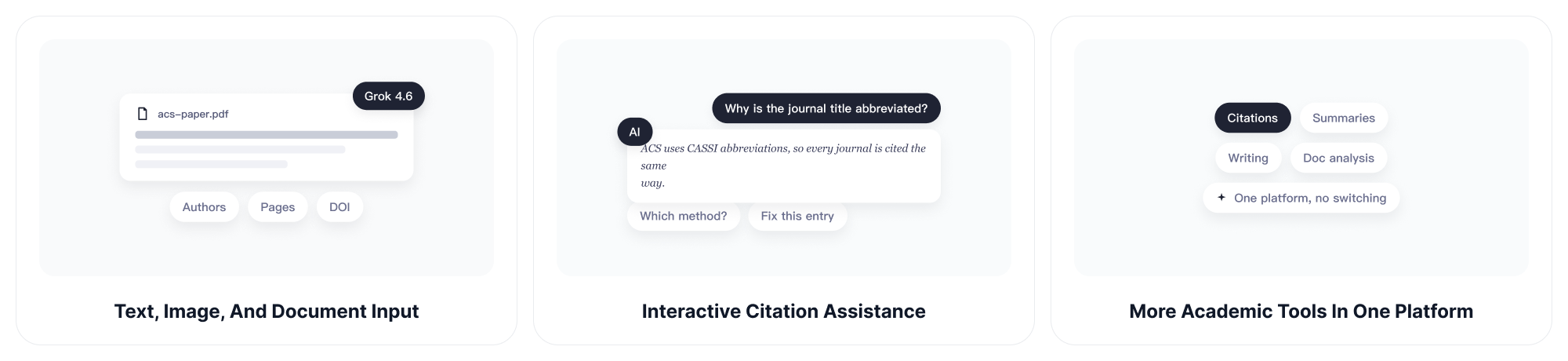
Enter source information as text or provide a readable image or document. ChatGOAT AI can help identify author names, titles, publication dates, page ranges, URLs, and DOI information without requiring you to type every field manually.
If the publication details are contained in a PDF, screenshot, or document, Grok 4.6 can help identify and organize the information needed for the reference.
Interactive Citation Assistance
Ask why a journal title is abbreviated, which in-text citation method to use, or what information is missing from a reference. You can request corrections and explanations instead of accepting a single static result.
More Academic Tools in One Platform
Continue working on source organization, summaries, writing, document analysis, and other research tasks without switching between unrelated platforms.
Who Can Use an American Chemical Society Citation Generator?
Chemistry Students
Create citations for chemistry essays, assignments, literature reviews, and laboratory reports without memorizing every punctuation and ordering rule.
Laboratory Report Writers
Format journal articles, textbooks, experimental methods, chemical databases, laboratory manuals, and technical websites used to explain procedures and results.
Graduate Students
Manage citations for research proposals, dissertations, theses, systematic reviews, and longer academic projects containing many scientific sources.
Chemistry Researchers
Prepare references for journal manuscripts, conference papers, technical reports, presentations, and supporting materials. Always check the author guidelines of the journal receiving the manuscript.
Teachers and Academic Editors
Review student bibliographies, identify incomplete source information, and check whether in-text citations correspond with the correct reference entries.
Students in Related Sciences
Use the American Chemical Society citation generator for biochemistry, chemical engineering, materials science, pharmaceutical science, environmental chemistry, and other courses requiring ACS style.
FAQ
What Is the American Chemical Society Citation Style?
American Chemical Society citation style is a system for documenting sources in chemistry and related scientific fields. It provides rules for in-text citations, reference lists, journal abbreviations, author names, titles, publication details, and electronic sources.
Is ACS the Same as American Chemical Society Citation Style?
Yes. ACS is the standard abbreviation for the American Chemical Society. An ACS citation generator and an American Chemical Society citation generator serve the same basic search intent.
What In-Text Citation Methods Does ACS Use?
ACS recognizes three common methods:
- Superscript numbers
- Italic numbers in parentheses
- Author-date citations
Check your instructor’s directions or the target journal’s author guidelines before choosing a method.
Does ACS Use Superscript Citations?
Many ACS journals and chemistry courses use superscript reference numbers, but superscripts are not the only ACS method. Parenthetical numbers and author-date citations may also be accepted.
How Are ACS References Ordered?
With numbered citation methods, references generally appear in the order in which they are first cited. With the author-date method, references are normally arranged alphabetically by the first author’s surname.
How Do I Cite a Journal Article in ACS Style?
Include the authors, article title, abbreviated journal title, publication year, volume, issue when required, page range or article number, and DOI when available.
Do ACS Citations Include Article Titles?
Current ACS guidance encourages complete references that include article titles. However, individual journals and instructors may apply different requirements, so check the relevant submission or assignment guidelines.
How Do I Cite a Website in ACS Style?
Include the available author or organization, page title, website name, URL, and access date. Add publication or update information when it is available and required.
Should I Include a DOI in an ACS Reference?
Include the DOI when it is available and requested by the target journal or instructor. Copy it from the original publication record to avoid transcription errors.
How Do I Cite a Source with Several Authors?
ACS references normally list authors in the order shown by the original publication. Separate individual authors according to the required ACS format and do not change the original author order.
Can I Cite a PDF with the American Chemical Society Citation Generator?
Yes, but a PDF is a file format rather than a source type. Identify whether the PDF is a journal article, report, thesis, book chapter, conference paper, or another publication, then provide the relevant source details.
Can I Use an American Chemical Society Citation Generator for a Lab Report?
Yes. It can help format textbooks, journal articles, laboratory manuals, chemical databases, technical reports, and websites used in a chemistry laboratory report.
Is an American Chemical Society Citation Machine Different from a Generator?
No. American Chemical Society citation machine, American Chemical Society citation generator, and ACS citation generator generally describe tools that format sources according to ACS style.
Is the American Chemical Society Citation Generator Free?
Yes. ChatGOAT AI provides free access for creating and reviewing American Chemical Society in-text citations and reference entries.