


AI Purity Test
Find out how much artificial intelligence has become part of your everyday life. Answer a series of questions about your AI experiences and receive an AI purity score you can reflect on or compare with friends.
What Is an AI Purity Test?
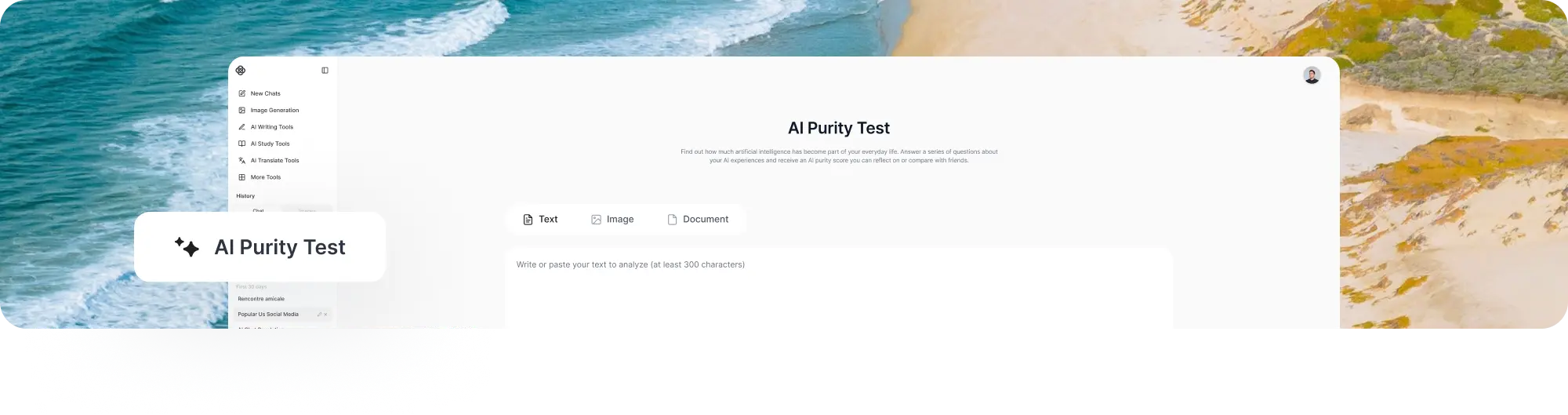
An AI purity test is a lighthearted self-assessment inspired by the checklist format of online purity tests. Instead of asking about general life experiences, it asks whether you have used or encountered AI in areas such as searching, writing, studying, work, image creation, entertainment, relationships, decision-making, and advanced technology.
Your answers are converted into an AI purity score from 0 to 100. A higher score generally represents fewer AI-related experiences, while a lower score reflects broader or deeper exposure to AI. The number is meant to encourage curiosity and conversation, not label someone as good, bad, skilled, dependent, or "pure."
The phrase "AI purity test" is also sometimes used by AI-detection websites to describe a score for written content. That is a different purpose. This page focuses on your personal AI experiences; if you need to analyze whether a passage contains possible machine-generated patterns, use an AI detector instead.
The test is not a scientific, medical, psychological, educational, or professional assessment. Answer for fun and self-reflection, and do not use the score to diagnose yourself or judge another person.
How to Use ChatGOAT AI's AI Purity Test
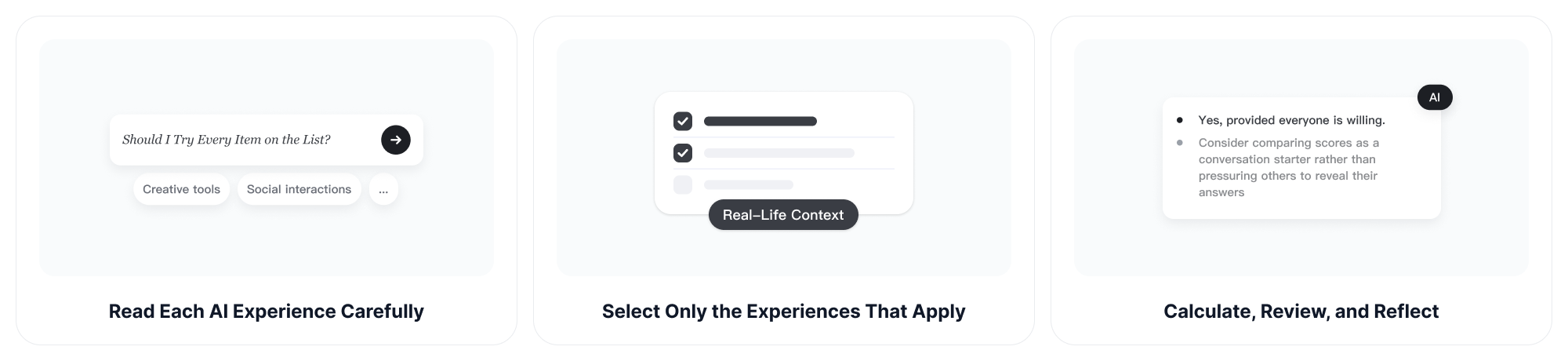
Step 1: Read Each AI Experience Carefully
Work through the questions from beginning to end. They may cover everyday chatbot use, AI-assisted writing, creative tools, social interactions, personal decisions, technical use, and less common situations.
Step 2: Select Only the Experiences That Apply
Mark an item only when you have genuinely done or experienced it. Do not select an answer because it sounds interesting, and do not treat unusual or risky questions as suggestions to try something new.
Step 3: Calculate, Review, and Reflect
Submit your answers to receive your AI purity score. Read the result as a snapshot of your past exposure to AI, not a permanent identity or a measure of personal worth. Notice which parts of your life involve AI most often, compare experiences without judging one another, or retake the test later to see how your habits have changed.
What Can an AI Purity Test Reveal?
Everyday AI Use
Questions may cover using chatbots instead of search engines, asking AI for recommendations, learning prompting techniques, or relying on AI for small daily tasks. These common experiences help show how naturally AI has entered your routine.
Writing, Study, and Work Habits
The test can reflect whether you have used AI for homework, professional tasks, resumes, emails, brainstorming, research, coding, or document preparation. A checked item records an experience; it does not determine whether that use followed your school or workplace policy.
Creative AI Experiences
Creative questions may include generating or editing images, producing music or sound effects, making videos, designing characters, or posting generated media. If you want to explore visual creation after the test, the AI image generator provides a separate creative workflow.
Social and Emotional Interactions
Some questions examine conversations with AI, emotional reactions to chatbots, AI companionship, relationship advice, or the choice to share personal thoughts with a model. These items are prompts for reflection rather than psychological conclusions.
Spending and Technology Adoption
Your result may also reflect whether you have paid for an AI service, followed a model launch, attended an AI event, used an API, tried function calling, fine-tuned a model, or purchased AI-powered hardware.
Trust, Privacy, and Disclosure
The checklist can highlight moments when you accepted AI output without verification, concealed AI assistance, posted AI-generated content without disclosure, or connected an AI product to personal accounts. These experiences can lead to useful conversations about transparency and data sharing.
Ethical and High-Risk Situations
The furthest end of the test may include rare, unsafe, illegal, or ethically serious scenarios. Their presence does not make them recommendations or challenges. Do not attempt an action simply to lower your score or complete the checklist.
A Score for Conversation, Not Diagnosis
Your result offers a simple way to discuss AI exposure, but it cannot measure addiction, intelligence, morality, mental health, or professional competence. Frequency, context, consequences, and personal boundaries matter more than one number.
Why Choose ChatGOAT AI's AI Purity Test?
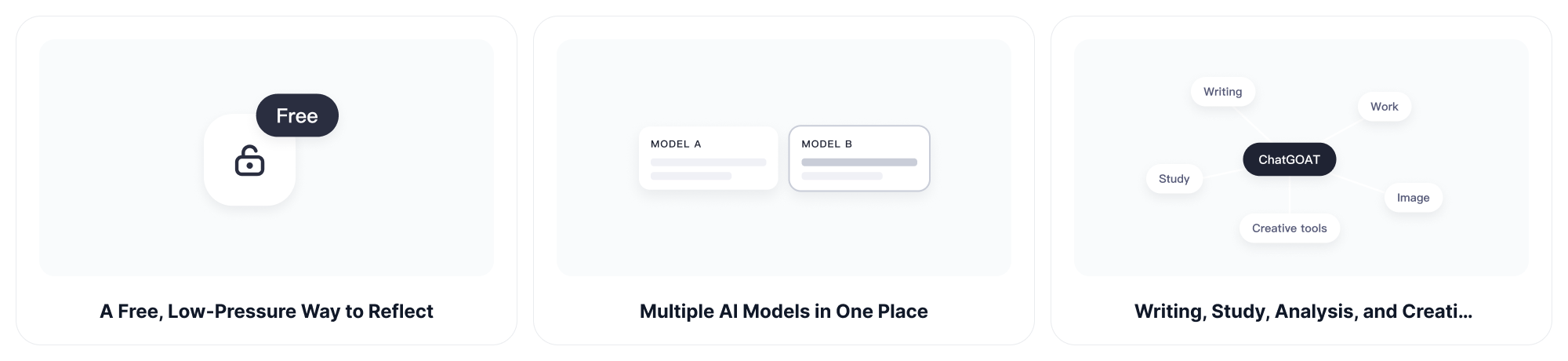
A Free, Low-Pressure Way to Reflect
Take the test for curiosity without treating the result like an exam. There are no correct experiences to collect and no ideal score everyone should try to reach.
Clear Explanations in One Conversation
ChatGOAT AI can explain unfamiliar AI terms, clarify what a question means, and help you think through the result. You can ask follow-up questions instead of receiving a score with no context.
Explore New AI Models on the Same Platform
The test may make you curious about how newer models differ from the tools you have already tried. GPT-6 Astra is one of the newer model pages available on ChatGOAT AI for exploring current AI capabilities in a separate workflow.
Multiple AI Models in One Place
ChatGOAT AI provides access to multiple models, so you can compare how different systems answer the same question or handle the same task. This broader platform experience is useful when your test result raises questions about the tools you use most often.
Writing, Study, Analysis, and Creative Tools Together
Continue from self-reflection to practical tasks without moving between unrelated services. ChatGOAT AI brings writing, study, document analysis, image, and creative tools into the same broader platform.
Who Can Take an AI Purity Test?
Curious AI Users
Take the test to see how many AI-related experiences have become part of your routine, including activities you may no longer notice as unusual.
Students and Educators
Use the questions to start a discussion about acceptable AI assistance, disclosure, verification, academic integrity, and the difference between support and substitution.
Professionals and Remote Teams
Reflect on how AI appears in meetings, emails, research, planning, customer communication, hiring, analysis, and decision-making. The score does not evaluate job performance or policy compliance.
Writers, Designers, and Creators
Review your exposure to AI writing, image generation, editing, music, video, brainstorming, and character tools. Creative use can be frequent while still involving substantial human judgment and revision.
Developers and Technical Users
See whether your experience includes APIs, function calling, model evaluation, fine-tuning, AI-assisted coding, automation, or building products around language and multimodal models.
Friends and Online Communities
Compare scores for entertainment and conversation while respecting personal boundaries. Nobody should be pressured to reveal private experiences or explain an answer they prefer to keep private.
People Reassessing Their AI Habits
Retake the test after a few months to notice changes in your behavior. A different score may reflect new tools, different work requirements, changing interests, or stronger personal boundaries.
AI Purity Test FAQs
What Does an AI Purity Test Measure?
It measures the number or range of AI-related experiences you report on a checklist. It reflects exposure and behavior across several areas, not the quality or morality of your AI use.
What Is an AI Purity Score?
An AI purity score is the numerical result produced from your answers. It usually ranges from 0 to 100, with higher scores indicating fewer selected AI experiences and lower scores indicating more.
Is a High AI Purity Score Better?
No. A high score is not automatically better, and a low score is not automatically worse. The result is designed for entertainment and reflection, not competition, diagnosis, or judgment.
How Is the AI Purity Score Calculated?
The score begins at 100 and decreases as more listed experiences are selected. Because different versions of the test may use different questions or weighting, compare scores only when people completed the same version.
Is This the Same as an AI Content Detector?
No. This test evaluates your reported experiences with AI. An AI content detector analyzes patterns in text and estimates whether the writing may have been generated by a model.
Does the Test Prove That I Depend on AI?
No. A checklist cannot determine dependence or addiction. It does not fully capture frequency, motivation, context, consequences, or your ability to complete tasks without AI.
Should I Try Every Item on the List?
No. The test is not a bucket list, dare, or challenge. Some items may describe unsafe, unethical, illegal, or extremely rare behavior and should never be attempted for a score.
Can I Compare My Score with Friends?
Yes, if everyone is comfortable. Treat the comparison as a conversation starter, avoid pressuring anyone to disclose answers, and remember that different lifestyles and jobs create different levels of AI exposure.
Can I Retake the AI Purity Test?
Yes. Retaking it later can show how your experiences have changed as new tools appear or your habits evolve. It is not necessary to aim for a particular direction.
Is the AI Purity Test Scientifically Validated?
No. It is an informal, entertainment-focused self-assessment inspired by online checklist quizzes. It should not be used for clinical, legal, academic, hiring, or disciplinary decisions.
Is ChatGOAT AI's AI Purity Test Free?
Yes. You can take the AI purity test and review your result for free. Availability of other platform tools and model features may vary.