


ACS Citation Generator
Create ACS-style references and in-text citations with ChatGOAT. Enter a DOI, URL, title, or source details and get a citation you can review, edit, and use in your academic work.
Create ACS Citations Without Formatting Everything by Hand
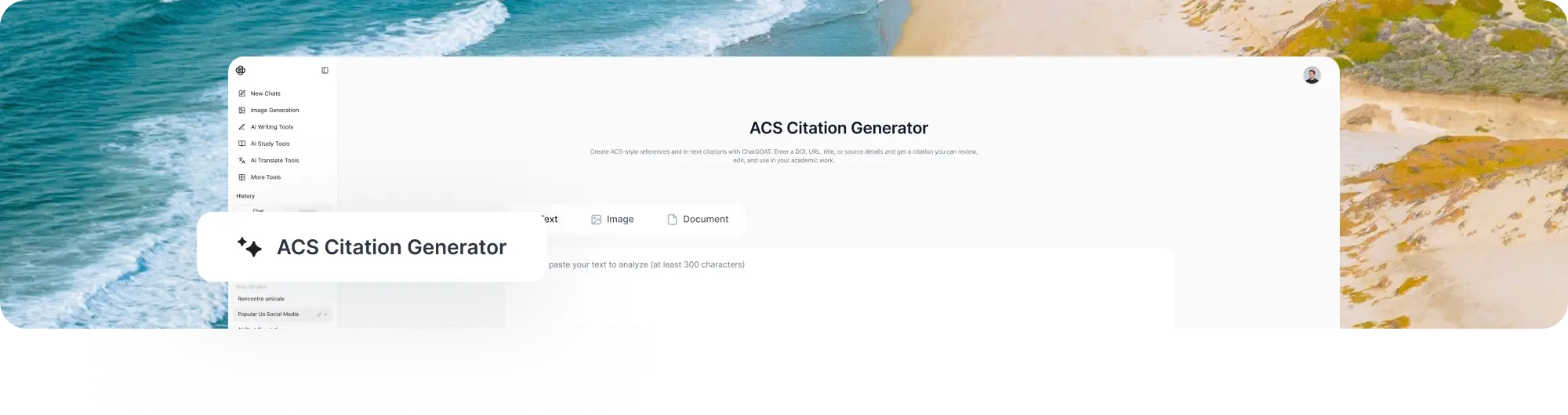
Citation formatting can become tedious when you are working with dozens of sources.
Instead of manually arranging author names, titles, journal information, publication details, and DOI information, ChatGOAT helps turn the source details you already have into an ACS-style citation.
Generate an ACS citation, create an ACS in-text citation, or refine an existing reference before adding it to your paper.
Whether you are writing a chemistry lab report, research paper, thesis, or scientific manuscript, ChatGOAT gives you a faster way to handle repetitive citation formatting.
From Source Details to an ACS Reference
You do not need to reconstruct a complete reference before getting started. Give ChatGOAT the information you have, then review the generated result.
Start with a DOI, URL, or Title
Enter a DOI, URL, article title, author information, or other publication details. A DOI can be particularly useful for journal articles because it provides a unique identifier for the source.
Generate a Complete Reference
ChatGOAT organizes the available information into an ACS-style reference, including relevant details such as authors, title, journal, year, volume, pages, publisher, or DOI depending on the source type.
Create the Corresponding In-Text Citation
Need to cite the source in your paper as well?
ChatGOAT can help create the corresponding ACS in-text citation so you can connect the source in your text with its full reference.
Review and Edit the Result
Treat the generated citation as an editable starting point. Check author names, publication details, journal information, DOI, and other source data against the original publication before submission.
For questions about citation rules or other academic writing tasks, you can also use AI chat.
Example: Create an ACS Citation from a Book
You do not always have a DOI to work with. For books and other sources, you can provide the publication information you already have.
Input
Steeped: The Chemistry of Tea
Mary Francl
Royal Society of Chemistry, 2024
Generated ACS Citation
Francl, M. Steeped: The Chemistry of Tea; Royal Society of Chemistry, 2024.
The generated result gives you a structured starting point that you can check against the original publication and your required ACS guidelines.
ACS Citation Before and After
Even when all the source information is correct, manually formatting it can lead to inconsistent punctuation, author formatting, or publication details.
Before
Francl M Steeped The Chemistry of Tea Royal Society of Chemistry 2024
After
Francl, M. Steeped: The Chemistry of Tea; Royal Society of Chemistry, 2024.
An ACS citation tool helps organize the available information into a consistent citation format, reducing repetitive manual formatting.
Always verify the final reference against the original source and the requirements of your course, institution, or target publication.
Understanding ACS Citation Style
ACS style is widely used in chemistry and related scientific disciplines. Unlike citation styles that primarily rely on author names and publication years in the text, ACS commonly uses numbered references linked to a numbered bibliography. The exact presentation can vary depending on the publication or assignment.
Common ACS Reference Elements
A journal article reference may include:
| Element | Typical ACS Treatment |
| Authors | Surname followed by initials |
| Multiple authors | Separated by semicolons |
| Article title | Included according to the applicable ACS format |
| Journal | Appropriate journal abbreviation |
| Year | Publication year |
| Volume | Journal volume |
| Pages | Page range or article number |
| DOI | Included when available |
Journal abbreviations are an important part of ACS references, and CASSI is commonly used as the source for standard journal abbreviations.
ACS In-Text Citations
ACS publications commonly use numbered citations corresponding to entries in the reference list. Some ACS publications use superscript numbers, while other citation formats may apply depending on the journal or assignment.
Always follow the specific instructions provided by your instructor, institution, or target journal.
Built for Chemistry and Scientific Writing
ACS style is particularly common in chemistry and related scientific fields, making citation management an important part of scientific writing.
ChatGOAT can help when you are preparing:
- Chemistry lab reports
- Research papers
- Literature reviews
- Theses and dissertations
- Scientific manuscripts
- Academic assignments
For larger research projects, you can also use the AI schedule maker to organize research tasks, writing deadlines, and citation work.
Why Use ChatGOAT for ACS Citations?
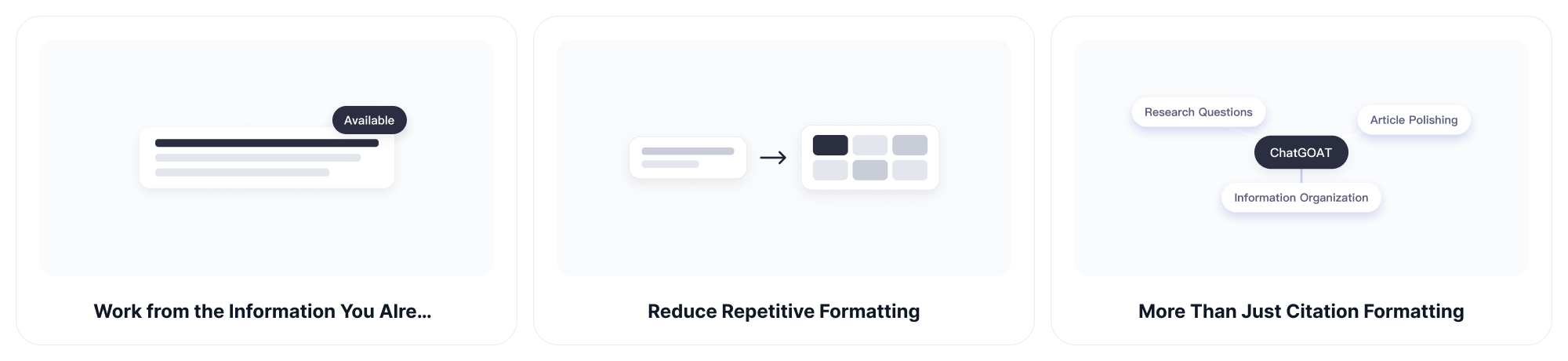
Work from the Information You Already Have
Start with a DOI, URL, title, or partial publication information instead of rebuilding the reference manually.
Reduce Repetitive Formatting
Let AI handle the repetitive work of arranging source details into an ACS-style citation, so you can focus on your research.
Keep Every Citation Editable
Generated citations are not locked. Review the result, correct source information, and adjust the formatting when your assignment or publication requires it.
Support More Than Citation Formatting
ChatGOAT can fit into a broader academic workflow. Use it to research questions, refine writing, organize information, and work through other academic tasks with AI.
For larger assignments, the AI report generator can also help turn notes, ideas, and data into structured reports.
How to Create an ACS Citation with ChatGOAT

Step 1: Add Your Source
Enter a DOI, URL, article title, author information, or other source details you have available.
Step 2: Generate Your Citation
ChatGOAT analyzes the information and creates an ACS-style reference. You can also generate the corresponding in-text citation.
Step 3: Review and Refine
Compare the result with the original source, correct any missing or inaccurate details, and adjust the citation according to your assignment or publication guidelines.
When an ACS Citation Generator Can Save You Time
Chemistry Lab Reports
Format references for research articles, experimental methods, and supporting sources used in laboratory assignments.
Research Papers
Keep citations consistent while working with sources across a chemistry or scientific research project.
Literature Reviews
Create structured references while reviewing and comparing findings from multiple studies.
Theses and Dissertations
Reduce repetitive formatting work when building large reference lists across multiple chapters.
Scientific Manuscripts
Prepare ACS-style references and in-text citations while drafting chemistry and related scientific manuscripts.
FAQ
1. What is an ACS citation generator?
An ACS citation generator is a tool that formats source information according to American Chemical Society (ACS) citation conventions. It helps organize details such as authors, titles, journal information, publication dates, pages, and DOI into an ACS-style reference.
2. How do I create an ACS citation?
Start with the source information you already have, such as a DOI, URL, article title, author details, or publication information. Enter the details into ChatGOAT, generate the citation, and review the result before using it in your paper.
3. Can I create an ACS citation from a DOI?
Yes. A DOI is a useful starting point for identifying a journal article and its publication details. Enter the DOI into ChatGOAT to create an ACS-style citation, then compare the result with the original source.
4. Can ChatGOAT generate ACS in-text citations?
Yes. ChatGOAT can help create an ACS in-text citation together with the corresponding reference. ACS publications commonly use numbered citations, but the exact format can vary by journal or assignment.
5. What types of sources can I cite in ACS style?
ACS style can be used for many source types, including journal articles, books, book chapters, websites, theses, dissertations, and conference papers. The information required varies by source type.
6. Can I check an existing ACS citation?
Yes. You can provide an existing reference and use ChatGOAT to help identify formatting or source-information issues. Always compare the result with the original publication before submitting it.
7. Does ChatGOAT guarantee that an ACS citation is correct?
No. An AI-generated citation should be treated as a starting point rather than a substitute for source verification. Check author names, publication details, journal information, DOI, and other elements against the original source and follow the requirements of your instructor or target journal.
8. Is ChatGOAT's ACS citation generator free?
You can try ChatGOAT's ACS Citation Generator for free to see how it works. Usage limits and additional features may vary depending on your account or plan.