


Physics AI
Give ChatGOAT AI your context, source material, and desired outcome. The AI agent analyzes the task, considers the important constraints, plans the response, and executes an editable result you can improve through follow-up instructions.
What Is a Physics AI?

Physics AI is a conversational problem-solving tool that helps translate physical situations into models, variables, equations, and justified solution steps. It can explain concepts and calculations, but useful physics support must keep assumptions, sign conventions, units, diagrams, and physical interpretation visible.
With ChatGOAT AI, start with the full problem, known and unknown quantities, units, diagram description, coordinate direction, assumptions, relevant formulas, and any work you have already attempted. The AI agent analyzes the information, considers the task and constraints, summarizes the important direction, and executes a draft you can refine through follow-up instructions.
What Can the Physics AI Create?
The physics AI supports several related outputs without treating every request as the same template. Choose the capabilities that match the result you actually need.
Mechanics, Motion, Forces, Energy, and Momentum
ChatGOAT AI can create mechanics, motion, forces, energy, and momentum from the details you provide. It analyzes how this element supports the main task, keeps it aligned with the requested audience and format, and lets you revise individual parts without discarding the entire result.
Waves, Sound, Optics, and Oscillations
Use the physics AI to develop waves, sound, optics, and oscillations. Specify what must remain accurate, what can be invented or adjusted, and how detailed the output should be so the result serves a real next step. Use the AI Study Guide Maker to organize laws, definitions, and common models before working through mixed-topic problems.
Electricity, Circuits, Magnetism, and Fields
ChatGOAT AI can create electricity, circuits, magnetism, and fields from the details you provide. It analyzes how this element supports the main task, keeps it aligned with the requested audience and format, and lets you revise individual parts without discarding the entire result.
Thermal Physics, Fluids, and Basic Modern Physics
Use the physics AI to develop thermal physics, fluids, and basic modern physics. Specify what must remain accurate, what can be invented or adjusted, and how detailed the output should be so the result serves a real next step.
Unit Analysis, Diagrams, Formulas, and Conceptual Explanations
ChatGOAT AI can create unit analysis, diagrams, formulas, and conceptual explanations from the details you provide. It analyzes how this element supports the main task, keeps it aligned with the requested audience and format, and lets you revise individual parts without discarding the entire result.
How to Use the Physics AI on ChatGOAT AI
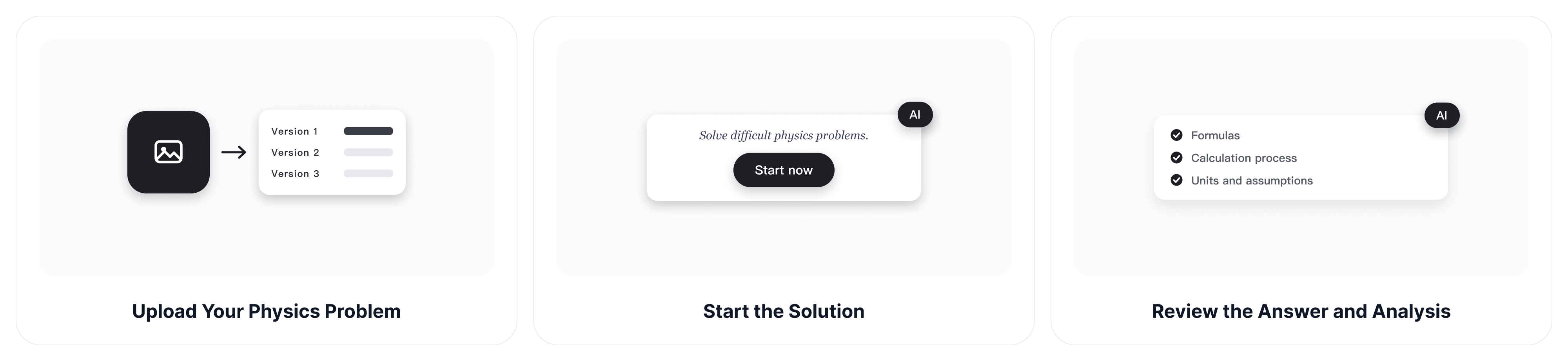
Solve a physics problem in three straightforward steps.
Step 1: Upload Your Physics Problem
Enter the question as text or upload an image containing the problem or related materials. Include any diagrams, values, units, formulas, or attempted work that may help clarify the question.
Step 2: Start the Solution
Click the Start now button to let ChatGOAT AI read the provided information, identify the relevant physics concepts, and work through the problem.
Step 3: Review the Answer and Analysis
Receive the final answer together with the solution steps and an explanation of the reasoning used. Review the formulas, calculations, units, and assumptions to understand how the result was obtained.
Physics AI vs. Equation Solver
Both can provide a starting point, but they solve different problems. An equation solver manipulates an entered formula, while ChatGOAT AI helps choose the model, define variables, state assumptions, solve, and interpret whether the result is physically reasonable.
| Equation Solver | Physics AI |
| Manipulates an entered formula | Helps choose the model, define variables, state assumptions, solve, and interpret whether the result is physically reasonable |
| Useful for a broad or random starting point | Useful when the output must follow your context, goal, and constraints |
Physics AI Use Cases
Use the physics AI when the output needs to support a specific real-world task. The following examples show how different users can define a clearer goal.
Students Working on Word Problems
Students Working on Word Problems can use ChatGOAT AI to translate a written situation into a diagram, define variables, select principles, and follow the calculation with units and signs. The result remains an editable starting point, so users can preserve their own judgment, subject knowledge, and final voice.
Learners Reviewing Concepts
Learners Reviewing Concepts can use ChatGOAT AI to compare related ideas such as velocity and acceleration, force and energy, or voltage and current through explanations and examples. The result remains an editable starting point, so users can preserve their own judgment, subject knowledge, and final voice. The AI Mind Map Generator can show how quantities, principles, diagrams, and conditions connect across a physics unit.
Lab Students
Lab Students can use ChatGOAT AI to check unit conversions, expected relationships, graph interpretation, uncertainty reasoning, and whether a result is plausible without fabricating observations. The result remains an editable starting point, so users can preserve their own judgment, subject knowledge, and final voice.
Teachers and Tutors
Teachers and Tutors can use ChatGOAT AI to create worked examples, conceptual questions, alternative explanations, and practice sets while independently checking every solution. The result remains an editable starting point, so users can preserve their own judgment, subject knowledge, and final voice.
Why Choose ChatGOAT AI

Start with the Physical Model
ChatGOAT AI can identify the system, known quantities, assumptions, and relevant physical principles before selecting equations and calculating the result.
Connect Physical Concepts with the Math
See how diagrams, units, sign conventions, formulas, and intermediate steps relate to one another, making the solution easier to understand and verify.
Continue Exploring the Same Problem
Ask why a particular principle applies, correct an assumption, compare different methods, or request a simpler explanation without entering the entire problem again.
For regular physics practice, use the AI Schedule Maker to organize study sessions, review topics, and problem-solving time.
Physics AI FAQ
1. What is a physics AI?
Physics AI is a conversational problem-solving tool that helps translate physical situations into models, variables, equations, and justified solution steps. It can explain concepts and calculations, but useful physics support must keep assumptions, sign conventions, units, diagrams, and physical interpretation visible.
2. What information should I provide?
Start with the full problem, known and unknown quantities, units, diagram description, coordinate direction, assumptions, relevant formulas, and any work you have already attempted. Add the audience, goal, length, format, and any facts or wording that must be preserved. More specific instructions usually produce a more relevant first draft.
3. Can I revise the generated result?
Yes. Ask ChatGOAT AI to change the length, tone, structure, difficulty, detail, or selected sections. Targeted follow-up instructions are usually more efficient than generating an unrelated result from the beginning.
4. Is the physics AI free?
ChatGOAT AI is free to try. Current usage limits and advanced features may vary by account or plan, so check the live product interface for the latest availability.
5. How accurate is AI-generated content?
Accuracy depends on the task, prompt, and source material. Verify important facts, calculations, citations, safety information, and specialized claims with authoritative sources or qualified people before relying on the result.
6. Can I use my own notes or documents?
Yes. Provide relevant text or a readable document and explain which sections matter. Ask the AI to stay grounded in the supplied source when outside information would be inappropriate or confusing.
7. Who should review the final output?
The person responsible for using or publishing the result should review it. AI can accelerate analysis and drafting, but it does not replace subject expertise, professional judgment, institutional rules, or final editorial control.
Create with the Physics AI
Add the full problem, known and unknown quantities, units, diagram description, coordinate direction, assumptions, relevant formulas, and any work you have already attempted, then tell ChatGOAT AI what the final result must accomplish. It will analyze the context, plan the response, execute the task, and help you refine the output in one conversation.