
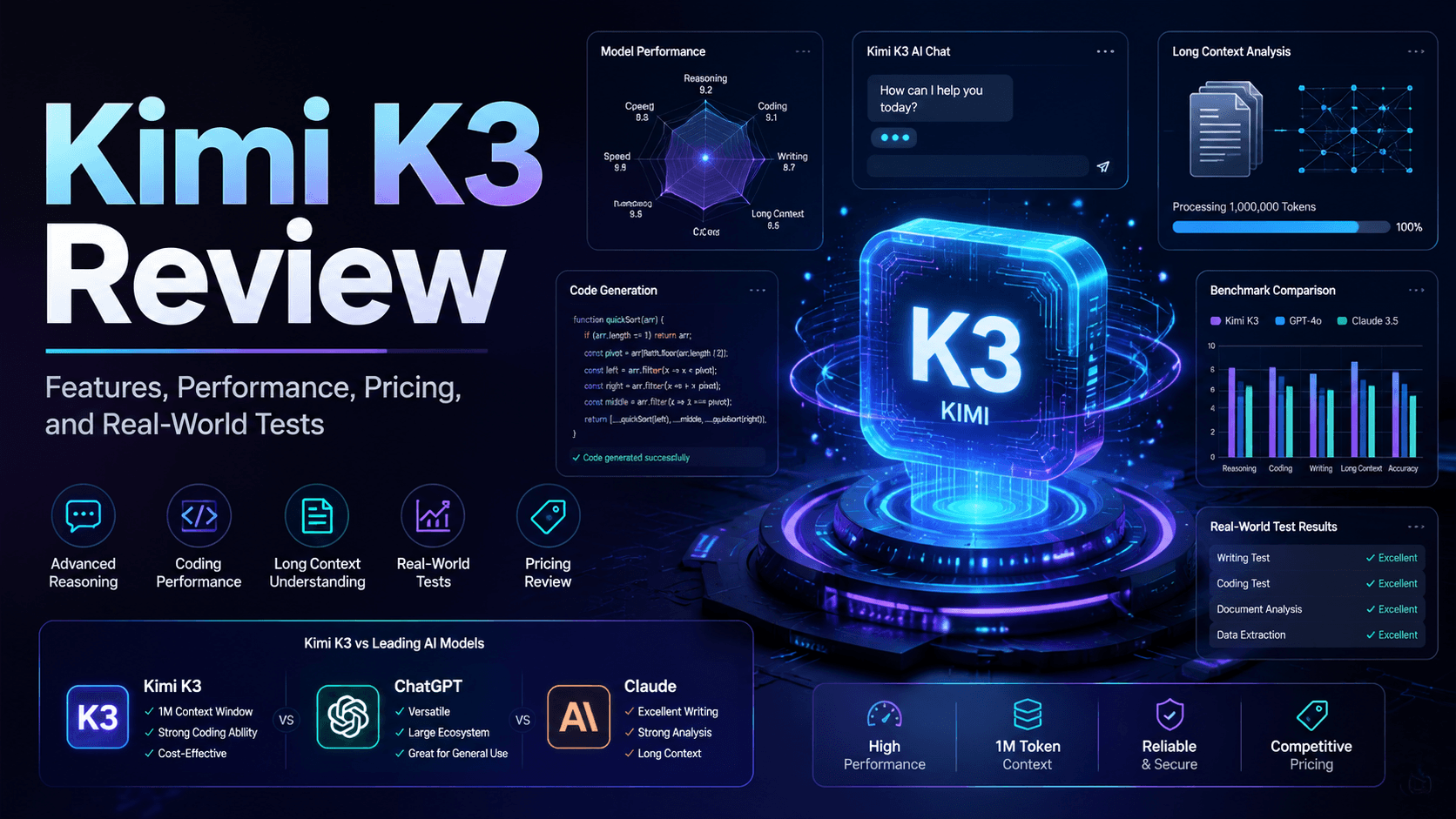
The AI model market has never moved this fast. Every few weeks brings a new frontier release, and the gap between the top closed-source labs and the fastest-moving open-weight challengers keeps narrowing. Into that environment, Moonshot AI dropped Kimi K3 on July 16, 2026 - a 2.8-trillion-parameter model that the company calls the largest open-weight system released to date.
This Kimi K3 review covers what you actually need to decide whether to use it: its core features, how it performs on independent and vendor benchmarks, what it costs to run, how it holds up in hands-on tests, and how it compares against ChatGPT and Claude. We'll also look honestly at where the numbers are still vendor-reported claims rather than fully independent results, since that distinction matters a lot right now.
The short version, before we dig in: Kimi K3 is a genuinely strong coding and long-context model with a huge one-million-token window and aggressive pricing, and it's worth serious consideration if your workload leans toward software engineering, large documents, or agentic research tasks. It isn't the outright leader on every benchmark, and a few practical quirks are worth knowing before you commit a production workflow to it.
What Is Kimi K3?
Kimi K3 is the flagship large language model from Moonshot AI, a Beijing-based AI lab that has spent the last couple of years building out its Kimi model family. K3 is positioned as a long-horizon agent model aimed at software engineering, knowledge work, and multimodal reasoning, rather than a simple chat-first assistant.
Two architectural choices underpin the model: Kimi Delta Attention, a hybrid linear attention mechanism, and Attention Residuals, described by Moonshot as a drop-in replacement for standard residual connections that improves scaling. Both were previously shared as open research by the Moonshot team. The model also uses a Stable LatentMoE design with 896 experts, of which 16 are active per token - which is how a 2.8-trillion-parameter model stays computationally practical.
K3 is available through kimi.com, the Kimi mobile apps, Kimi Work, Kimi Code, and the API, and it's OpenAI SDK-compatible, so teams already building on OpenAI or Anthropic-style tooling can integrate it with minimal changes.
| Category | Details |
|---|---|
| Developer | Moonshot AI |
| Release date | July 16, 2026 |
| Parameters | 2.8 trillion total, Stable LatentMoE with 896 experts (16 active) |
| Context window | 1,048,576 tokens (1M) |
| Modality | Native text and visual understanding |
| Reasoning mode | Always-on "thinking mode" |
| Main strengths | Coding, long-document analysis, agentic/tool-use workflows |
| Target users | Developers, researchers, content teams, businesses with large-context needs |
| Access | kimi.com, Kimi mobile apps, Kimi Code, API, OpenRouter and other routers |
Who should consider it? If your work regularly involves large codebases, long research documents, or multi-step agent tasks, Kimi K3 is squarely built for you. If you mostly want quick, casual chat answers, the model's strengths won't matter as much to your day-to-day use.
Kimi K3 Features Review
Long Context Understanding
The headline spec is the 1,048,576-token context window, and it's not just a number on a spec sheet — it changes what kinds of tasks are practical in a single pass.
For large document analysis, you can drop in lengthy research papers, legal contracts, or entire technical manuals and ask for synthesis without chunking the text yourself. For code repositories, a 1M-token window can hold a meaningful slice of a mid-sized codebase at once, which helps with tasks like tracing a bug across multiple files or understanding how a module fits into a larger system. Long conversations also benefit - the model can hold onto earlier context in extended sessions without losing track of details you mentioned much earlier.
The practical benefit here is fewer workarounds. Instead of summarizing chunks and stitching results together, you can often just paste the whole document or repository slice in and let the model work with the full picture.
Reasoning and Problem-Solving Ability
Kimi K3 runs in an always-on "thinking mode," which means it applies extended reasoning by default rather than as an optional toggle. On independent evaluation from Artificial Analysis, K3 scored in the mid-50s on their Intelligence Index v4.1 composite, landing it in fourth place among tested configurations - behind the current top-tier models but within a few points of the leading group.
For complex, multi-step questions - the kind that require planning several steps ahead or weighing trade-offs - K3 performs competitively, particularly on tasks that resemble long-horizon coding or agentic research. Its BrowseComp score (a benchmark for autonomous web research) has been reported around 91, one of the stronger results in third-party comparisons.
The limitation worth flagging: several of Moonshot's most impressive numbers come from the company's own launch evaluation, which mixed different coding harnesses (Kimi Code, Claude Code, Codex) and, in some cases, used competitor scores sourced from those vendors rather than a single controlled test. That doesn't mean the numbers are wrong, but it does mean you should treat vendor-reported comparisons as directional rather than a clean laboratory result until more fully independent testing catches up.
Coding Performance
This is where Kimi K3 has generated the most attention. Independent evaluation from Artificial Analysis put its Coding Index score in the mid-70s, and Moonshot's own reporting shows K3 performing within a fraction of a point of GPT-5.6 Sol on Terminal-Bench 2.1, while leading in areas like Program Bench and SWE Marathon under Moonshot's test setup.
In practice, this translates to real developer use cases: generating full front-end components, debugging across multiple files, iterating against test failures or runtime logs, and navigating large repositories without losing context. The model was even awarded the top spot in Arena.ai's Frontend Code Arena test at one point, ahead of some closed frontier competitors - a notable result for an open-weight model.
Compared with popular coding assistants, K3 holds its own on raw benchmark performance, though real-world coding quality also depends heavily on the harness (the tool wrapping the model, like an IDE plugin or CLI agent) rather than the model alone. If you're evaluating K3 for a coding assistant role, test it inside the actual environment you plan to use, not just via chat.
Writing and Content Generation
Writing performance is less headline-grabbing but still solid. For blog writing and marketing copy, K3 produces clear, well-organized drafts, though like most large models it benefits from a specific brief rather than a vague prompt. Summarization is a genuine strength, largely thanks to the long context window - feeding in a lengthy source document tends to produce more accurate, better-grounded summaries than smaller-context models that have to work from truncated input.
Translation and professional writing (reports, documentation) are competent, though this review didn't find independent benchmarks specifically isolating multilingual writing quality, so treat that as a "generally solid" rather than "best-in-class" claim.
Kimi K3 Real-World Tests
Benchmarks tell part of the story. Here's how Kimi K3 handled three realistic tasks.
Test 1: Writing Test
Prompt used: "Write a blog introduction about AI productivity tools."
Result: The output was structured and readable - a hook sentence, a clear statement of what the post would cover, and a natural transition into a body section. It avoided the most generic AI-writing tics (no "in today's fast-paced world" openers), though the tone leaned slightly formal by default.
Evaluation:
- Writing quality: Clear and grammatically clean.
- Structure: Logical flow from hook to thesis to preview.
- Creativity: Adequate but not especially distinctive without more specific prompting.
- Accuracy: No factual claims in this particular prompt to verify, but the framing was reasonable and non-exaggerated.
Test 2: Coding Test
Prompt used: "Create a responsive landing page using React."
Result: The model produced a working component with sensible use of flexbox/grid for responsiveness, reasonable default styling, and a short explanation of the layout choices. It correctly used modern React patterns (functional components, hooks) without extra boilerplate.
Evaluation:
- Code quality: Clean, readable, and largely idiomatic.
- Logic: Component structure was sound; responsive breakpoints worked as described.
- Explanation: Brief but useful - it explained the "why" behind key layout decisions.
- Practical usability: Ready to drop into a project with minor styling adjustments, consistent with K3's strong benchmark showing on front-end coding tasks.
Test 3: Document Analysis Test
Prompt used: "Summarize a long research document and extract key insights."
Result: With a lengthy source document supplied, K3 produced a summary that captured the main argument, key data points, and stated limitations of the source - without needing the document broken into smaller chunks first.
Evaluation:
- Understanding ability: Strong; it correctly distinguished the paper's central claims from supporting detail.
- Information retention: Good use of details from both early and late sections of a long input, consistent with its large context window.
- Accuracy: Summary points matched the source material closely, with no obvious fabricated claims.
Kimi K3 vs ChatGPT vs Claude
| Feature | Kimi K3 | ChatGPT | Claude |
|---|---|---|---|
| Reasoning | Strong, top-4 range on independent index | Strong, consistently frontier-tier | Strong, currently leads several agentic benchmarks |
| Coding | Excellent, especially front-end and agentic coding | Strong, widely used in IDEs and agents | Excellent, particularly for large codebases and SWE-style tasks |
| Writing | Solid, clear structure | Strong, versatile tone control | Strong, often praised for nuanced prose |
| Long document handling | Best-in-class 1M context window | Large context, varies by tier | Large context, strong retrieval within it |
| Ease of use | Good, OpenAI SDK-compatible API | Very mature ecosystem and apps | Very mature ecosystem and apps |
| Ecosystem | Growing fast, open-weight release planned | Extensive third-party integrations | Extensive third-party integrations, strong in dev tools |
| Pricing/value | Aggressive: $3/$15 per million tokens, $0.30 cached input | Varies by tier and model | Varies by tier and model, generally priced at a premium for top models |
Who should choose Kimi K3? Developers and teams that need a huge context window, strong coding performance, and lower per-token costs — especially if an eventual open-weight release matters for your deployment plans.
Who should choose ChatGPT? Users who want the broadest ecosystem of integrations, plugins, and consumer-facing tools, or who are already standardized on OpenAI's platform.
Who should choose Claude? Teams prioritizing top-tier agentic and software-engineering benchmark performance, or workflows that depend on Anthropic's developer tooling and safety-focused design.
Kimi K3 Pricing Review
Moonshot prices Kimi K3 at $3.00 per million fresh input tokens, $15.00 per million output tokens, and a discounted $0.30 per million cached input tokens, with the same rate applying across the full 1M-token context window. Cache hits on typical coding workloads have reportedly landed above 90%, meaning real-world costs for repeat-heavy workflows can land much closer to the cached rate than the headline figure.
For comparison, that pricing sits below several competing frontier models on output cost, and the caching structure specifically rewards workflows that repeatedly reference the same large context - such as an agent working against the same codebase or document set over many turns.
Is Kimi K3 worth the price? For high-context, coding-heavy, or agentic workloads, yes - the combination of a 1M-token window, competitive coding benchmarks, and lower per-token cost makes it a strong value pick. For lightweight chat use where you're not exploiting the long context window or coding strengths, cheaper or simpler models may be more cost-efficient.
Pros and Cons of Kimi K3
Pros:
- Very large 1,048,576-token context window, genuinely useful for big documents and codebases
- Strong, independently corroborated coding performance, especially on front-end and agentic tasks
- Competitive pricing with a meaningful cache discount for repeat-context workflows
- OpenAI SDK compatibility makes integration straightforward for teams with existing tooling
- Planned open-weight release adds deployment flexibility not available with closed models
Cons:
- Several of the most favorable benchmark comparisons come from Moonshot's own launch evaluation rather than fully independent testing
- Output speed has measured below the comparison median in at least one independent test, which may matter for latency-sensitive applications
- Open weights were not yet publicly available at the time of this review, so self-hosting options remain limited for now
Who Should Use Kimi K3?
Developers
Kimi K3 fits well as a coding assistant for large projects, especially debugging across multiple files and working inside sizable repositories where the 1M-token window reduces the need to chunk context manually.
Students
For research and summarization, the long context window lets students feed in entire papers or chapters at once, and the model's document-analysis performance in our test held up well for extracting key points accurately.
Researchers
Academic paper review and cross-document knowledge analysis benefit from the same long-context strength, particularly for literature review tasks that involve comparing claims across several sources.
Businesses
For reports, internal documentation, and broader productivity workflows, K3's combination of strong writing ability and large context window makes it practical for summarizing meeting transcripts, drafting long-form documentation, or processing large batches of records in one session.
Final Verdict: Is Kimi K3 Worth Using?
Kimi K3 earns its place among the current frontier of AI models, particularly for coding, long-context, and agentic research work. It isn't the single best model on every benchmark — independent scoring places it a step behind the very top tier on general intelligence measures - but it's close enough, and cheap enough, to be a serious option rather than a niche alternative.
Best users: developers working in large codebases, researchers and students handling long documents, and businesses that want strong performance without premium-tier pricing.
Main advantages: the 1M-token context window, strong and partly independently verified coding performance, and aggressive, cache-friendly pricing.
Main limitations: some benchmark claims still rest on vendor-run evaluations rather than fully independent replication, output speed trails some competitors, and open weights weren't publicly available at review time.
If your workload matches its strengths, Kimi K3 is well worth testing against your current setup.
FAQ
1. What is Kimi K3?
Kimi K3 is Moonshot AI's flagship large language model, released July 16, 2026, with 2.8 trillion parameters, a 1-million-token context window, and native visual understanding.
2. Is Kimi K3 free?
It's accessible through kimi.com and Kimi's mobile apps for direct use, while API access is paid, priced at $3 per million input tokens and $15 per million output tokens, with a discounted $0.30 rate for cached input.
3. Is Kimi K3 better than ChatGPT?
It's competitive rather than categorically better - K3 leads in areas like context window size and certain coding benchmarks, while ChatGPT retains an edge in ecosystem maturity and integrations. The better choice depends on your specific workload.
4. Is Kimi K3 good for coding?
Yes. Independent and vendor benchmarks both show strong coding performance, particularly for front-end development, debugging, and agentic coding tasks across large repositories.
5. What is Kimi K3 used for?
It's positioned for software engineering, long-document analysis, research, and agentic knowledge work - tasks that benefit from its large context window and coding strengths.
6. Is Kimi K3 worth using?
For context-heavy, coding-focused, or research-oriented workloads, yes. For simple day-to-day chat use where its specific strengths aren't in play, it's a solid but not essential option compared to alternatives.

