The Definitive Guide to Image AI Generator Technology in 2026: From Text to Masterpiece
An image AI generator is a sophisticated artificial intelligence system—typically based on diffusion models or transformer architectures—that translates natural language descriptions (prompts) into high-fidelity visual content. By analyzing millions of existing images and their corresponding metadata, these generators learn to replicate styles, lighting, textures, and anatomical structures, allowing users to synthesize unique artwork in seconds. In 2026, the best image AI generator tools have transcended simple pixel generation; they now offer multimodal capabilities, real-time editing, and unprecedented semantic understanding, making them indispensable for global marketing, game development, and personal creativity.
Whether you are a professional designer seeking to accelerate your workflow or a hobbyist exploring digital art, the current landscape offers a diverse array of tools. This guide analyzes the top platforms, including the versatile ChatGOAT.ai, to help you navigate the future of visual generative AI.
1. How Does an Image AI Generator Work? The Science of Latent Diffusion
To master these tools, it is vital to understand the underlying mechanics. In 2026, the dominant technology is Latent Diffusion.
The Noise-to-Image Process
At its core, an image AI generator does not "search" for images. Instead, it starts with a canvas of pure digital noise (static). Through a process called "denoising," the AI iteratively refines the pixels based on the prompt's instructions.
- Text Encoding: The AI uses a transformer model to "understand" the nuances of your prompt (e.g., distinguishing between a "bank of a river" and a "financial bank").
- Latent Space: The heavy lifting happens in a compressed mathematical space called "Latent Space," which allows the AI to process high-resolution concepts without requiring massive local hardware.
- Image Reconstruction: Finally, a "Decoder" turns those mathematical coordinates back into a visible image.
Transformer Integration in 2026
The latest shift in 2026 involves the integration of Vision Transformers (ViT). This allows generators to maintain better "Global Coherence," ensuring that if you ask for a "cat on a bicycle," the cat’s paws are correctly positioned on the pedals—a common fail point in earlier 2023-2024 models.
2. Top 5 Image AI Generator Platforms in 2026: A Comparative Analysis
The market has bifurcated into specialized tools and "all-in-one" hubs. Choosing the right one depends on your specific aesthetic and technical needs.
| Platform | Best For | Model Engine | Key Feature |
| Midjourney v7 | Hyper-Realism | Proprietary Diffusion | Cinematic lighting and textures |
| DALL-E 4 | Semantic Accuracy | GPT-4.5 Integrated | Perfect text rendering and logic |
| ChatGOAT.ai | Multi-Model Hub | Integrated (Nano Banana 2) | Access to multiple engines in one UI |
| Stable Diffusion 3.5 | Local Control | Open Source | Unlimited customization via LoRAs |
| Adobe Firefly 4 | Commercial Safety | Adobe Stock Trained | Enterprise-ready, copyright-cleared |
Why ChatGOAT.ai is Gaining Dominance
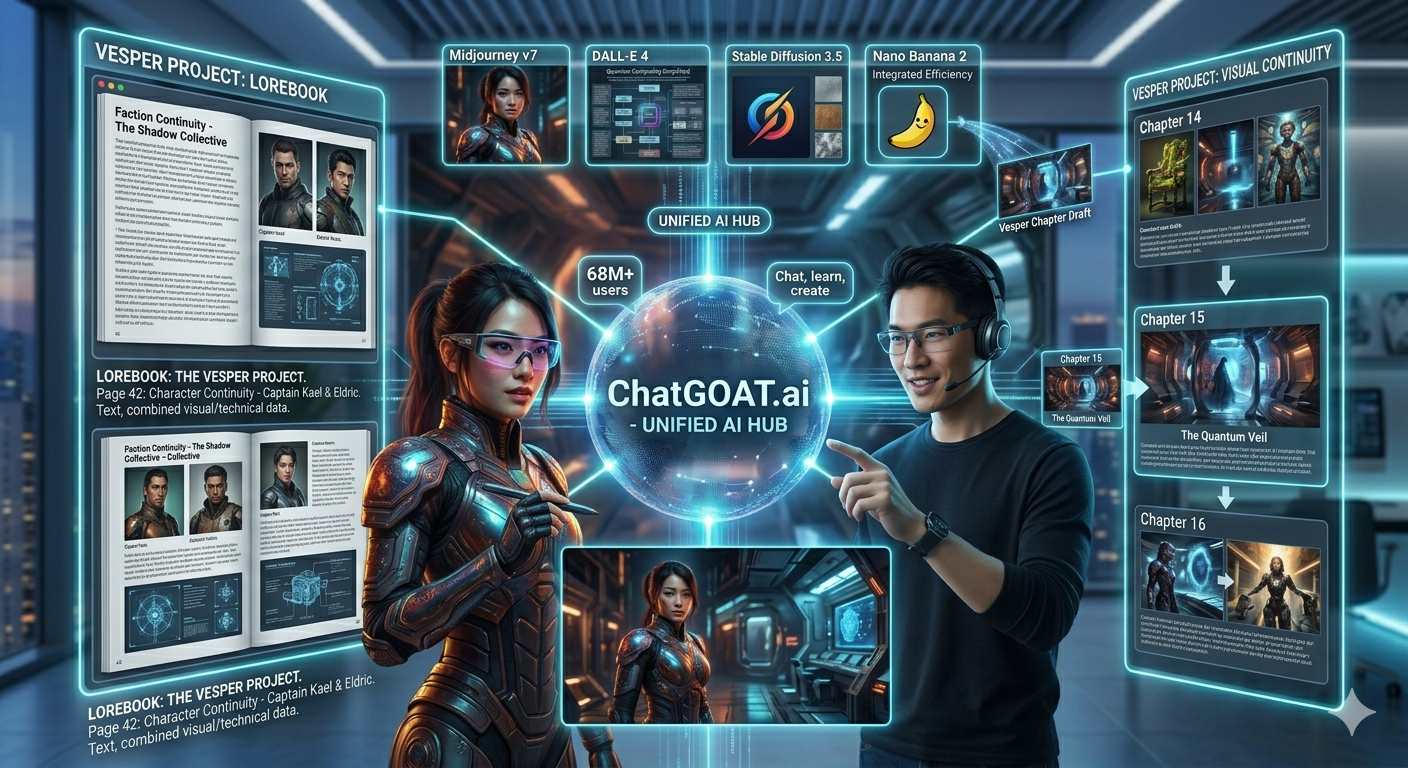
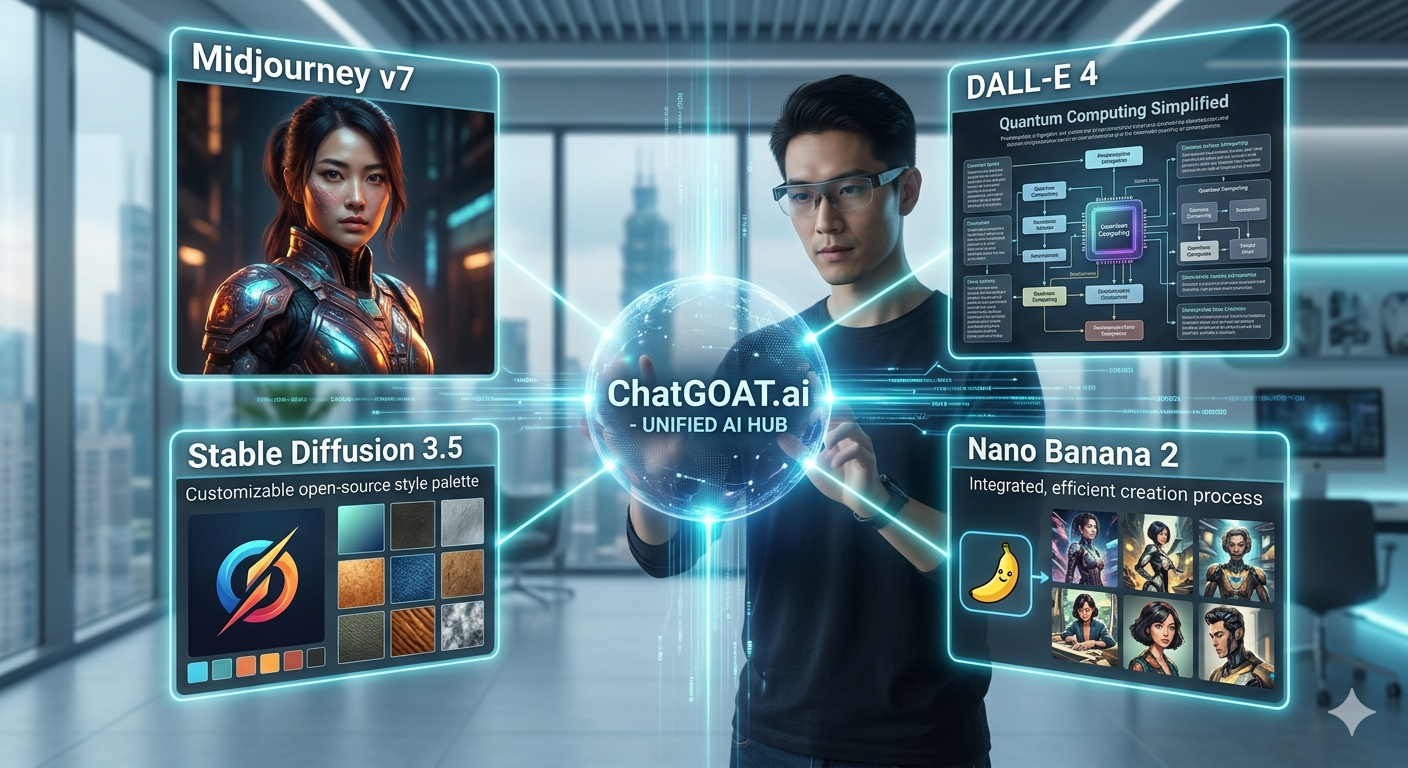
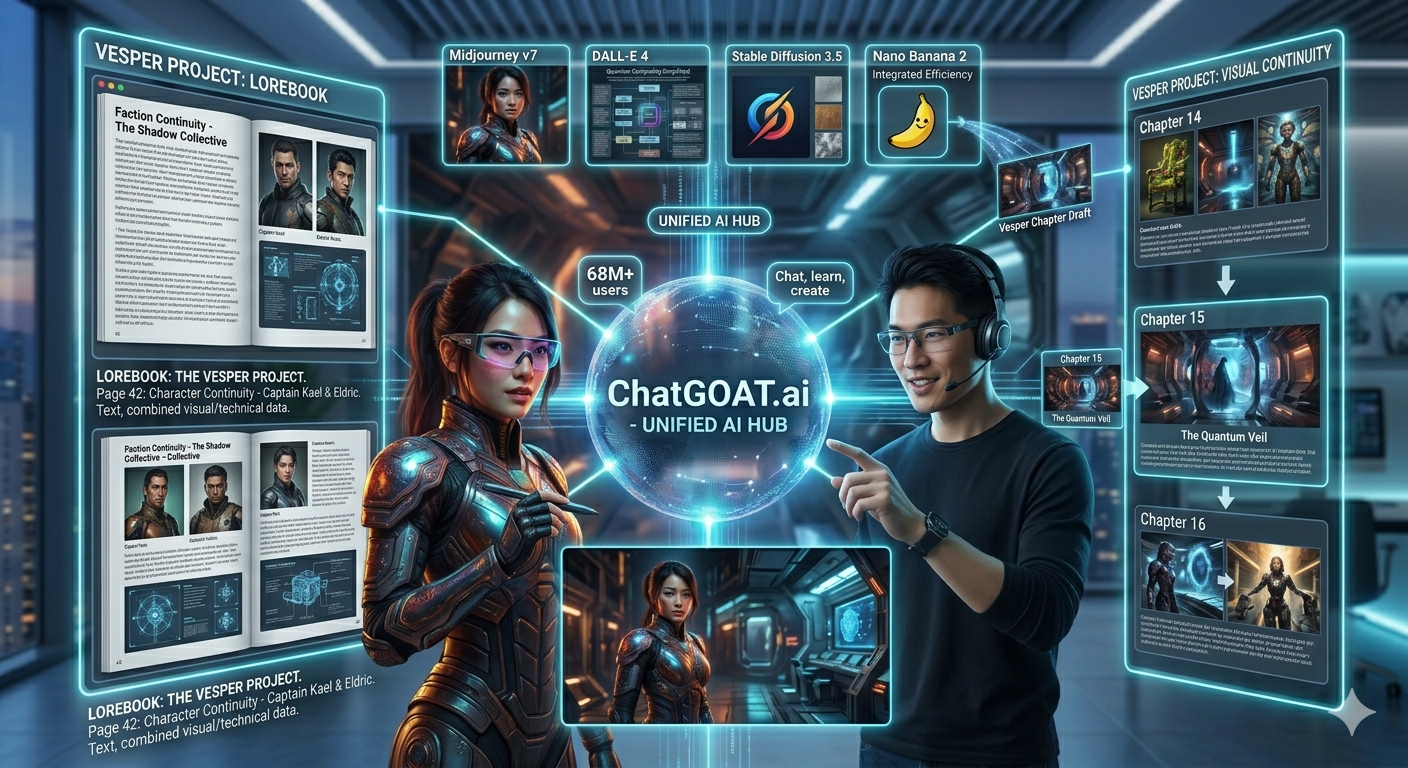
For many users, ChatGOAT.ai has become the go-to image AI generator because it solves the "subscription fatigue" problem. Instead of paying for five different services, users can access the best of OpenAI, Google’s Gemini-based image models, and specialized creative engines (like Nano Banana 2) from a single dashboard. This allows for rapid A/B testing: generating the same prompt across three different models to see which one captures the "vibe" best.
3. The Business Impact: Real-World Use Cases and Market Data
The adoption of the image AI generator is no longer a luxury; it is a competitive necessity. In 2025, data showed that mid-sized marketing agencies using AI visual tools reduced their graphic design lead times by 72%.
E-commerce Efficiency
A leading fashion retailer recently used a custom image AI generator to create "Virtual Photoshoots." Instead of flying a crew to the Maldives, they generated hyper-realistic beach backgrounds and mapped their digital garment files onto AI-generated models.
- Total Savings: $85,000 per collection.
- Speed to Market: Reduced from 4 weeks to 48 hours.
Prototyping in Gaming and Architecture
Architects are now using text-to-image AI to generate 20 variations of a building's facade during a client meeting. This real-time iteration allows for immediate feedback, drastically cutting down on the "revision loop" that traditionally plagues the industry.
4. Mastering Prompt Engineering: How to Get Professional Results
The difference between a "weird" AI image and a professional masterpiece lies in the prompt. In 2026, prompting has evolved into a structured language.
The Professional Prompt Formula
To get the most out of an image AI generator, use the S-C-L-P structure:
- Subject (S): Be specific. Instead of "a car," use "a vintage 1967 Mustang with matte black finish."
- Context/Environment (C): Where is it? "Driving through a neon-lit Tokyo street at midnight, rain-slicked pavement."
- Lighting & Camera (L): This adds realism. "85mm lens, f/1.8, cinematic bokeh, volumetric lighting, ray-traced reflections."
- Parameters (P): Aspect ratios and model versions (e.g., --ar 16:9 or --v 7).
Using Negative Prompts
Effective negative prompting is just as important. By adding --no blurry, deformed hands, low resolution, cartoonish, you force the image AI generator to avoid common pitfalls of the training data.
5. Ethics, Copyright, and the Legal Landscape of 2026
As of 2026, the legal framework surrounding an image AI generator has matured significantly.
- Copyright Ownership: In many jurisdictions, including the US and EU, AI-generated images without significant human intervention cannot be copyrighted. However, images that are "substantially transformed" through in-painting or manual editing are increasingly being granted protection.
- The "Opt-Out" Standard: Most ethical AI generators now respect the "Artist Opt-Out" protocol, where living artists can remove their work from future training sets.
- SynthID and Watermarking: In compliance with the 2025 Global AI Safety Accord, tools like ChatGOAT.ai and DALL-E now embed invisible digital watermarks. These watermarks allow social media platforms to label content as "AI-Generated," maintaining public trust.
6. Practical Advice for Choosing Your Image AI Generator
Before you commit to a subscription, consider these three factors:
Determine Your Output Goal
If you are creating marketing assets that require specific brand text, DALL-E 4 is the best choice due to its superior character rendering. If you are a concept artist looking for "mood" and "texture," Midjourney remains the gold standard for artistic flair.
Analyze Your Budget
Professional tools can be expensive. For individuals or small teams, a multi-model hub like ChatGOAT.ai offers the best ROI. You pay one price to access the high-end capabilities of multiple generators, rather than paying $30-$96/month for each individual service.
Consider Privacy
Enterprise users should look for platforms that offer "Private Training" or "Zero Data Retention." This ensures that your proprietary product designs aren't accidentally leaked into the public training data for the next version of the model.
7. The Future: From Static Images to Real-Time Worlds
What is the next frontier for the image AI generator? By the end of 2026, we are seeing the rise of 4D Generative AI.
- Spatial Consistency: Creating multiple images of the same character from different angles with 100% accuracy.
- Image-to-Video Seamlessness: The ability to generate a static image and immediately "animate" it with consistent physics.
- Real-Time VR Generation: Generators that can build a 360-degree environment around you in a VR headset based on a voice command.
FAQ Section
1. Is an image AI generator legal for commercial use?
Yes, most platforms (like ChatGOAT, Midjourney, and Adobe Firefly) grant commercial rights to paid subscribers. However, you cannot always copyright the result, meaning competitors might be able to use similar visuals if they are not trademarked.
2. Which AI generator is best for photorealism?
In 2026, Midjourney v7 and Nano Banana 2 (available on ChatGOAT.ai) are the leaders in photorealism. They excel at simulating sub-surface scattering (how light hits skin) and complex lens flares.
3. How do I fix "AI hands" or "extra fingers"?
Modern 2026 models have mostly solved this. If it happens, use an "In-painting" or "Generative Fill" tool to brush over the hand and prompt the AI to "regenerate anatomically correct hand."
4. Can I use my own photos as a reference?
Yes. Most generators offer an "Image-to-Image" or "Image Prompt" feature. You upload a photo, and the AI uses its composition or style as a foundation for the new generation.
5. Does ChatGOAT.ai offer a free trial for image generation?
Most platforms offer a limited daily "Free Tier" or a trial period. ChatGOAT.ai typically allows users to test various models with a few free credits before opting for a premium plan.
6. Why is text rendering so hard for AI?
Text requires precise spatial coordination of pixels. While older models struggled, 2026's transformer-based engines (like DALL-E 4) now handle text almost perfectly by treating letters as specific "tokens" with rigid shapes.
7. Can AI replace human photographers?
AI is a powerful supplement, not a total replacement. While it handles "idealized" stock imagery and concepts perfectly, it cannot capture the unique, spontaneous emotion of a live event or a specific, real-world person without extensive training data.