
Key Takeaways
- Grok 4.6 launched August 12, 2026, built on the same 1.5-trillion-parameter foundation as Grok 4.5, with gains coming from post-training rather than a bigger base model.
- It ties GPT-5.6 Sol on the Artificial Analysis Intelligence Index (61) and sits one point behind Fable 5 Max (62), xAI's own comparison shows.
- Grok 4.6 is priced at $2 per million input tokens and $6 per million output tokens on the API - roughly half of some rival frontier models.
- It's built for long-running agentic work: coding sessions, research, and interactive builds that run for many steps without user intervention.
- SuperGrok at $30/month is the standard consumer tier that includes Grok 4.6, with a $10/month Lite option and a $100/month Plus tier for heavier users.
- Coding results are mixed: Grok 4.6 leads on some coding benchmarks (CursorBench, DeepSWE) but trails GPT-5.6 Sol Max and Fable 5 Max on Terminal-Bench v3.0.
- The best model for you depends on your workflow - Grok 4.6 for cost-conscious agentic coding, Claude or Fable-class models for the top reasoning ceiling, GPT-5.6 for broad ecosystem integration, Gemini for Google Workspace users.
Frontier AI releases used to happen every few months. In 2026, they're happening almost every few weeks - and each one claims to be smarter, cheaper, or more autonomous than the last. That pace makes it genuinely hard to know which model deserves your subscription money and which one is just riding a marketing wave.
Grok 4.6 landed in the middle of exactly that noise. xAI positioned it as a meaningful step up from Grok 4.5, with a specific focus on agents that can work independently for long stretches - the kind of AI that can take a rough idea and turn it into a working piece of software without you checking in every five minutes.
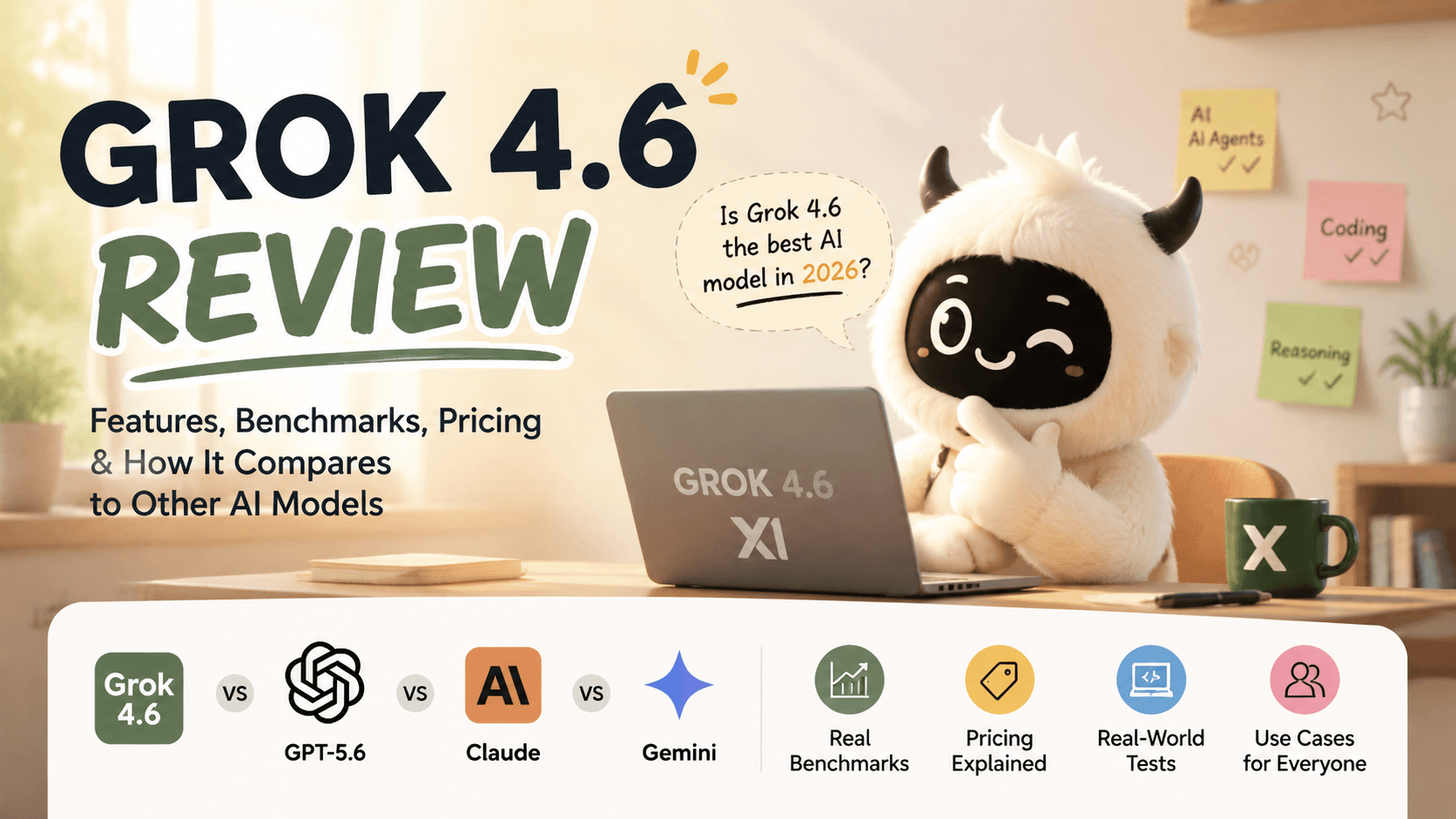
This review breaks down what Grok 4.6 actually does well, where it still falls short of GPT-5.6 Sol, Claude, and Gemini, what it costs across every plan, and how to decide whether it deserves a spot in your toolkit. We'll also walk through real use cases for developers, writers, business users, and students, so you're not just looking at benchmark charts - you're seeing how the model behaves in practice.
Section 1: What Is Grok 4.6?
Grok 4.6 is xAI's flagship large language model, released on August 12, 2026. It's built on the same roughly 1.5-trillion-parameter foundation that powered Grok 4.5, meaning the improvements come almost entirely from post-training work - better supervised fine-tuning, reinforcement learning, and training against real coding tasks through xAI's "Grok Build" harness, rather than a larger underlying model.
xAI's stated goal with this release was narrower and more practical than "make it smarter across the board." The company built Grok 4.6 specifically to sustain long-running agentic work: digging through an unfamiliar codebase over many steps, researching a topic across multiple sources, or taking a rough product idea all the way to a working piece of software. xAI also says the model shows more self-checking behavior during long tasks - verifying its own output before moving to the next step instead of producing one pass and stopping.
What problem does Grok 4.6 solve for users? Mainly, it addresses the frustration of AI agents that lose the thread on longer tasks. Earlier models often needed a nudge every few steps to stay on track. Grok 4.6 is tuned to stay coherent across longer, more complex jobs - while doing it at roughly half the API price of some comparable frontier models.
Compared with Grok 4.5, Grok 4.6 shows measurable gains across every benchmark xAI has published, with the largest jumps on agentic and technical evaluations rather than general conversation quality.
Section 2: Grok 4.6 Key Features
Advanced Reasoning
Grok 4.6 handles multi-step reasoning problems - the kind that require breaking a question into smaller parts, working through each one, and combining the results. It's tuned for decision-heavy tasks like planning a project, comparing options, or working through ambiguous instructions where the "right" first step isn't obvious.
AI Agent Capabilities
This is where Grok 4.6 is meant to stand out. xAI built the model around autonomous workflows: giving it a broad instruction and letting it plan, execute, and self-check across many steps without a human re-prompting it constantly. Independent testers have reported sessions where Grok 4.6 worked from a single prompt for over 20 minutes, producing a fairly complete small software project along the way.
Coding Ability
Grok 4.6 is a genuinely capable coding assistant - strong at generating new code, following instructions across a codebase, and debugging. It's available inside coding-focused tools like Cursor and xAI's own Grok Build, and it's trained specifically against real coding tasks rather than just general text.
That said, coding strength varies by benchmark. Grok 4.6 leads on some evaluations and trails GPT-5.6 Sol Max and Fable 5 Max on others - more detail on that in the benchmarks section below.
Multimodal Understanding
Grok 4.6 accepts both text and image input, with text-only output. That means you can share screenshots, diagrams, or photos alongside a prompt, but it won't generate images or video directly in the base model (that's handled separately through xAI's Imagine feature on paid plans).
Speed and Efficiency
At $2 per million input tokens and $6 per million output tokens, Grok 4.6's API pricing is meaningfully lower than several rival frontier models, while independent testing puts response speed in a competitive range for a model of its size. For everyday chat use, that combination of speed and low cost is one of Grok 4.6's clearest advantages.
Feature Comparison Table
| Feature | Grok 4.6 |
|---|---|
| Context window | 500,000 tokens |
| Input types | Text, image |
| Output types | Text |
| Agentic tasks | Long-running, self-checking |
| Coding harness | Grok Build (dedicated training) |
| API pricing | $2 / $6 per million tokens (in/out) |
| Cached input discount | Up to 85% off |
| Availability | xAI API, Grok Build, Cursor, Grok Bot/X, OpenRouter, Vercel, Cloudflare |
Section 3: Grok 4.6 Performance and Benchmarks
xAI's own launch benchmarks, later cross-checked by independent outlets, put Grok 4.6 in a genuinely competitive spot among 2026's frontier models - but not a clean win across the board.
On the Artificial Analysis Intelligence Index, a composite built from nine separate evaluations, Grok 4.6 scored 61 - exactly matching GPT-5.6 Sol Max and sitting one point behind Fable 5 Max's 62. On GDPVal-AA, a benchmark for complex agentic reasoning, Grok 4.6 posted 1753, and it also reached the #1 spot on the Databricks leaderboard and a 1753 Elo score on LMSYS Chatbot Arena.
Coding results are more mixed. Grok 4.6 leads on CursorBench v3.2 (69.9%) and DeepSWE v1.1 (65.9%), and it topped AA-Briefcase at 1577, narrowly ahead of Fable 5 Max (1574) and GPT-5.6 Sol Max (1502). But on Terminal-Bench v3.0, Grok 4.6 scored 26% - well behind GPT-5.6 Sol Max's 34.6% and Fable 5 Max's 34.1%. It also trailed Fable 5 Max on APEX-SWE (56.4% vs. 58.8%).
What do these results mean for normal users? In practice, Grok 4.6 is not the single best model at everything - no current model is. It's a strong, well-rounded performer that's especially good at staying on task through long agentic sessions and offers some of the best coding results per dollar available right now. If your workflow depends specifically on terminal-heavy software engineering tasks, GPT-5.6 Sol Max or Fable 5 Max currently score higher. For broader agentic and knowledge work at a lower price, Grok 4.6 holds up well.
It's also worth noting that xAI self-reported these numbers, pulling competitor scores from published system cards rather than running rival models itself - a standard practice across the industry, but one worth keeping in mind when reading any vendor's launch-day benchmarks.
Section 4: Grok 4.6 vs GPT-5.6 vs Claude vs Gemini
| Category | Grok 4.6 | GPT-5.6 Sol | Claude | Gemini |
|---|---|---|---|---|
| Reasoning | Strong, ties GPT-5.6 Sol on AA Intelligence Index | Strong, matches Grok 4.6 on AA Intelligence Index | Frontier-class, among the top scorers on AA Intelligence Index | Strong via Gemini 3.1 Pro, Google's top reasoning tier |
| Coding | Leads on CursorBench/DeepSWE, trails on Terminal-Bench | Leads on Terminal-Bench v3.0 | Consistently strong across agentic coding benchmarks | Competitive, improving fast with agentic-focused Flash models |
| Writing | Solid, less polished tone than some rivals | Well-rounded, widely used for general writing | Frequently praised for natural, nuanced prose | Strong, tightly integrated with Docs/Workspace |
| Research | Good with real-time X data access | Strong general research | Strong long-context research and synthesis | Deep Google Search integration |
| Multimodal | Text + image input | Text, image, some audio/video features | Text + image, expanding multimodal support | Broadest native multimodal, including video via Gemini Omni |
| AI agents | Built specifically for long-running agentic work | Strong agent tooling, broad ecosystem | Strong for structured, tool-using agents | Growing agent lineup (multiple new models for agents at scale) |
| Speed | Fast, competitive median response time | Fast, varies by tier | Fast on smaller tiers, slower on top reasoning tier | Very fast on Flash-tier models |
| Pricing (API) | $2 / $6 per million tokens | Ranges from ~$0.20 to $5+/$30 depending on tier | Tiered by model size, generally mid-to-premium | Competitive, especially on Flash tiers |
| Best for | Cost-conscious agentic coding and long-running tasks | Broad general use, wide plugin/tool ecosystem | Writing quality, careful reasoning, longer documents | Google Workspace users, fast multimodal tasks |
Who should choose each model?
- Choose Grok 4.6 if you want strong agentic coding performance at a lower API cost, you're already on X/SuperGrok, or your workflow involves long, multi-step autonomous tasks.
- Choose GPT-5.6 if you rely on OpenAI's broader plugin and tool ecosystem, or you need consistently strong terminal-level coding performance.
- Choose Claude if writing quality, careful reasoning, and working with long documents matter most to you.
- Choose Gemini if you're already inside Google Workspace and want tight integration with Docs, Sheets, and Search, plus fast multimodal features.
Section 5: Real-World Tests and Use Cases
Developers
Grok 4.6 works well as a coding assistant inside Cursor or Grok Build, particularly for tasks that span many files or steps - generating a feature, wiring it up, and debugging the result in one continuous session. It's also useful for writing documentation once code is in place, since it can read through a codebase and summarize what each part does.
Content Creators
For blog writing, research, and content ideation, Grok 4.6's real-time access to X data gives it an edge on anything tied to current events or trending topics. It can pull together a first draft, suggest angles based on what's currently being discussed, and help outline longer pieces.
Business Users
Grok 4.6's agentic strength translates well to workflow automation - chaining together research, data pulls, and drafting into a single session instead of manually stitching together outputs from several tools. For data analysis, it can work through structured data and explain findings in plain language, though heavier statistical work may still benefit from a dedicated tool.
Students
Grok 4.6 is capable as a study and research assistant - explaining concepts, working through practice problems step by step, and helping structure research for papers. As with any AI tool used for schoolwork, it's worth treating it as a study partner rather than a source to copy from directly.
Section 6: Grok 4.6 Pricing and Availability
Grok 4.6 is available through both consumer subscriptions and the pay-as-you-go xAI API.
Consumer plans:
- Free - limited daily access, smaller context window, no Grok 4.6 guarantee.
- SuperGrok Lite ($10/month) - Grok 4.6 access with higher limits than free, but without Imagine or Expert mode.
- SuperGrok ($30/month) - the standard tier most people should consider; includes Grok 4.6, higher usage limits, and Expert mode (a multi-agent setup where several Grok instances work together on harder problems).
- SuperGrok Plus ($100/month) - adds significantly higher usage, 1080p video generation, and priority access during peak times.
- SuperGrok Heavy (~$300/month) - xAI's top consumer tier, aimed at users who need the highest rate limits and the most compute-heavy agent modes.
- Business and Enterprise - contact-sales pricing, aimed at teams needing compliance features like SOC 2.
API pricing: $2.00 per million input tokens, $0.50 per million cached input tokens (up to an 85% discount), and $6.00 per million output tokens, with no published free tier for API access.
Who should upgrade? Casual users testing Grok 4.6 can start on the free tier or SuperGrok Lite. Anyone doing regular coding, research, or agentic work will get more consistent value from the standard $30/month SuperGrok plan. Heavy or Plus tiers make sense mainly for power users running frequent, compute-intensive sessions.
Section 7: How to Use Grok 4.6
Step 1: How to access Grok 4.6
You can reach Grok 4.6 through grok.com, the Grok app, X (Twitter), or developer tools like Cursor and the xAI API. If you just want to try it conversationally, grok.com or the X app is the simplest entry point.
Step 2: How to choose the right plan
If you're testing the waters, start free. If you use Grok regularly for coding or research, SuperGrok at $30/month is the sensible default. Only move to Plus or Heavy once you're consistently hitting usage limits.
Step 3: How to write effective prompts
Be specific about the outcome you want, give Grok 4.6 room to work through multiple steps on its own for agentic tasks, and provide context upfront (files, goals, constraints) rather than trickling it in over many messages.
Step 4: Best prompt examples
- "Review this codebase, identify the three most likely sources of the bug described below, and propose a fix for each."
- "Research the current state of [topic], summarize the three most relevant recent developments, and draft a 600-word blog intro based on them."
- "Take this rough app idea and build a working prototype, checking your own output at each major step before continuing."
- "Explain [concept] the way you would to someone with no background in the subject, then give me three practice questions."
Section 8: Best Grok 4.6 Alternatives
- ChatGPT (GPT-5.6): Better choice if you rely on OpenAI's plugin ecosystem or need top-tier terminal-based coding performance.
- Claude: Better choice for writing quality, nuanced reasoning, and working through long documents carefully.
- Gemini: Better choice if you're already using Google Workspace and want tight integration with Docs, Sheets, and Search.
- Other AI assistants: Smaller, specialized tools may outperform any general model for narrow tasks like transcription or niche translation.
Users should choose an alternative when their workflow depends heavily on a specific ecosystem (Google Workspace, OpenAI plugins) or when a benchmark category directly relevant to their work — like Claude's writing quality or GPT-5.6's terminal coding scores - outweighs Grok 4.6's pricing advantage.
Section 9: Can You Try Grok 4.6 on ChatGoat AI?
If you'd rather not manage separate subscriptions for every AI model, ChatGoat AI gives you a way to explore different AI models - including options comparable to Grok 4.6 - in one place, without constantly switching between platforms and logins.
Through ChatGoat AI, users can compare how different AI assistants handle the same prompt, side by side, which is a practical way to figure out which model actually fits your workflow before committing to a paid plan elsewhere. The platform also includes AI tools for writing, research, coding, and creative tasks, so you're not limited to just chat.
It's not a replacement for going directly to xAI if you need the full Grok 4.6 experience with Expert mode or Imagine - but for anyone who wants a simpler way to experiment with AI models and compare results before choosing where to spend money, it's a useful starting point.
FAQ
What is Grok 4.6?
Grok 4.6 is xAI's flagship AI model, released August 12, 2026, built on the Grok 4.5 foundation with improvements focused on long-running agentic tasks, coding, and self-checking behavior.
Is Grok 4.6 free?
There's a free tier with limited daily usage and no guaranteed access to Grok 4.6. Full access starts at $10/month (SuperGrok Lite) or $30/month (SuperGrok) for consumer plans, or pay-as-you-go through the API.
Is Grok 4.6 better than ChatGPT?
It depends on the task. Grok 4.6 ties GPT-5.6 Sol on the Artificial Analysis Intelligence Index and leads on some coding benchmarks, but GPT-5.6 Sol Max scores higher on Terminal-Bench v3.0. Neither model is definitively "better" across every category.
What is Grok 4.6 best for?
Long-running agentic tasks - coding sessions, research, and multi-step projects - at a lower API price than several rival frontier models.
How does Grok 4.6 compare with Claude?
Claude is generally considered stronger for writing quality and careful reasoning over long documents, while Grok 4.6 is more focused on agentic, self-checking task execution and lower cost.
Can Grok 4.6 write code?
Yes. It's trained specifically for coding through xAI's Grok Build harness and is available inside coding tools like Cursor. It performs strongly on some coding benchmarks and trails top competitors on others.
How do I access Grok 4.6?
Through grok.com, the Grok app, X, or developer channels including Cursor, the xAI API, OpenRouter, Vercel, and Cloudflare.
Which AI model should I use in 2026?
There's no single best model for everyone. Grok 4.6 suits cost-conscious agentic coding work, GPT-5.6 suits broad ecosystem needs, Claude suits writing-heavy work, and Gemini suits Google Workspace users. Matching the model to your actual workflow matters more than chasing the top benchmark score.
Does Grok 4.6 support images?
Yes, it accepts image input alongside text, though it outputs text only - separate tools like Imagine handle image and video generation.
Is Grok 4.6 worth switching to?
If your work involves long, multi-step coding or research tasks and you want a lower API cost, it's worth testing. If you depend on a specific ecosystem or a benchmark category where a rival leads, it may not be worth switching entirely.

